Overview
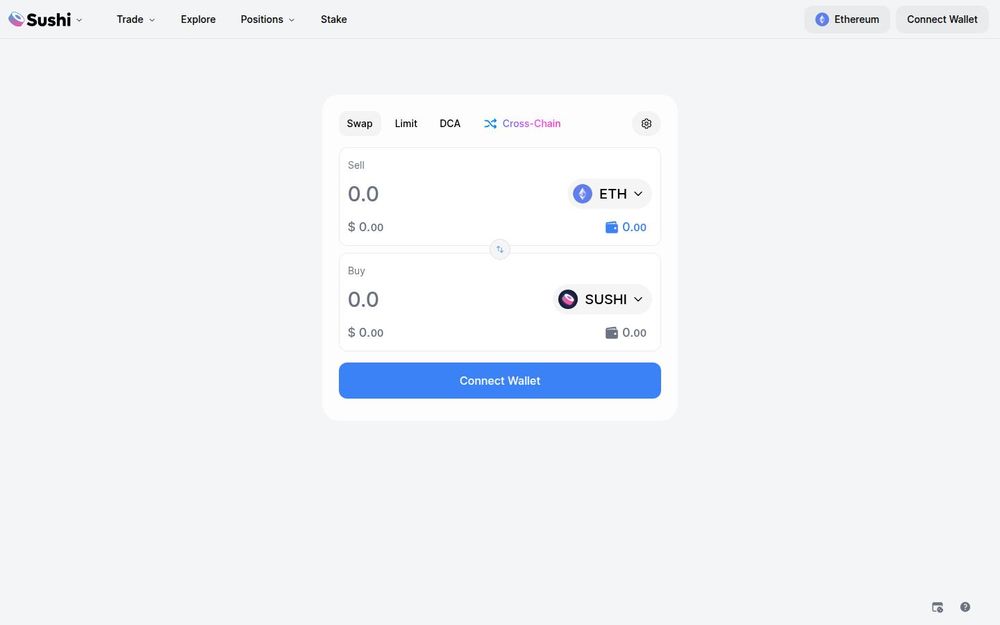
Sushi is a decentralized exchange frontend that connects users to the SushiSwap protocol and its multi-chain trading capabilities. It provides an accessible web application for swapping tokens, placing limit orders, executing dollar-cost averaging strategies, and performing cross-chain swaps. The interface works with common Web3 wallet connectors such as WalletConnect, allowing users to manage assets on Ethereum and other supported networks. Key trade information—including price impact, estimated maximum and minimum received tokens, routing source, and network fees—is presented directly in the swapping UI to support informed decision-making.
Core Capabilities
-
Swap and Instant Trades: The primary function is to swap tokens on-chain with routing that aggregates liquidity across pools to get competitive prices.
-
Limit Orders: Users can set price-based orders that execute when market conditions meet their specified thresholds, enabling more controlled execution strategies.
-
DCA (Dollar-Cost Averaging): Sushi supports recurring purchase strategies to help users accumulate tokens over time and reduce exposure to short-term volatility.
-
Cross-Chain Swaps: The app enables cross-chain transfers and swaps where supported, letting users move value between networks with routed bridges and liquidity paths.
-
Wallet Integration and Connectivity: Integration with WalletConnect and other wallet providers allows secure on-chain signing and account management without custodial custody by the app.
How It Works
The Sushi web app presents a simple trade flow: select the network (for example, Ethereum), choose the token to sell and the token to buy, adjust slippage and other preferences, connect your wallet, and submit the transaction. Behind the scenes, Sushi’s routing engine analyzes available liquidity pools and paths to optimize execution price and minimize slippage or price impact. For tokens with special tokenomics (so-called tax tokens), the UI factors additional tax amounts into the preferred slippage calculation, explicitly warning users that the displayed slippage must cover both standard slippage tolerance and token-specific taxes.
Fees, Slippage, and Pricing
The interface clearly displays the platform fee (commonly 0.35% on some routes), expected price impact, and estimated amounts (maximum and minimum tokens received). Users can set a slippage tolerance percentage; the app also explains how to combine this tolerance with any token taxes (for example, 0.5% slippage + 5% tax = 5.5% effective allowance). Network fees (gas) are shown separately and depend on the underlying blockchain. Routing source information helps users understand where liquidity is being sourced, improving transparency about execution paths.
Security, Transparency, and Support
Sushi is a non-custodial interface: trades are signed by users through their wallets and executed on-chain. The app surfaces routing and fee details to help users assess trade conditions. For bugs or issues, the UI includes a reporting channel (e.g., support email links) to contact maintainers or security teams. As with any DeFi interface, users should verify contract addresses, ensure they are on the correct network, and be cautious when interacting with tokens that have atypical tokenomic rules or high slippage.
Recommended Use Cases
- Users looking for quick token swaps with routing across multiple liquidity sources.
- Traders who want limit orders and scheduled DCA strategies within a single UI.
- Cross-chain users needing to move assets between networks while accessing aggregated liquidity.
- Anyone who prefers a non-custodial trading experience with transparent fee and routing information.
Why Choose Sushi
Sushi combines a clean, web-based trading interface with advanced DeFi capabilities: on-chain swaps, limit executions, recurring buy strategies, and cross-chain functionality. Its emphasis on transparent fees, slippage handling (including explicit tax token considerations), and routing visibility makes it a practical choice for a broad range of DeFi users—from casual swappers to more active traders seeking controlled order types. The integration with WalletConnect and other wallets preserves user sovereignty while enabling seamless on-chain interactions.
Final Notes
As with any decentralized application, users should practice wallet hygiene, review transaction parameters before signing, and understand that on-chain trades are subject to network conditions and irreversible blockchain finality. If anything appears uncertain, use the app’s help and bug report channels to get assistance or further clarification.