


Overview
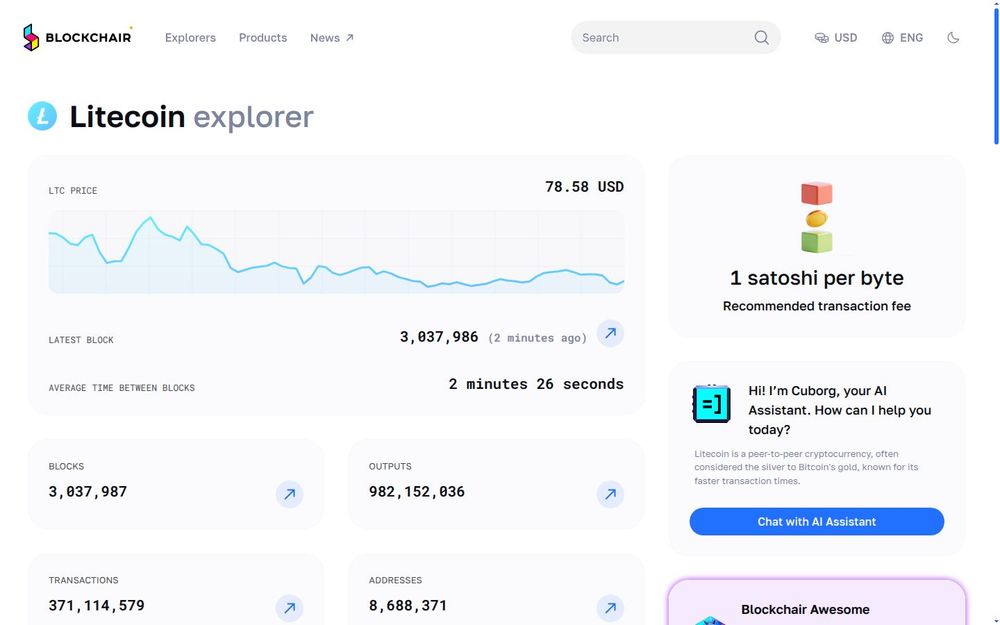
Blockchair’s Litecoin page is a comprehensive explorer and analytics dashboard focused on the Litecoin (LTC) blockchain. It brings together live market pricing, block and transaction data, chain statistics, and auxiliary services in a single interface. Users can view the latest block, average block time, circulating supply, market capitalization, and historical charts, while also accessing mempool status, recommended transaction fees, and network health indicators. The page functions both as a public explorer for on-chain queries and as an entry point to Blockchair’s broader product ecosystem such as APIs, charts, and node explorers.
Core Capabilities
-
Real-time market and chain metrics: The page presents up-to-the-minute price information, market cap, and dominance figures alongside chain-specific metrics like circulating supply and blockchain size.
-
Block and transaction explorer: Users can inspect the latest block, browse blocks and transactions, and drill down into transaction counts, outputs, and address statistics to analyze on-chain activity.
-
Performance and network statistics: Key operational metrics such as average block time, transactions per second (TPS), hashrate (Scrypt), and difficulty estimates are shown to help evaluate network performance.
-
Mempool and fee guidance: The mempool section provides pending transaction counts, total mempool size, and a recommended fee suggestion (for example, satoshis per byte), which is useful for optimizing transaction costs.
-
Integrated products and data services: Links to Blockchair’s API, charts, news aggregator, and other tools enable programmatic access, visual analysis, and contextual news — expanding utility beyond the browser interface.
Data & Metrics Explained
The page aggregates several types of data:
-
Market data: Current LTC price in USD, market capitalization, and circulating supply give a snapshot of market valuation.
-
On-chain metrics: Transaction volume, total transactions, number of outputs, and addresses reveal usage patterns and user adoption trends.
-
Network health: Difficulty, hashrate, estimated next difficulty, and node counts help assess the security and decentralization of the Litecoin network.
-
Historical charts: Visual charts for price, blockchain size, difficulty, and median/average fees allow for trend analysis and historical comparisons.
How to Use
-
Navigate to the top sections to check price and the latest block for immediate status.
-
Use the blocks and transactions links to search specific block heights, transaction hashes, or addresses when investigating activity.
-
Consult the mempool and recommended fee to choose an appropriate fee when broadcasting a new transaction.
-
If you need programmatic data, follow the API and charts links to retrieve machine-readable metrics and datasets.
Recommended for
Blockchair’s Litecoin page is well suited for developers, traders, researchers, and node operators. Developers benefit from the integrated API and datasets, traders can use the market and fee information to time and price transactions, and researchers can leverage historical charts and detailed transaction counts for analytics. Node operators and miners can track hashrate, difficulty, and node counts to evaluate network conditions.
Integration & Ecosystem
The page also highlights partners, wallets, exchanges, and mining pools to facilitate interaction with the broader Litecoin ecosystem. Tools like wallet statements, transaction receipts, and news aggregation further round out the offering, making the Blockchair Litecoin page a single place to explore, analyze, and act on Litecoin blockchain data.
Conclusion
In summary, the Blockchair Litecoin page is a multi-faceted explorer that combines live market data, detailed on-chain metrics, network health indicators, and auxiliary tools to support both casual users and professional workflows. Its combination of visuals, metrics, and links to developer tools makes it a practical resource for anyone seeking reliable Litecoin information.


