Overview
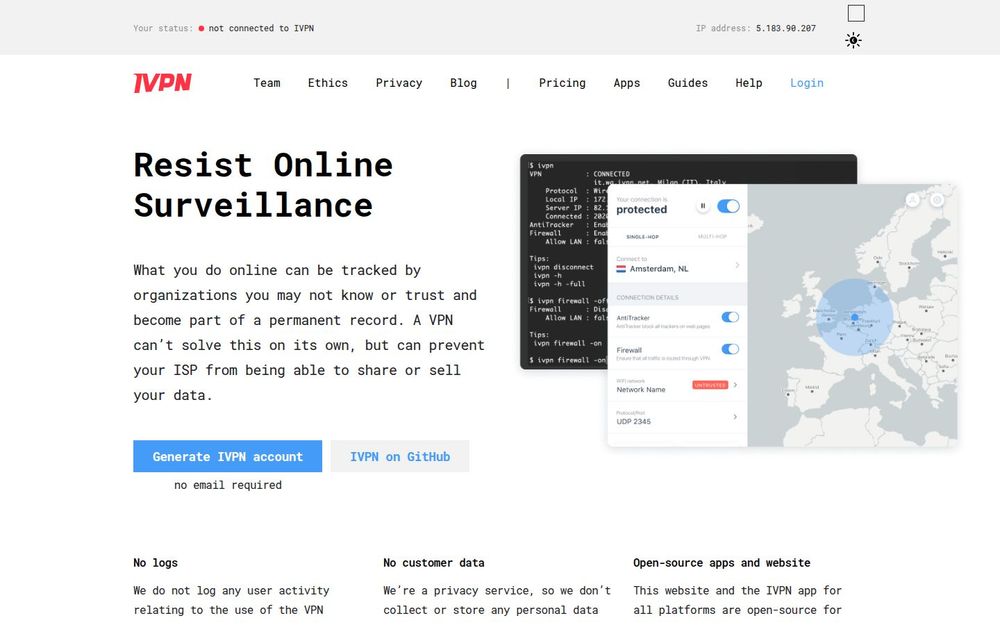
IVPN is a privacy-first VPN service designed to reduce the amount of information your ISP and other third parties can collect about your online activity. The provider makes a clear distinction between what VPNs can and cannot do: while a VPN cannot guarantee full anonymity or prevent third parties like Google or Facebook from tracking you across the web, IVPN focuses on preventing your ISP from logging or selling your browsing data. The company emphasizes transparency through open-source apps and website code, independent security audits, and a business model based solely on subscription revenue.
Core Capabilities
-
No logs and minimal data collection: IVPN states that it does not log any user activity related to VPN usage and does not collect personal information during signup, supporting anonymous payment methods such as cash, Bitcoin, and Monero.
-
Multiple protocol support: The service supports WireGuard, OpenVPN, and IPSec, allowing users to choose between high-performance and widely compatible connection options.
-
Killswitch / Firewall protections: IVPN offers killswitch functionality on macOS, Windows, Linux, and Android, with iOS covered using the built-in On-demand feature. These protections guard against DNS, IPv6, disconnection, and WebRTC leaks.
-
AntiTracker and private DNS: Built-in AntiTracker blocks ads, adware, malicious sites, and data-harvesting trackers. IVPN also runs private, non-logging DNS servers accessible over the VPN to reduce DNS-based leaks and ISP visibility into requested domains.
-
Advanced routing and anti-censorship tools: Features include multi-hop VPN routes for chaining connections through multiple jurisdictions, Obfsproxy to help circumvent censorship, and configurable WireGuard key and IP rotation for enhanced privacy.
Additional Features and Operational Practices
IVPN self-hosts its infrastructure rather than relying on third-party cloud services, and runs its own email and customer support systems to limit third-party exposure. The apps and site are open-source, allowing independent inspection of the codebase for transparency. The company commits to annual independent security audits and explicitly rejects paid reviews and affiliate programs to avoid biased marketing. Users can define trusted Wi‑Fi networks and automate connection rules, pause the VPN temporarily with automatic restoration (except on iOS), and customize WireGuard privacy controls for scheduled key rotation.
Why Choose IVPN
Choose IVPN if your primary concern is operational transparency and minimizing trust in intermediaries. The combination of open-source apps, self-hosted infrastructure, and no-signup personal data policies means the provider reduces many standard attack and surveillance surfaces that other services introduce. IVPN’s support for multiple protocols, privacy-focused DNS, multi-hop routing, and ad/tracker blocking makes it a practical option for users who want configurable, defense-in-depth privacy rather than marketing slogans about anonymity.
IVPN also educates users through privacy guides and emphasizes realistic expectations for what a VPN can and cannot achieve. The provider’s stance on not promising absolute anonymity and its focus on practical protections like encryption of ISP-visible traffic, DNS privacy, and anti-censorship tools make it suitable for privacy-conscious individuals, journalists, and activists who require a transparent, accountable VPN operator.
Recommended Uses and Limitations
IVPN is effective for encrypting ISP traffic, preventing DNS exposure to your network provider, improving security on public Wi‑Fi, and masking your IP address from websites and servers you connect to. It is not a silver bullet: it cannot stop large-scale tracking by services where you are logged in, prevent fingerprinting on browser platforms, or guarantee total anonymity. Use IVPN as part of a broader privacy strategy that includes careful account hygiene, browser privacy measures, and threat-aware operational behavior.