Overview
Hotspot Shield is a consumer-focused VPN service designed to provide private, high-speed access to the internet across a wide range of devices and platforms. Built around the company’s proprietary Hydra protocol, the service aims to deliver faster throughput and lower latency than many traditional VPN solutions, positioning itself particularly for streaming, gaming, and heavy download use. Hotspot Shield highlights cross-platform availability—including recent support for Linux—and emphasizes privacy-critical features like strong encryption and a limited logging policy.
Core Capabilities
-
High-performance protocol and speed: Hotspot Shield’s Hydra protocol is presented as the cornerstone of its performance claims. The vendor advertises streaming-ready speeds and benchmarks that show up to 2.2x faster performance compared to some competitors, which helps reduce buffering and improves responsiveness for gaming and video.
-
Strong encryption and privacy protections: The service uses military-grade encryption to protect user traffic and states that it does not log information that can be directly tied back to individual users. This combination aims to secure user data on public Wi‑Fi and local networks while minimizing privacy exposure.
-
Large global server footprint: With servers across 80+ countries and 115+ virtual locations, Hotspot Shield enables access to geo-restricted content around the world and offers multiple endpoint options to optimize routing, latency, and streaming access.
-
Multi-device coverage: A single subscription can secure up to 10 devices, supporting Windows, macOS, iOS, Android, Linux, smart TVs, and dedicated apps for other platforms. This makes it practical for families or users with many connected devices.
-
Streaming, torrenting, and P2P support: The service is positioned as friendly to streaming platforms (Netflix, Prime Video, Disney+, YouTube) and supports P2P use cases, with specialized servers and performance tuning to maintain speed and stability.
Features in detail
-
Platform support: Native apps for major desktop and mobile systems, plus instructions for routers and manual setups for other systems. The site now specifically calls out Linux availability.
-
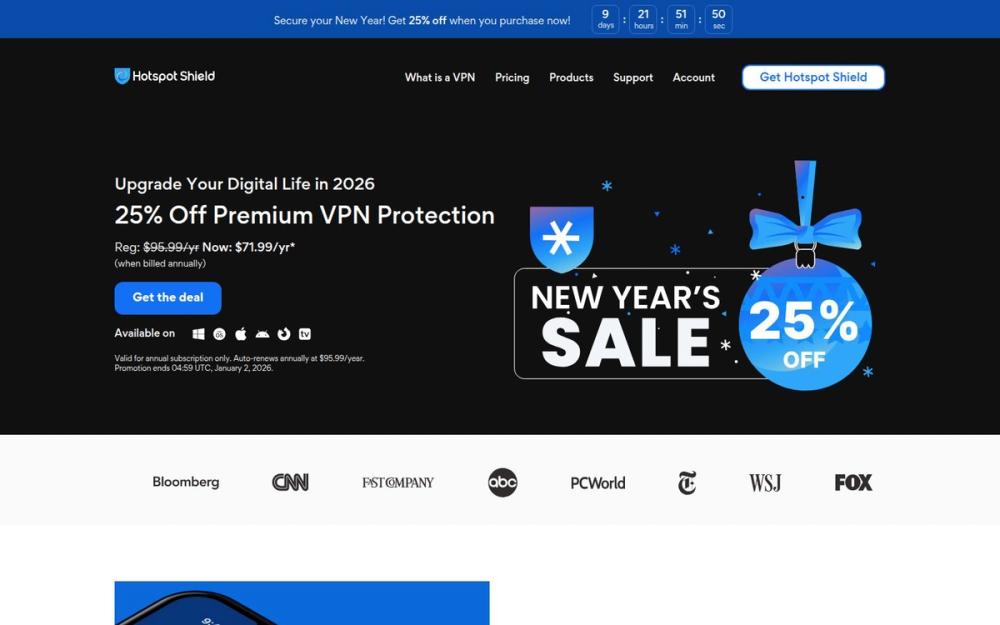
Trial and pricing: Hotspot Shield offers a 7-day free trial and both monthly and annual plans. Promotional campaigns, such as limited-time discounts on yearly plans, are periodically available. Annual subscriptions auto-renew and have a stated renewal price.
-
User experience: The apps emphasize simplicity and ease of setup, with quick connect options, server selection, and an interface suitable for users with varying technical skills.
Security and trust signals
Hotspot Shield highlights third-party endorsements and press mentions, including positive quotes from outlets that praise its speed and ease of use. The site reinforces trust through aggregated ratings for mobile stores (App Store and Google Play) and showcases user testimonials praising reliability and background performance. The privacy posture, while presented as strong, should be reviewed in the provider’s privacy policy and independent audits for users with high-risk needs.
Why choose Hotspot Shield
Hotspot Shield is a strong choice when speed and cross-platform convenience are primary concerns. The Hydra protocol and large server network make it suitable for streaming, gaming, and P2P traffic, while multi-device support and a trial period lower the barrier to testing the service. Promotional pricing on annual plans can make it cost-effective for long-term protection.
Considerations and next steps
Before committing, users should confirm specifics such as the provider’s exact logging practices, jurisdictional implications, and whether particular streaming platforms are reliably supported from their region. Trialing the service during the free period and reviewing the privacy policy and any available independent audits will help assess whether Hotspot Shield meets your security and performance requirements.
Conclusion
Hotspot Shield combines a performance-oriented VPN protocol, broad device support (including Linux), and a global server footprint to deliver a fast and user-friendly VPN experience. Its focus on streaming performance and the option to protect multiple devices make it a practical choice for users seeking speed and convenience, provided they validate privacy and logging details for their personal threat model.