Overview
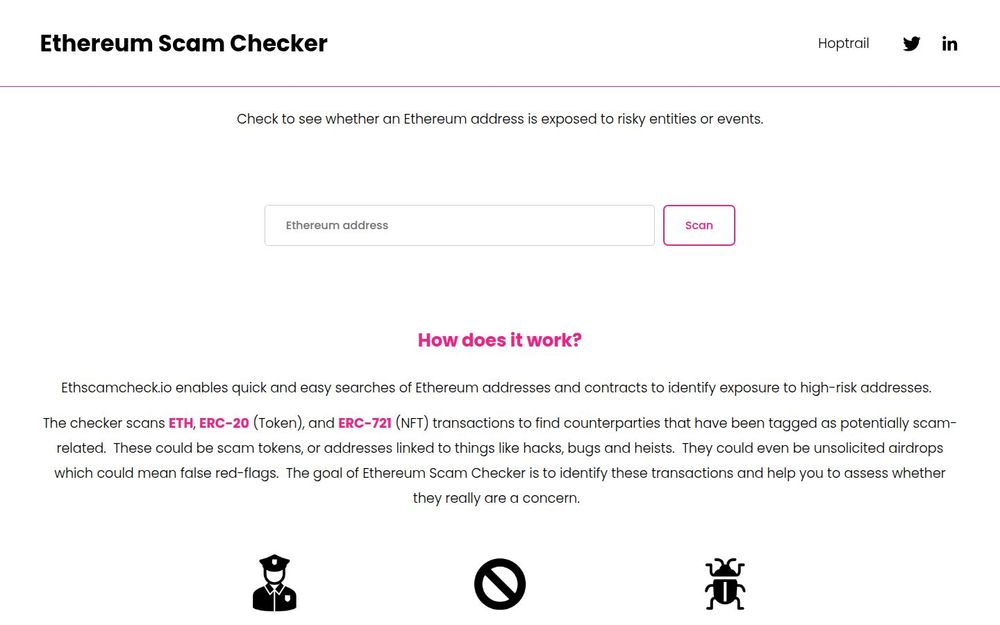
Ethereum Scam Checker is a focused online utility designed to help cryptocurrency holders, researchers, and compliance teams quickly assess whether an Ethereum address or smart contract has had interactions with potentially risky or malicious counterparties. The tool scans on-chain activity across ETH, ERC-20 tokens, and ERC-721 NFTs to surface transactions involving addresses that have been tagged for reasons such as scams, hacks, heists, bugs, mixing services, sanctioned entities, or unsolicited airdrops. Built and powered by Hoptrail, the service combines a maintained database of risk-tagged addresses with a simple search interface and a user submission form to improve coverage over time.
Core Capabilities
-
Address and Contract Scanning: Enter an Ethereum address to scan its transaction history for interactions with flagged counterparties across ETH, ERC-20, and ERC-721 activity.
-
Risk Tag Matching: The system identifies counterparties that match a catalog of risk tags such as Phish/Hack, Ponzi, Compromised, Heist, Bug, Darknet Marketplace, Sanctions, Mixing Service, Scam, Exploit, and Sextortion.
-
Community Reporting and Verification: Users can submit addresses they suspect are risky by filling out a form with a chosen Tag, email, and additional notes; submitted addresses are reviewed and verified before being added to the database.
-
Multi-Asset Coverage: The checker inspects native ETH transfers as well as token and NFT transfers, helping users spot risky counterparties that might appear only in token or NFT flows.
-
Contextual Guidance and Contact: The site links to resources (for example, guidance about being blocked by a stablecoin provider) and offers direct contact via Hoptrail for deeper inquiries or assistance.
How It Works
When you submit an address, Ethereum Scam Checker queries on-chain transaction records and cross-references counterparties against its curated list of flagged addresses. Matches are surfaced to the user so they can evaluate whether the interaction represents a genuine risk (for example, funds routed to a known heist address) or a potentially benign situation such as an unsolicited airdrop that can create false positives. Because on-chain tagging and interpretation require human review, the platform emphasizes verification and accepts community submissions to expand and refine its database.
Why Use Ethereum Scam Checker
-
Fast screening: It provides a quick, first-pass assessment for wallets and contracts without needing complex tooling. This makes it useful for individuals checking incoming funds or for security teams performing lightweight triage.
-
Broader asset visibility: By covering ETH, tokens, and NFTs, the checker helps catch risky counterparties that might otherwise be overlooked if only native transfers were considered.
-
Community-driven database: The submission and verification workflow allows the dataset to improve over time, leveraging crowd signals and operator verification to reduce blind spots.
Limitations and Best Practices
Ethereum Scam Checker is an investigatory aid, not proof of wrongdoing. False positives can occur (for example, receiving unsolicited airdrops or interacting with addresses that later get flagged). Users should treat findings as starting points for deeper due diligence rather than definitive judgments. For sensitive cases — legal disputes, large transfers, or compliance decisions — follow up with professional analysis and chain-of-custody evidence.
Getting Help and Reporting
If the checker misses a risky address, users are encouraged to submit it via the on-site form with a selected tag and notes. Hoptrail reviews submissions before adding them to the public dataset. For direct inquiries or further assistance, the site provides an email contact (info@hoptrail.io) and links to supporting guidance such as articles about stablecoin provider actions.
Conclusion
Ethereum Scam Checker offers a pragmatic, community-augmented way to identify on-chain exposure to labeled risky entities. It is most valuable as a rapid screening tool and as a mechanism to surface potential concerns for further investigation, all backed by Hoptrail’s maintenance and a user-submission process to keep its risk database current.