


Overview
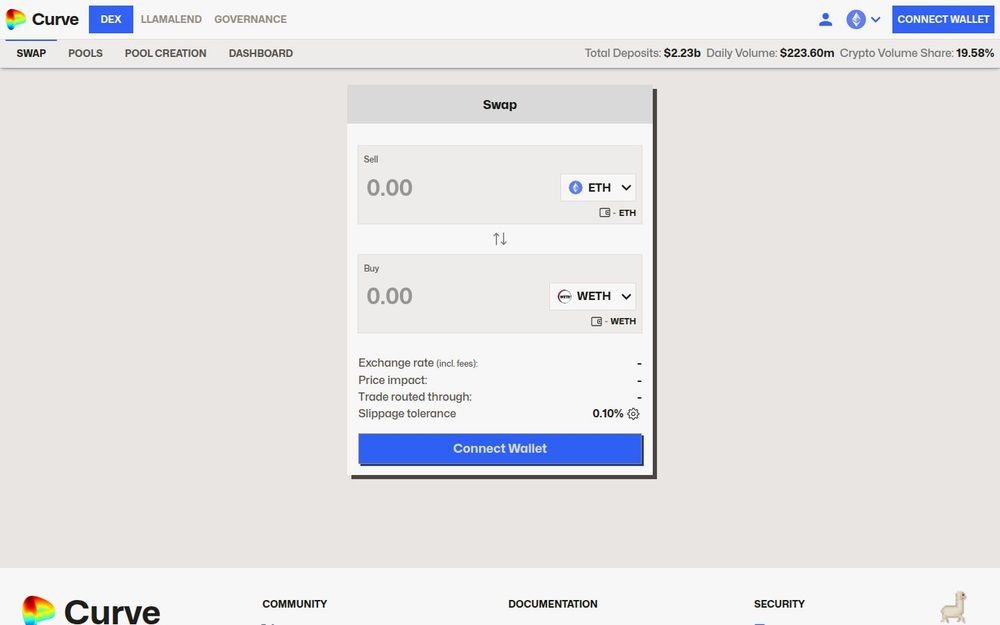
Curve is a decentralized exchange and liquidity protocol designed specifically for low-slippage swapping of stablecoins and similarly priced assets. Rather than optimizing for volatile, high-price-impact trades, Curve’s architecture focuses on assets that maintain a close peg — for example, stablecoins (USDC, USDT, DAI) and wrapped tokens (WETH, WBTC). The platform offers a straightforward interface for swaps, liquidity provision, and yield farming, while exposing detailed trade information such as exchange rates, price impact, routing, and slippage settings.
Core capabilities
-
Efficient Stable Swaps: Curve’s Automated Market Maker (AMM) is tailored to minimize slippage and fees when trading between assets that should trade near parity. This design yields better prices for users swapping stablecoins or wrapped equivalents compared with general-purpose AMMs.
-
Low Fees and Capital Efficiency: By optimizing pool curves and liquidity parameters for low-variance assets, Curve can offer very competitive trading fees and tighter spreads, enabling more capital-efficient liquidity provisioning.
-
Liquidity Provision and Pools: Users can deposit assets into specialized pools (including meta-pools) to earn fees from swaps. Pools are designed for like-kind assets, which reduces impermanent loss and improves long-term returns for liquidity providers.
-
Incentives and Governance (CRV): Curve implements token-based incentives and on-chain governance powered by the CRV token. Liquidity providers can earn CRV rewards, and token holders participate in gauge voting to direct emissions and incentives across pools.
-
Cross-chain and Integrations: Curve integrates with wallets, bridges, and other DeFi primitives. It supports wrapped assets and is available across Ethereum and layer-2 solutions, enabling broad composability within the DeFi ecosystem.
How it works
At the core, Curve uses mathematical curves specifically chosen to keep prices stable between assets that should have a near-equal value. When you submit a swap in the UI, the protocol calculates an exchange rate that includes fees, estimates price impact, and determines optimal routing — sometimes splitting a trade across pools to minimize slippage. The interface exposes settings such as slippage tolerance, letting users control acceptable deviation and avoid failed transactions. Wallet connectivity is required to sign transactions and interact with pools, swaps, and staking mechanisms.
User experience and interface
Curve’s web interface is intentionally minimal: choose input and output tokens, set the amount, review the quoted exchange rate and estimated price impact, choose slippage tolerance, and connect a wallet to execute the trade. Visual cues (token icons, approximate route, and fee breakdowns) help users understand trade execution. For liquidity providers, the UI surfaces pool compositions, current yields, and accrued rewards. More advanced integrations and analytics are available through Curve’s documentation and analytics dashboards.
Security, governance, and community
Security practices include audited smart contracts and community scrutiny typical in mature DeFi projects. Governance is decentralized via CRV, enabling stakeholders to propose and vote on parameter changes, reward allocations, and new pool additions. The token-driven governance model aligns incentives between liquidity providers, traders, and protocol stewards.
Recommended reasons
- Use Curve for low-slippage, low-fee swaps among stablecoins and pegged assets.
- Provide liquidity in specialized pools to earn fees plus CRV incentives while minimizing impermanent loss relative to general pools.
- Take advantage of broad DeFi composability and multi-chain availability for integrating yields and strategies across platforms.
In short, Curve is a cornerstone DEX for stable and like-asset trading in DeFi, prioritizing price efficiency, liquidity depth, and incentive alignment through on-chain governance and CRV-driven rewards.


