Overview
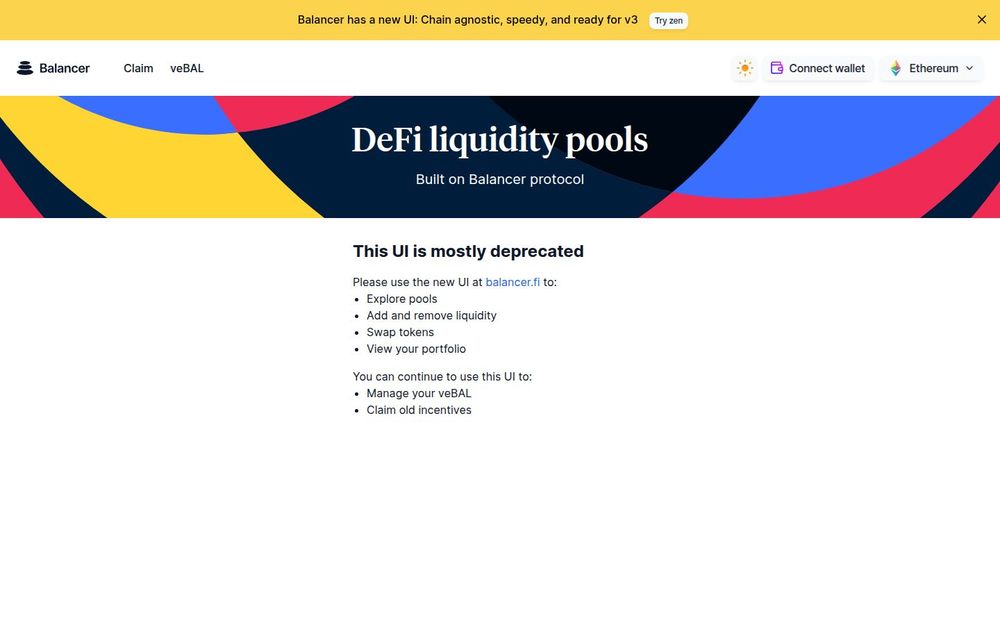
Balancer is a decentralized liquidity protocol with a redesigned front-end focused on speed, cross-chain compatibility, and the features introduced in Balancer v3. The new UI is promoted as a chain-agnostic experience that emphasizes performance and simplicity — summarized by the tagline “Try zen.” While the legacy app remains accessible for a couple of maintenance tasks, the recommended entry point for active trading, liquidity management, and portfolio monitoring is the official site at balancer.fi.
Core Capabilities
- 1. Pool Exploration: Discover and analyze liquidity pools across supported chains, review pool composition, fees, and historical performance.
- 2. Liquidity Management: Add and remove liquidity with streamlined flows, supporting both single-sided and balanced provisioning (where supported by pool design).
- 3. Token Swaps: Execute swaps across available pools with routing optimized for price and gas efficiency, leveraging Balancer’s AMM mechanics.
- 4. Portfolio View: Track your positions, asset distributions, and performance metrics in a consolidated dashboard tied to your wallet.
- 5. veBAL and Governance Tools: Interact with Balancer’s governance token mechanics; note that some veBAL management and legacy incentive claims may still require use of the older UI.
Key Features and Functionality
-
Chain-agnostic Design: The UI is built to operate across multiple chains, enabling users to interact with Balancer liquidity pools wherever the protocol is deployed. This reduces friction for multi-chain liquidity providers and traders.
-
Performance and UX Improvements: The interface focuses on speed and simplified flows — faster pool browsing, quicker transaction preparation, and optimized routing for swaps. The “Try zen” messaging highlights a minimal, calm design intended to reduce complexity for users.
-
Advanced Pool Types: As a v3-ready interface, the platform supports the protocol’s modern pool mechanics such as concentrated liquidity and more flexible fee structures, permitting more capital-efficient liquidity provision strategies.
-
Wallet Integrations and Transaction Management: Users can connect common wallets (e.g., MetaMask, WalletConnect) and sign transactions natively. The UI aims to present clear transaction details, gas estimates, and interactions with on-chain contracts.
-
Analytics and Discovery: Built-in tools for researching pools, viewing on-chain metrics, and understanding impermanent loss or historical fees help users make better provisioning and trading decisions.
Migration and Legacy UI
The legacy app remains accessible but is marked as mostly deprecated. Users are advised to use the new balancer.fi UI for primary activities like exploring pools, managing liquidity, swapping tokens, and viewing portfolios. The older interface can still be used to manage veBAL positions and to claim historical incentives that have not yet been migrated, but most day-to-day actions should be transitioned to the new site.
Security and Governance
Balancer is an on-chain protocol, meaning core behavior is enforced by smart contracts. Users should always verify they are interacting with the official domain (balancer.fi) and review transaction details before confirming. Governance is organized around veBAL, which grants voting power and aligns long-term contributors. The UI provides visibility into governance actions and may include tools for delegations and vote tracking.
Recommended Use Cases
- Traders who want multi-hop, gas-efficient swaps across Balancer pools.
- Liquidity providers seeking advanced pool types and concentrated liquidity features to improve capital efficiency.
- Portfolio holders who want a consolidated dashboard showing Balancer positions across chains.
- Governance participants managing veBAL and participating in protocol decisions (with some legacy flows still on the older UI).
Conclusion
Balancer’s redesigned interface aims to simplify and accelerate interactions with the protocol while supporting the advanced features of v3. By moving to the chain-agnostic balancer.fi experience, users gain faster navigation, modern pool mechanics, and robust analytics. For specialized legacy actions like claiming old incentives or certain veBAL management tasks, the deprecated UI remains available for now, but the new UI should be considered the primary and future-facing entry point for most users.