


Overview
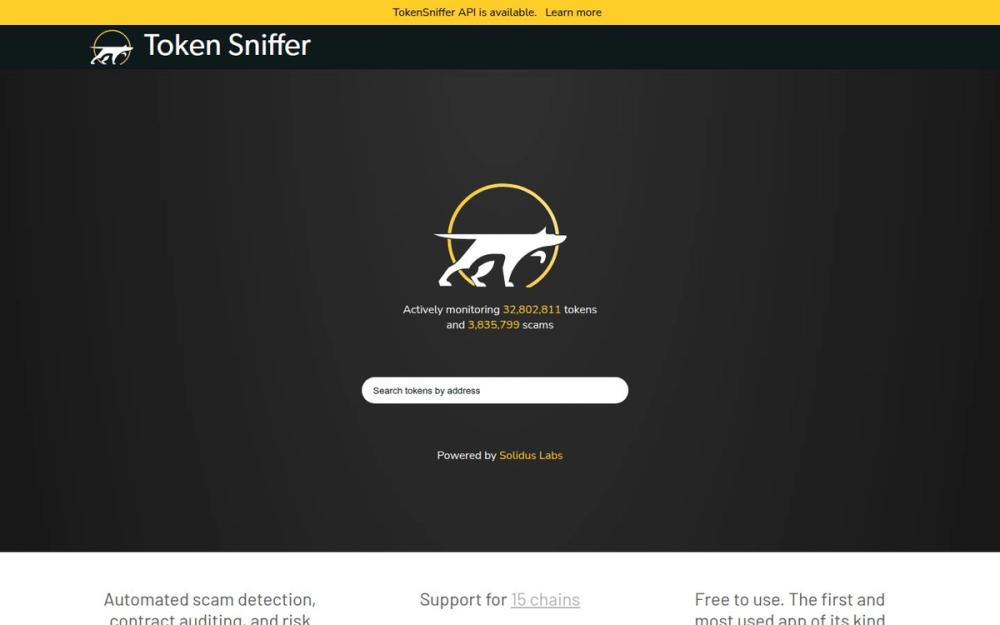
Token Sniffer is a crypto security and analytics service developed with backing from Solidus Labs. It provides automated scam detection, contract auditing, and risk analysis across numerous blockchain networks. With claims of actively monitoring over 32.8 million tokens and identifying more than 3.8 million scams, Token Sniffer aims to give users fast, data-driven signals about the trustworthiness of tokens and contracts. The platform is accessible via a web interface and exposes an API for integration into tooling, wallets, or exchange workflows. It is free to use and is positioned as one of the first and most widely used tools of its kind.
Core Capabilities
- Automated Scam Detection: Identifies patterns and behaviors often associated with rug pulls, honeypots, and other malicious schemes.
- Contract Auditing: Performs automated static checks on smart contract code to surface risky constructs or suspicious privileges.
- Risk Scoring & Analysis: Generates risk indicators and aggregated metrics to help users quickly assess token safety.
- Multi-Chain Support: Provides coverage across 15 supported chains, such as Ethereum, Solana, BSC, Polygon, Arbitrum, Optimism, Avalanche, Fantom, and more.
- API Access: Offers an API for developers and enterprises to integrate Token Sniffer’s signals and datasets into their applications or monitoring pipelines.
Main Features
- Large-scale Token Monitoring: Continuously tracks millions of tokens and contract events to detect suspicious activities early.
- Automated Alerts and Flagging: Flags tokens that match known scam patterns and surfaces them to users for rapid awareness.
- Contract Checks and Heuristics: Runs rule-based and heuristic checks against smart contract code to identify potential vulnerabilities or admin privileges.
- Cross-chain Coverage: Works across many popular and emerging chains to ensure detection is applicable to diverse wallets and marketplaces.
- Programmatic Integration: Provides endpoints for automated queries, enabling integration into trading bots, marketplaces, or compliance tools.
How It Works
Token Sniffer combines on-chain telemetry, static contract analysis, and heuristic rules developed from observed scam behaviors. The platform ingests token and contract data across multiple networks, applies automated checks, and assigns flags or risk indicators when specific red flags are detected. These signals are then presented through a web interface and via the API so that users can query token reputations, audit results, and historical incident records.
Supported Networks
Token Sniffer lists support for 15 networks, making it relevant for users operating on both Layer 1 and Layer 2 ecosystems. Examples include Ethereum, Solana, Binance Smart Chain (BSC), Polygon, Arbitrum, Optimism, Avalanche, and others. Multi-chain support broadens the platform’s usefulness for traders and integrators who need consistent safety checks across many environments.
Why Use Token Sniffer
Token Sniffer is recommended for users who need quick, automated visibility into token risks without building bespoke tooling. It suits:
- Retail traders wanting a fast check before interacting with a new token.
- Developers and integrators seeking programmatic risk signals.
- Compliance teams and marketplaces that require automated screening to reduce user exposure.
The combination of broad token coverage, multi-chain support, and a public API makes it practical for both individual due diligence and scaled security workflows.
Limitations & Considerations
While Token Sniffer provides automated detection and heuristic auditing, users should treat its outputs as indicative rather than definitive. Automated tools can generate false positives or miss novel scam techniques. For critical decisions, combine Token Sniffer signals with manual audits, third-party code reviews, and on-chain behavioral analysis.
Conclusion
Token Sniffer delivers a pragmatic, accessible layer of automated scam detection and contract analysis for the crypto ecosystem. With large-scale monitoring, multi-chain reach, and API access, it helps users make faster, more informed decisions about token interactions while acknowledging that human verification and deeper audits remain necessary for high-risk or high-value engagements.


