


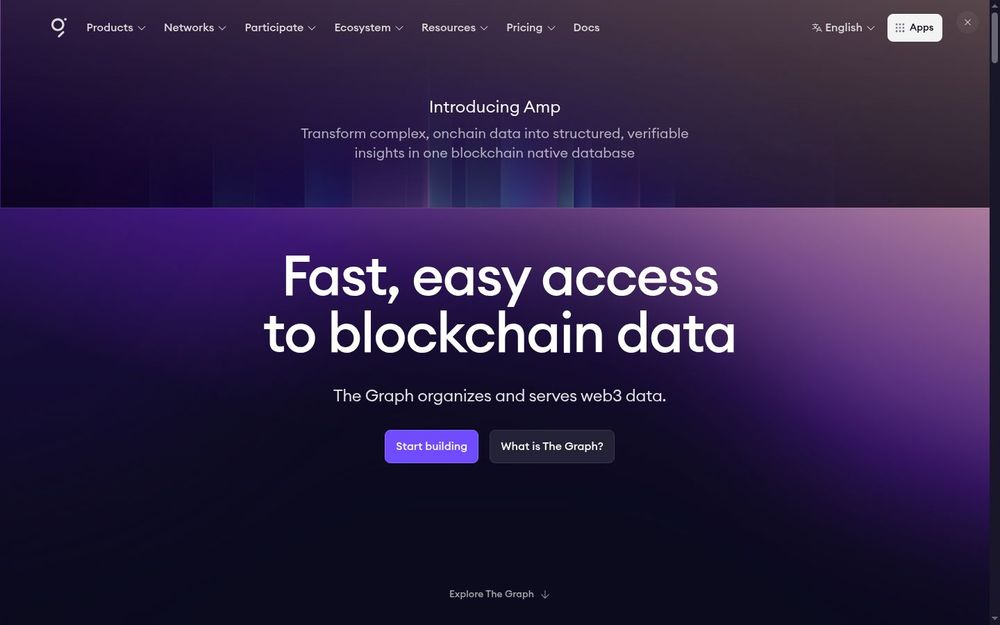
Overview
The Graph is a decentralized data infrastructure that transforms raw blockchain activity into organized, queryable datasets that developers can use directly in applications. Instead of running and maintaining costly, bespoke indexing servers, teams can author or consume subgraphs—declarative schemas that map smart contract events into entities—and query them via GraphQL. This approach accelerates development, reduces operational complexity, and enables richer, more responsive Web3 experiences.
Core Capabilities
-
Subgraphs: Define how smart contract events and transaction logs map to structured entities. Subgraphs let developers index specific protocols or contracts and expose the resulting data through efficient GraphQL endpoints.
-
Substreams: Stream on-chain data into custom sinks and processes. Substreams provide a way to build high-throughput pipelines that transform and dispatch blockchain data for analytics, off-chain processing, or other storage targets.
-
Token API: Access standardized token metadata, balances, and price information. The Token API is a focused product that helps applications retrieve token-related data without custom indexing work.
-
Amp (Blockchain-First Database): Designed from the ground up for the unique properties of blockchain data, Amp provides a verifiable, structured database that is blockchain-native, facilitating complex queries and verifications over on-chain datasets.
-
Hypergraph: A framework for building privacy-preserving consumer applications that leverages The Graph’s data primitives while protecting sensitive user information.
How it works
Developers write a subgraph manifest that describes which contracts and events to index and how to map them into application-friendly types. Once deployed to The Graph Network or a hosted service, a network of participants—Indexers (who run indexing nodes), Curators (who signal which subgraphs are valuable), Delegators (who stake tokens to support indexers), and Subgraph Developers—collaborate to index and serve queries. Consumers query the resulting datasets with GraphQL queries, getting structured responses in milliseconds, which streamlines frontend rendering and complex analytics.
Benefits and differentiators
-
Reduced operational cost and complexity: By outsourcing indexing to The Graph’s network, teams avoid running and maintaining bespoke indexing servers, often cutting infrastructure costs substantially.
-
Faster development cycles: With ready-made subgraphs and a GraphQL interface, developers build features and iterate more rapidly, as data is available in an application-friendly shape.
-
High availability and resilience: A globally distributed network of indexers provides redundancy and uptime guarantees, ensuring applications can serve queries 24/7.
-
Ecosystem and interoperability: The Graph supports dozens of networks and a large catalog of community-created subgraphs, enabling reuse, discovery, and cross-project composability.
Recommended reasons to use The Graph
If you are building a Web3 application that relies on timely, structured on-chain data, The Graph significantly lowers the barrier to entry. Use it to:
- Avoid building and maintaining complex indexing pipelines and focus engineering effort on product logic.
- Gain access to a marketplace of curated subgraphs and community-built schemas to accelerate development.
- Improve frontend performance and user experience by serving fast GraphQL responses instead of parsing raw blockchain logs in the client.
Getting started and ecosystem participation
Getting started is straightforward: discover an existing subgraph or author your own, deploy it, and query it with GraphQL. The Graph also welcomes participants in multiple roles—developers, indexers, curators, and delegators—so teams and individuals can contribute to and benefit from the network. Documentation, blogs, videos, and examples provide practical guidance for each step, from subgraph quick starts to advanced network participation.
Conclusion
The Graph is a robust, production-ready solution for indexing and querying blockchain data. Its modular product set (Subgraphs, Substreams, Token API, Amp, Hypergraph) and decentralized network model offer both flexibility and reliability. For teams focused on building scalable, responsive Web3 applications without the burden of running bespoke indexing infrastructure, The Graph provides an efficient, well-documented, and widely adopted platform to source verifiable on-chain data.


