


Overview
Synapse is a cross-chain communications network focused on enabling secure, efficient, and developer-friendly transfers of assets and messages between disparate blockchain networks. Positioned as an extensible infrastructure layer, Synapse powers user workflows such as bridging tokens, routing transactions across multiple chains, and providing interfaces for wallets and dApps to interact with its protocols. The platform markets itself as widely used and secure, offering both end-user features (Bridge, Portfolio, Activity) and developer-oriented capabilities that allow teams to integrate cross-chain logic into applications.
Core Capabilities
-
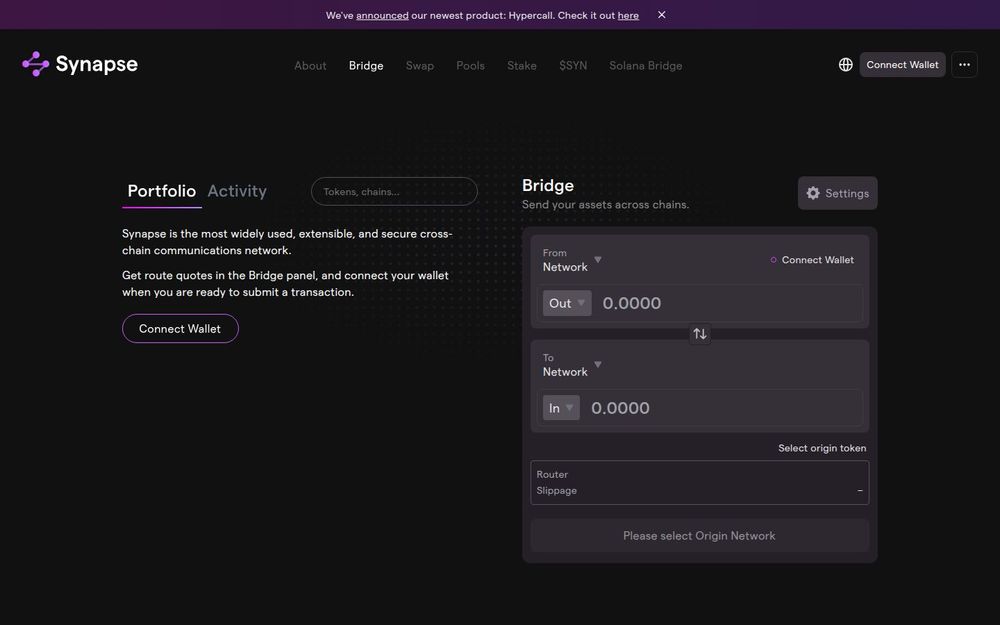
Cross-chain Bridging: Synapse provides a user-facing Bridge panel that allows users to send assets between supported networks. The bridge offers route quotes, lets users select origin and destination networks and tokens, and integrates wallet connection for transaction submission and monitoring.
-
Routing and Liquidity Management: The protocol supports intelligent routing to determine optimal paths for cross-chain transfers. Routers and liquidity pools are used to execute transfers efficiently, aiming to reduce slippage and transaction costs while maintaining throughput across multiple chains.
-
Security and Reliability: Synapse emphasizes security in cross-chain messaging and asset transfers, employing audited smart contracts and operational practices that mitigate common risks in bridging, such as double spends, replay attacks, and misrouting. Transaction tracking and pending activity views help users confirm status and resolve issues.
-
Developer Extensibility: The platform is built to be extensible, offering components and integrations that developers can use to embed cross-chain features into their applications. This includes SDKs, APIs, and composable primitives for routing, messaging, and liquidity interactions.
-
User Experience and Wallet Integration: Synapse includes UI affordances like Connect Wallet, Portfolio and Activity sections, and settings for slippage and routers. These features are designed to help users manage cross-chain operations, view recent and pending transactions, and configure transaction parameters before submission.
How It Works
At a high level, Synapse operates by coordinating liquidity and message passing across connected networks. When a user initiates a bridge transfer, the system obtains route quotes, selects an appropriate router or liquidity path, and constructs the necessary on-chain transactions. Users connect their wallets to sign and submit these transactions; Synapse then tracks pending and completed transactions in the Activity feed and updates the user Portfolio. Behind the scenes, smart contracts and off-chain orchestration ensure funds are locked, minted, or swapped as needed to complete the cross-chain move while preserving security guarantees.
Notable Features and Integrations
-
Route Quotes and Slippage Controls: Users can request route quotes and set slippage tolerance to balance speed, cost, and price certainty.
-
Router Selection: The platform supports multiple routing implementations or liquidity routers, offering flexibility in execution strategies.
-
Developer Tools: APIs and SDKs facilitate integration with wallets, dApps, and third-party services, enabling new UX paradigms for cross-chain workflows.
-
Activity & Portfolio Tracking: Built-in dashboards help users monitor transactions and asset positions across chains.
-
Evolving Product Suite: Synapse continues to expand its offerings, as evidenced by announcements like Hypercall, which signal new tooling for cross-chain interactions and developer-focused RPC-style capabilities.
Why Choose Synapse
Synapse is suitable for teams and users who need a reliable cross-chain infrastructure that balances security, usability, and flexibility. For developers, its extensible primitives and tooling reduce integration friction, while end users benefit from a streamlined bridge experience with transparent routing and activity tracking. Organizations building multi-chain applications can leverage Synapse to abstract away complex cross-chain mechanics and focus on product-level features.
Recommendations
For users: connect a secure wallet, review route quotes and slippage settings, and monitor the Activity feed for transaction confirmation. For developers: evaluate Synapse’s SDKs and routing options to see how they align with desired security and UX requirements, and watch for new products like Hypercall that may enable additional cross-chain capabilities.


