


Overview
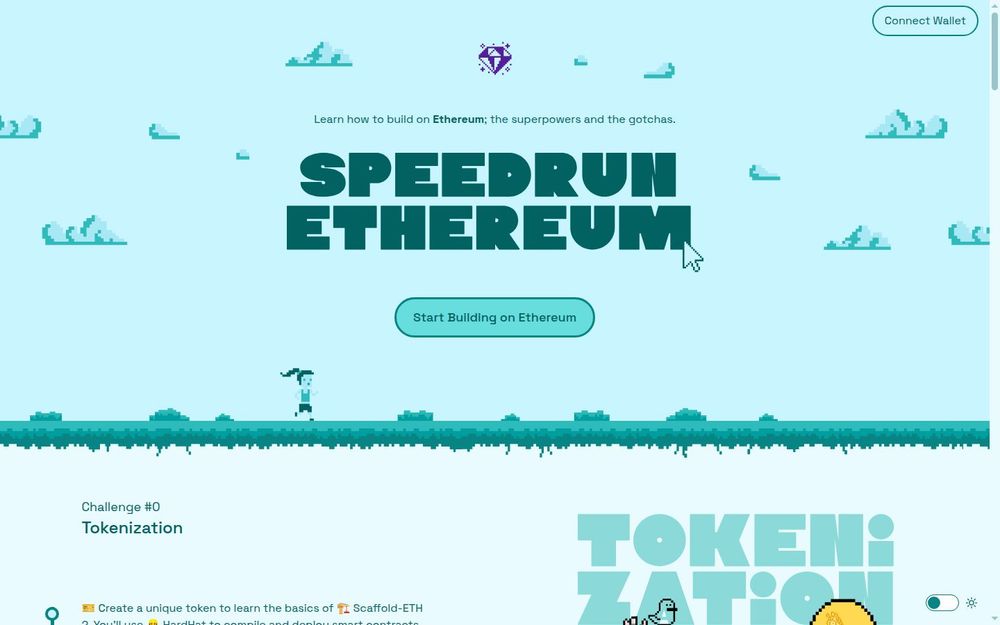
Speedrun Ethereum is a hands-on curriculum designed to teach developers how to build real applications on the Ethereum blockchain. The platform uses a challenge-driven approach where learners progress through discrete quests that introduce fundamental and advanced Solidity concepts alongside practical tooling and frontend integration. Each challenge includes a task description, starter templates, and instructions to compile, test, and deploy smart contracts using modern developer stacks like HardHat, React, and scaffolding tools. The goal is to grant learners practical experience with both the logic of smart contracts and the operational mechanics of deploying and interacting with decentralized applications (dApps).
Core Capabilities
-
Interactive Challenges and Quests: Structured exercises that range from basic token minting and NFT deployment to more advanced systems like automated market makers, oracles, and zero-knowledge voting. Each quest focuses on a small, teachable set of concepts and culminates in a working smart contract and frontend.
-
End-to-End Tooling and Templates: Starter projects and React templates that include Ethereum components and hooks, enabling learners to connect wallets, call contract functions, and build usable dApp frontends. The platform emphasizes modern tools like HardHat for compiling, testing, and deployment.
-
Progressive Curriculum: Challenges are organized from simple to complex, covering topics such as ERC20/ERC721 tokens, staking, liquidity pools (DEX), lending and stablecoins, prediction markets, randomness exploitation, and oracles. This progression helps learners build on prior knowledge and tackle increasingly realistic scenarios.
-
Security and Attack Scenarios: Many exercises highlight common pitfalls and adversarial conditions, demonstrating how deterministic blockchains handle randomness, how financial primitives can be manipulated, and what security trade-offs arise with oracles and dispute mechanisms.
-
Community and Mentorship Opportunities: Cohort-based batches, mentorship from experienced builders, and collaborative open-source projects help learners get feedback and real-world perspectives as they implement and iterate on their projects.
How It Works
Learners pick a challenge and clone a starter repository that typically contains smart contract skeletons, tests, and a React frontend. Using HardHat, they compile and test contracts locally, iterate on contract logic, and run automated tests to validate behavior. Once the contract behaves correctly, the challenge walks through deploying to a public test network and connecting the frontend, so users can mint tokens, swap assets, or interact with the system via a wallet. Each quest often includes guidance on common issues, debugging tips, and recommended patterns like the ERC20 approve/transferFrom flow.
Who It's For
This platform targets developers who already know basic JavaScript and want to learn blockchain development by building. It is suited to beginners who prefer guided, practical exercises, as well as intermediate engineers seeking to deepen their understanding of DeFi primitives, security considerations, and real-world dApp workflows. Teams and students can use the challenges to prototype ideas or to practice for hackathons and interviews.
Why Choose Speedrun Ethereum
Speedrun Ethereum emphasizes experiential learning: instead of passive tutorials, you build functioning contracts and frontends that expose you to tooling, deployment, and attack surfaces. The curriculum balances theoretical explanations with pragmatic guidance and offers community support and mentorship to accelerate learning. If you want a structured, project-based path to becoming an Ethereum builder — with clear challenges that map to real industry primitives like tokens, DEXes, lending protocols, and oracles — Speedrun Ethereum provides a focused, practical route to competency.
Getting Started
Start with the Tokenization challenge to learn contract compilation and NFT minting, then progress through staking, token vending, and DEX challenges to understand financial primitives. Use the provided React templates to practice frontend integration and wallet connectivity, and join cohort batches or community channels to get feedback and mentorship as you advance.


