


Overview
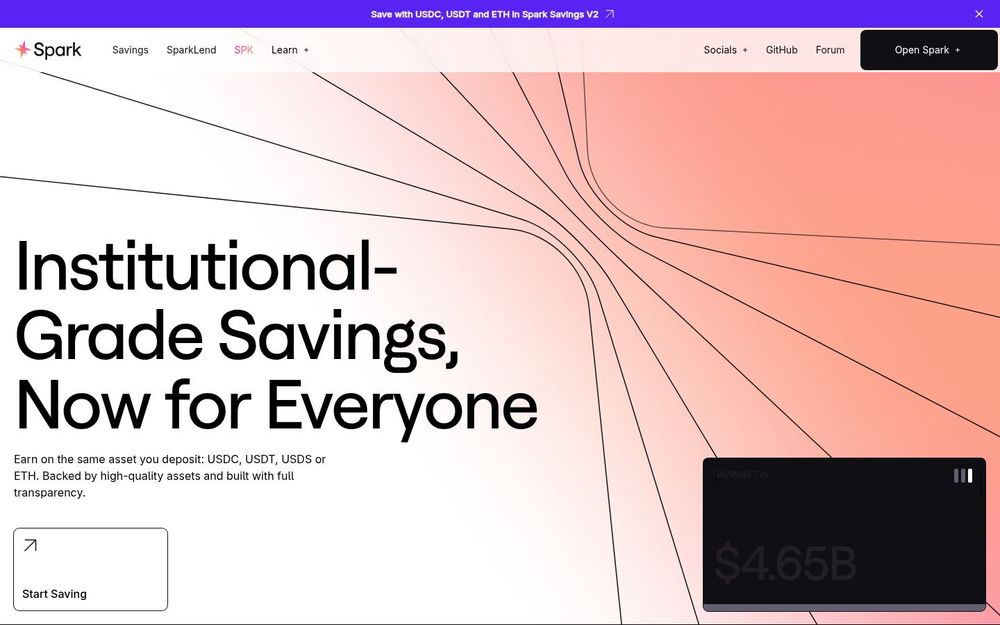
Spark is a composable, onchain asset allocator and yield engine built to deliver institutional-grade savings and liquidity products to everyone. It allows users to deposit stablecoins (USDC, USDT, USDS) and ETH and earn yield generated from diversified allocations across decentralized finance (DeFi), centralized finance (CeFi), and tokenized real-world assets (RWAs). Spark emphasizes transparency and verifiability: capital deployments and performance are visible onchain through its Data Hub, and users can withdraw into supported assets with minimal or zero slippage.
Core Capabilities
-
Savings (savings vaults and sTokens): Spark provides savings vaults that let users earn on the exact asset they deposit—USDC, USDT, USDS, or ETH—via allocations to yield-generating strategies. Withdrawals are designed to be low-slippage and instant into the same asset type.
-
SparkLend (borrowing and lending markets): SparkLend powers large-scale borrowing and lending with transparent, governance-determined rates. Users can borrow USDC and USDS against supplied collateral while monitoring positions and rebalancing with high-liquidity assets.
-
Spark Liquidity Layer (capital deployment engine): This layer boots new products and routes capital across partner protocols and markets. It supports integrations with lending and liquidity providers like Aave, Morpho, and other specialized counterparties to generate competitive, risk-adjusted yield at scale.
-
SPK token and governance: The native SPK token enables staking, farming, and onchain governance—allowing holders to vote on protocol parameters, delegate votes, and align long-term incentives across the ecosystem.
-
Onchain transparency and Data Hub: All allocations and strategy activity are observable onchain and accessible through the Spark Data Hub and analytics pages, enabling users and auditors to verify operations and performance.
Security, Audits and Bug Bounty
Spark places high emphasis on security and code quality. Multiple smart contract audits have been completed by respected firms, covering SparkLend, the Liquidity Layer, and Savings contracts. Audit reports are publicly available for review. Additionally, Spark operates one of the larger DeFi bug bounty programs, offering substantial financial incentives—up to multi-million-dollar rewards—to encourage responsible disclosure and proactive vulnerability hunting.
Token, Staking and Ecosystem Participation
SPK, Spark’s native token on Ethereum, is the core of the protocol’s economic and governance model. Holders can:
- Stake SPK to secure and participate in protocol programs and earn staking rewards or points.
- Farm SPK by locking SKY or USDS in supported farming campaigns to bootstrap liquidity and align long-term contributors.
- Vote in governance to shape risk parameters, deploy capital, and approve integrations.
This triad of staking, farming, and voting ensures active alignment between users, liquidity providers, and the long-term health of the protocol.
Integrations and Ecosystem Growth
Spark partners with institutional players and emerging projects to deploy capital and expand utility. The platform has integrated with tokenization and liquidity providers, facilitating access to markets such as ETH derivatives, tokenized treasuries, and other highly liquid assets. These partnerships help Spark scale capital deployment and offer users diversified, institutional-grade yield opportunities.
Why Choose Spark
Spark is suited for users seeking a transparent, scalable, and security-conscious way to earn yield on stablecoins and ETH without giving up the underlying asset. Its combination of a robust liquidity layer, modular lending markets, visible onchain allocations, and active governance via SPK creates a comprehensive toolkit for both retail savers and institutional participants. With public audits, an active bug bounty program, and a data-first approach to transparency, Spark aims to balance yield generation with rigorous risk management.
For developers, treasury managers, and yield-seeking users, Spark offers a clear path to participate in a growing liquidity ecosystem while maintaining verifiability and control over assets and governance exposure.


