


Overview
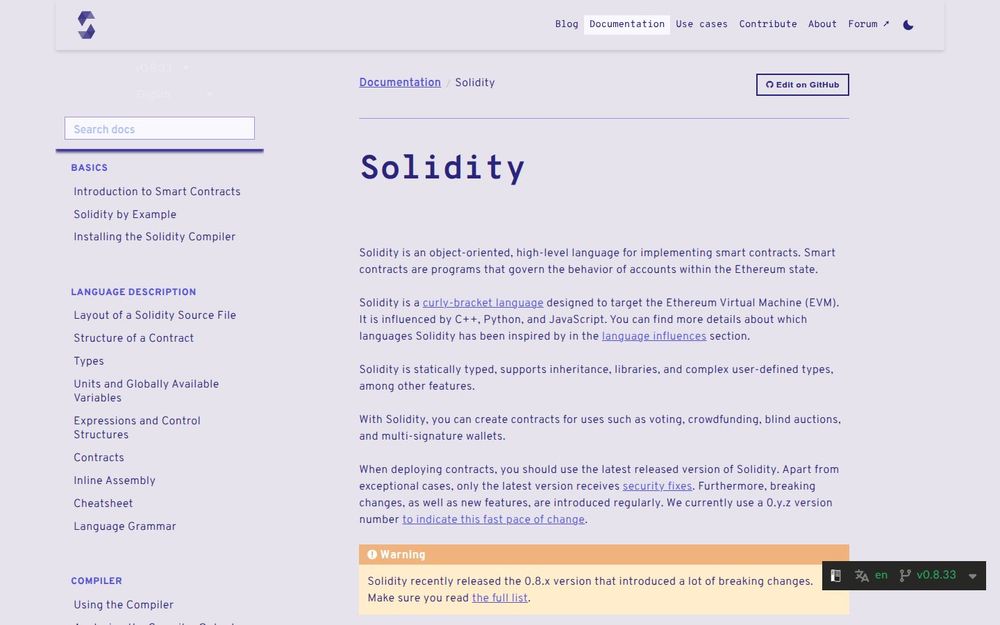
Solidity is the primary high-level language for authoring smart contracts on Ethereum and EVM-compatible chains. It is an object-oriented, statically-typed, curly-bracket language that draws influences from C++, Python, and JavaScript. Designed to target the Ethereum Virtual Machine, Solidity provides language constructs and primitives tailored to blockchain needs, such as state variables, events, function modifiers, and a native understanding of Ether units and transaction context. The official documentation (including the v0.8.33 release notes) presents comprehensive guidance for getting started, language reference, compiler usage, internals, and security best practices.
Core Capabilities
-
Smart contract structure and modularity: Solidity supports contracts, libraries, interfaces, and inheritance. Developers can craft modular systems, reuse logic through libraries, and define clear interfaces for composability between contracts.
-
Types and ABI interoperability: Solidity provides a wide range of value and reference types, mappings, arrays, structs, and enums. The Contract ABI Specification standardizes how functions and events are encoded for external calls, enabling reliable interaction with wallets, dapps, and off-chain tooling.
-
Compiler and optimization: The Solidity toolchain includes a robust compiler with multiple configuration options, an optimizer, and JSON-based input/output formats for integration. Documentation covers command-line usage, EVM targeting, IR-based codegen changes, and advice for reading and analyzing compiler output.
-
Developer tooling and examples: The docs include hands-on materials like Solidity by Example, sample contracts (voting, auctions, micropayments), and guidance for using the Remix IDE, npm packages, Docker images, and building from source. These resources make it easier to experiment, test, and deploy contracts.
-
Security and formal verification support: Solidity emphasizes security guidance and provides links to the SMTChecker and formal verification options. The documentation explains common pitfalls, recommended patterns, and a list of known bugs and breaking changes so developers can avoid risky constructs and keep contracts safer.
Ecosystem and Documentation
The official website and docs host extensive reference material including the language grammar, cheat sheets, style guide, common patterns, and internals such as storage layout, memory, and call data encoding. Community translations and a contributor workflow are maintained so documentation can reach developers in many languages. Versioned documentation helps teams align on specific compiler releases and track breaking changes across major versions.
Security and Best Practices
The documentation underlines the importance of code review, testing, and audits. It warns about the fast-paced nature of the language (frequent breaking changes and security fixes) and recommends using the latest stable releases unless exceptional circumstances require otherwise. The docs include explicit sections on security considerations, pitfalls to avoid, and formal verification tooling advice to support higher-assurance development.
Why Use Solidity
Solidity is the de facto language for smart contract development on Ethereum, offering specialized features, a mature compiler, and broad tooling support. It balances familiar programming paradigms with blockchain-specific constructs to enable developers to write expressive, composable contracts. With extensive documentation, practical examples, and active community contributions, Solidity is well suited for building decentralized applications, token contracts, governance systems, and complex on-chain logic. Whether you are learning smart contracts or building production systems, Solidity’s ecosystem provides the language and resources needed to develop, analyze, and deploy secure smart contracts.


