


Overview
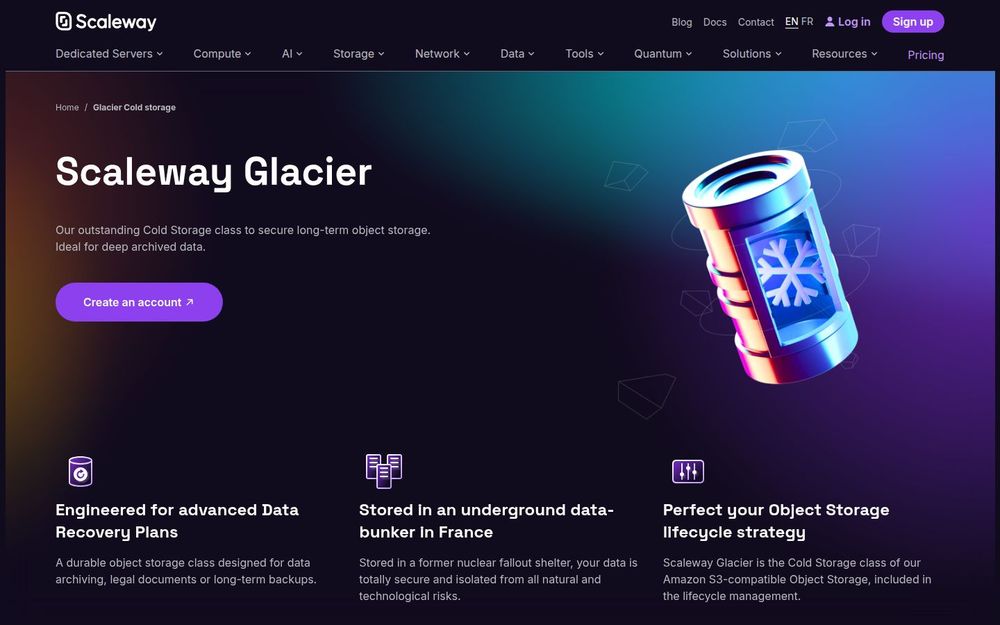
Scaleway Glacier is a cold storage class for Scaleway Object Storage engineered for long-term archiving and deep retention. It is presented as an S3-compatible tier intended for data that does not require frequent access but must be preserved reliably over long periods — for example, legal archives, long-term backups, heavy logs, and ultra-high-definition media. The service emphasizes low-cost storage, lifecycle management compatibility, and a unique physical host environment: an underground databunker in France designed to mitigate natural and technological risks.
Core Capabilities
-
Durable S3-compatible cold object storage: Glacier behaves like an Amazon S3 storage class, making it compatible with existing S3 tooling and lifecycle rules to transition or expire objects between classes.
-
Low-cost archival pricing: The tier is optimized to minimize long-term storage costs. Data transfer into Glacier is free; users pay primarily for storage and restores, with no minimum commitments, making it suitable for archives accessed very rarely.
-
Lifecycle management integration: Glacier supports transition and expiration rules, enabling automated movement of objects from Multi-AZ or One-Zone IA to Glacier and back to Standard class upon restore.
-
Highly secure physical storage: Data is stored in a former nuclear fallout shelter located under Paris, offering additional isolation and protection from a broad range of hazards.
-
Specialized hardware and retrieval model: The infrastructure uses SMR disks and custom board-level controls to power disks on/off on demand. This enables dense, cost-efficient storage but introduces retrieval latency and throughput trade-offs.
Key Features and How They Matter
-
Cold archival optimization: Glacier is tailored for workloads where data is accessed rarely (e.g., once in years). The storage design and hardware choices drive down per-GB cost while accepting higher retrieval latencies.
-
Controlled restore process: Objects archived in Glacier must be restored to Standard class before download. Retrieval times can range from a few seconds for small average-sized files to 24–48 hours for first-byte latency on larger objects, so planning and lifecycle rules are recommended.
-
Data residency and compliance: With storage physically located in France and adherence to European regulations, Glacier is positioned for customers with GDPR and local compliance needs.
-
Operational tooling and docs: Scaleway provides tutorials, quickstarts, and documentation for editing storage class, configuring lifecycle rules, and performing restores, helping teams automate archival workflows.
Use Cases
-
Ultra HD media archives: Store raw 8K footage or large media assets that are retained for long-term reference rather than immediate streaming.
-
Heavy logs & backups: Automate lifecycle policies to archive logs and backups, and set expirations to control long-term costs while retaining auditable history.
-
Legal and regulatory archives: Preserve contracts, accounting data, and access logs with long retention windows while maintaining compliance with European data-protection frameworks.
Security, Reliability, and Sustainability
Scaleway highlights physical security by using a subterranean databunker, which reduces exposure to many environmental and technological risks. The provider also emphasizes a European, multi-cloud, and open-source orientation, 24/7 support options, and a sustainability commitment where data centers run on renewable electricity and decommissioned hardware is reused or recycled.
Pricing and Retrieval Expectations
Glacier’s model focuses on minimizing storage costs. Data ingress is free, and charges apply mainly for storage and data restores. Because of the cold nature of the tier and the SMR-based architecture, retrievals are intentionally slower — customers should expect the first byte of restored objects to take anywhere from a few seconds to up to 24–48 hours in typical conditions. This trade-off must be considered when defining retention policies and business continuity plans.
Getting Started
To adopt Glacier, create a Scaleway account, configure an Object Storage bucket with lifecycle rules to transition objects to Glacier, and review documentation on restore procedures. Tutorials and quickstarts are provided to guide standard operations such as editing storage classes and initiating restores.
Recommendation
Scaleway Glacier is best suited for organizations seeking cost-effective, compliant, long-term archival in Europe where retrievals are infrequent and can tolerate substantial latency. It works well as part of a lifecycle strategy that moves cold data to Glacier while keeping frequently accessed assets in Standard tiers. If your priority is immediate access or high-throughput restores, consider using Standard or One-Zone IA storage classes instead.
Conclusion
As a specialized cold-tier offering with strong European data residency, low-cost archival pricing, and lifecycle management compatibility, Scaleway Glacier is a practical solution for long-lived archives, legal compliance storage, and large media datasets that require preservation rather than frequent access. Its unique physical infrastructure and sustainability commitments add further differentiation for organizations prioritizing security and European hosting.


