


Overview
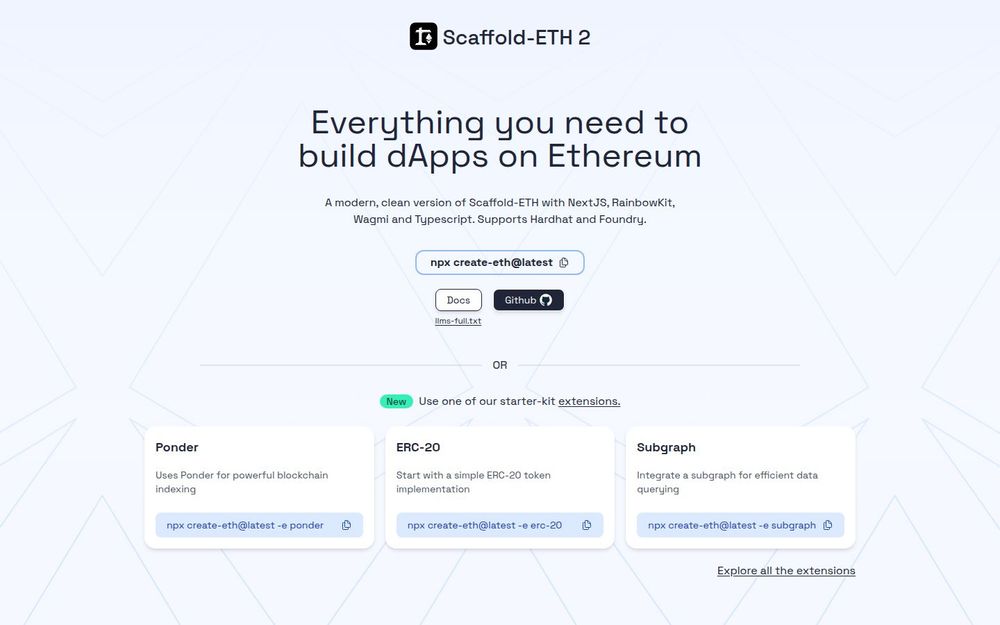
Scaffold-ETH 2 is a focused developer toolkit that streamlines the process of building, testing, and iterating Ethereum dApps. It combines a modern frontend stack with proven web3 integrations and developer utilities to reduce boilerplate and allow engineers to concentrate on application logic rather than repetitive setup. By pairing Next.js, RainbowKit, Wagmi, and TypeScript with support for Hardhat and Foundry, Scaffold-ETH 2 offers a full-stack experience aimed at both rapid prototyping and production readiness.
Core Features
- 1. Project Scaffolding: The CLI (npx create-eth@latest) scaffolds a ready-to-run project with sensible defaults so you can start building immediately.
- 2. Wallet & Web3 Integration: Built-in support for RainbowKit and Wagmi provides wallet connections, transaction handling, and reactive contract interactions with TypeScript autocompletion.
- 3. Debug Contracts & Live UI: A live-updating frontend that adapts to your contract ABI lets you debug and refine smart contracts with immediate feedback during development.
- 4. Modular Extensions: Installable extensions (e.g., Ponder indexing, ERC-20 starter, Subgraph) act as starter-kits to add pages, contracts, or integrations at project creation time.
- 5. Developer Tools & Utilities: Includes custom hooks, a built-in block explorer for inspecting local transactions, Tailwind + daisyUI components, and examples that accelerate common web3 patterns.
How It Works
Scaffold-ETH 2 uses the CLI to create a project that integrates front-end and back-end tooling. Developers write contracts using Hardhat or Foundry, then scaffold front-end components and hooks that are already wired to interact with those contracts. The custom hooks wrap Wagmi calls and provide typed interfaces for contract reads, writes, and event monitoring, reducing friction and improving developer velocity. The built-in block explorer displays local test transactions and makes it easy to verify behavior without leaving your development environment.
Extensions and Starter Kits
Extensions are a core part of Scaffold-ETH 2’s flexibility. They are modular add-ons you can include at project creation with a single CLI flag (for example, -e ponder or -e erc-20). Extensions typically provide:
- Starter contracts (templates for tokens, governance, or custom logic)
- Example frontend pages and components wired to those contracts
- Optional indexing or subgraph integration to enable efficient querying
Extensions are designed to be compatibility-safe with the Scaffold-ETH core so you can adopt features without long-term maintenance headaches.
Components, Hooks, and Developer Experience
Scaffold-ETH 2 ships a library of pre-built front-end components styled with Tailwind CSS and daisyUI, aimed at common web3 UI patterns (connect wallet, transaction status, token displays, etc.). The hook system offers typed wrappers such as useScaffoldReadContract and useScaffoldWriteContract that reduce boilerplate and provide instant autocompletion. These utilities are particularly helpful when switching between local testing, staging, and mainnet environments since they abstract provider and network details.
Why Choose Scaffold-ETH 2
Scaffold-ETH 2 is ideal for teams and individual builders who want to move quickly from concept to working prototype while keeping a path toward production. It emphasizes developer ergonomics with TypeScript typings, hot-reloading debug UIs, and a modular extension system so projects start with practical, focused examples rather than an empty repo. The project also benefits from community resources, documentation, and an ecosystem of extensions that reduce time-to-first-demo.
Getting Started
- Run: npx create-eth@latest to scaffold a new project.
- Choose extensions (for example -e ponder or -e erc-20) to include starter functionality.
- Use the included hooks, components, and the block explorer to test contracts locally and iterate quickly.
Scaffold-ETH 2 lowers the barrier to building Ethereum dApps by combining modern front-end tech, robust tooling for smart contracts, and a set of curated extensions and utilities that accelerate development and debugging.


