


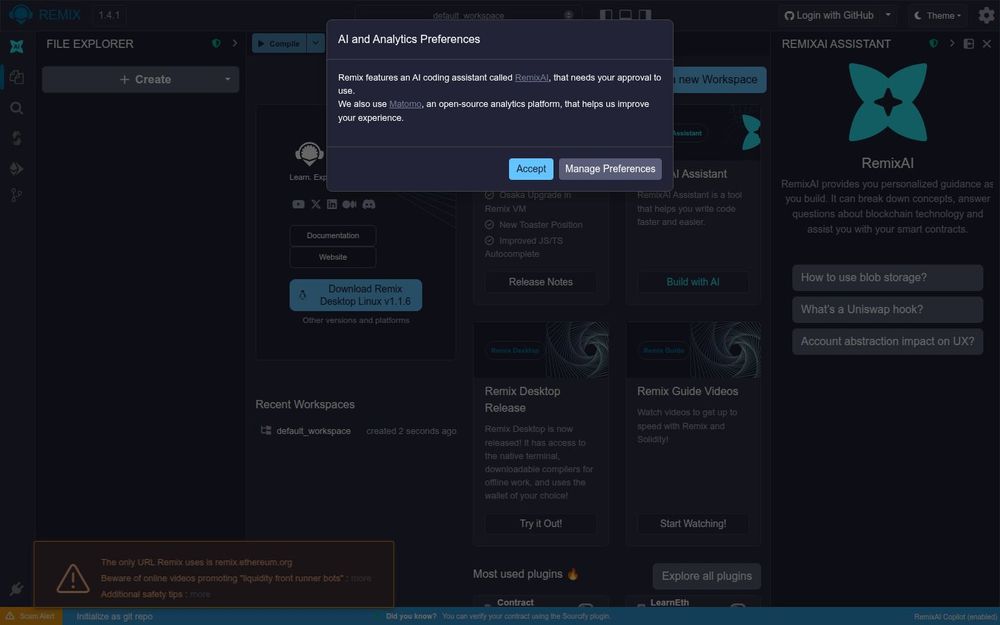
Overview
Remix is a web-based Integrated Development Environment (IDE) built primarily for Ethereum smart contract authors. Designed for rapid prototyping and iterative development, Remix bundles compilers, debuggers, testing frameworks, and deployment tools into a single modular interface. It targets both beginners learning Solidity and experienced developers building production-grade smart contracts by combining a powerful core maintained by the Remix team with an ecosystem of community and third-party plugins.
Core Capabilities
Remix brings together many capabilities that cover the full lifecycle of smart contract development. Key features include:
-
Integrated Compilers and Language Support: The IDE includes support for Solidity, Vyper, Noir, Circom (ZKP circuits), and other compilers via plugins, enabling compilation and artifact generation directly in the browser or via downloadable compiler binaries in Remix Desktop.
-
Deploy & Run Environments: Multiple execution environments are available such as the Remix VM (a local JavaScript EVM), injected web3 providers (e.g., MetaMask), and network-specific plugins for chains like Arbitrum, ZKsync, and Starknet. This flexibility simplifies testing across networks.
-
Debugging and Analysis: A built-in transaction debugger, static analyzers (Remix, Solhint, Slither), and gas estimators let developers trace transactions, identify vulnerabilities, and optimize gas usage.
-
Plugin Ecosystem and Extensibility: A plugin manager hosts official and community plugins (e.g., Contract Verification, Tenderly integration, Defender Deploy, BuildBear sandbox). Plugins extend functionality without bloating the core IDE.
-
Testing, Scripting and Automation: Support for unit testing in Solidity, a script runner for automation, and file-based workflows make it easy to run reproducible test suites and deploy scripts.
Main Features (numbered)
-
File & Workspace Management: Create multiple workspaces stored in IndexedDB, manage files, and initialize or clone Git repositories with GitHub integration.
-
Plugin-driven Workflow: Use and install plugins such as Contract Verification, Solidity Analyzers, RemixAI Assistant, and chain-specific deploy plugins to customize the IDE to your stack.
-
Seamless Deployment Options: Deploy directly from the IDE using the Remix VM, injected wallets, or third-party services (e.g., OpenZeppelin Defender, BuildBear sandbox).
-
Security & Verification Tools: Integrations with Etherscan, Sourcify and auditing tools help verify contract sources and run automated vulnerability scans.
-
AI-assisted Development: RemixAI provides contextual guidance, code suggestions, and explanations to speed up development and troubleshooting.
Why use Remix
Remix is ideal for fast iteration, learning, and exploratory development. Its zero-install web interface lets newcomers compile and deploy contracts quickly while providing advanced tools that experienced teams expect. The plugin model enables selective extension — teams can add functionality like ZK compilers, network-specific deploy plugins, or monitoring integrations without changing the core IDE.
Recommended Workflow
- Start with the file manager to create contracts and scripts.
- Use the Solidity compiler or other language plugins to compile and generate artifacts.
- Run unit tests and static analysis to catch issues early.
- Deploy to the Remix VM for local testing; switch to an injected provider or a chain-specific plugin for integration testing.
- Use the debugger for failed transactions and the contract verification plugin when publishing to explorers.
Tips and Considerations
- For persistent or offline development, try Remix Desktop which supports native terminals and downloadable compilers.
- Keep workspace backups and configure Git/GitHub credentials to ensure commits are attributed correctly.
- Follow the security guidance and avoid executing untrusted scripts; use the security docs and scam alerts provided by Remix.
Remix remains a versatile, plugin-first IDE that supports end-to-end smart contract development — from education and prototyping to deployment and verification on multiple EVM and non-EVM ecosystems.


