


Overview
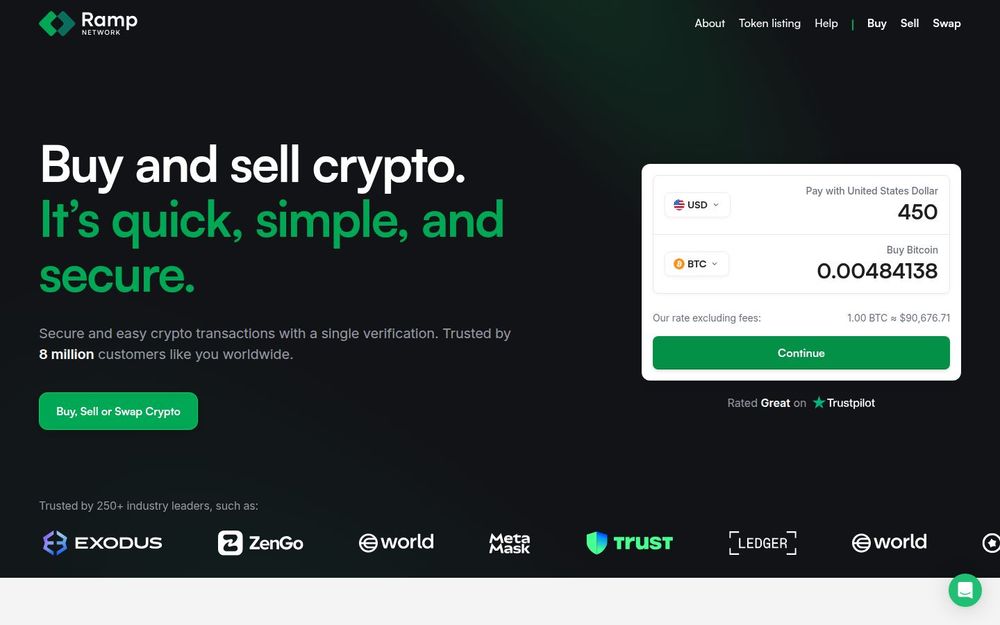
Ramp Network is a consumer‑facing Web3 payments and fiat‑to‑crypto infrastructure provider designed to make the process of acquiring, selling, and swapping digital assets approachable for everyday users. Built as a lightweight checkout and routing layer, Ramp connects traditional payment rails (cards, Apple Pay, local bank transfers) with on‑chain destinations, enabling funds to be sent directly into self‑custodial wallets or partner platforms without forcing users through a full exchange account. The company highlights user experience, global availability, and compliance alongside integrations with major wallets and custodial tools.
Core capabilities
Ramp offers a number of capabilities designed to remove common friction when onboarding users into crypto:
-
Single verification KYC: One identity verification unlocks purchases across hundreds of wallets and integrated services, reducing repeat identity flows and speeding customer journeys.
-
Best‑in‑class pricing: Ramp advertises highly competitive rates and savings on network fees (notably for BTC transfer routing) compared with many conventional exchanges.
-
Flexible payments & tokens: Support for many payment options — cards, Apple Pay, local rails like PIX, and regionally specific methods — and a broad token catalog covering major coins and many ERC‑20 tokens.
-
Global coverage and compliance: Availability in 150+ countries, with regulatory registrations (FinCEN in the U.S., FCA in the U.K., CBI in Ireland) and industry certifications such as SOC 2.
-
Direct to self‑custody: Ramp can send purchased crypto directly to user‑controlled wallets (Metamask, Ledger, Trust Wallet, Exodus, and others) to promote private key ownership rather than custodial holding.
Key features explained
-
One KYC for many partners: By centralizing verification, Ramp reduces friction for users who want to buy crypto via different wallets or third‑party products. This is particularly valuable for mobile wallet ecosystems or when integrating a buy flow into multiple apps.
-
On‑ramp and off‑ramp flows: Ramp supports buying (on‑ramp), selling (off‑ramp), and swapping flows. It also partners with services like BitPay for off‑ramp and integrates with wallet providers to simplify transfers.
-
Security and compliance posture: Ramp emphasizes security practices and third‑party attestations. Holding SOC 2 and maintaining registrations with multiple regulators underscores their approach to risk management, monitoring, and controls.
-
Mobile and widget experiences: There are native mobile apps and embeddable checkout widgets for partners, allowing brands and wallets to embed Ramp’s flows without building payments infrastructure from scratch.
Why choose Ramp Network
Ramp is aimed at users and partners who want a low‑friction, compliant, and wallet‑centric pathway between fiat and crypto. Its biggest strengths are user experience, broad integrations with popular wallet providers, and a compliance‑forward stance that eases enterprise adoption. The service is attractive when the goal is to avoid complex exchange onboarding, to route funds directly to self‑custody, or to provide a fast, multi‑rail payments experience for global customers.
Considerations and risks
Ramp is a payments and routing layer — it does not eliminate the financial risk inherent in cryptocurrency markets. The platform displays explicit risk warnings: users should be prepared to lose their invested funds. Geographic availability, transaction limits, fees, and KYC requirements vary by jurisdiction, and end users should review local terms and restrictions before using Ramp’s flows.
Final notes
Ramp Network positions itself as a pragmatic bridge between traditional finance and Web3: a merchant‑grade payments stack, broad wallet partnerships, and a focus on simplicity for mainstream users. For businesses and wallets looking to add buy/sell capabilities quickly and compliantly, Ramp offers a mature, security‑oriented option that prioritizes direct delivery to self‑custody and a streamlined customer journey.


