


Overview
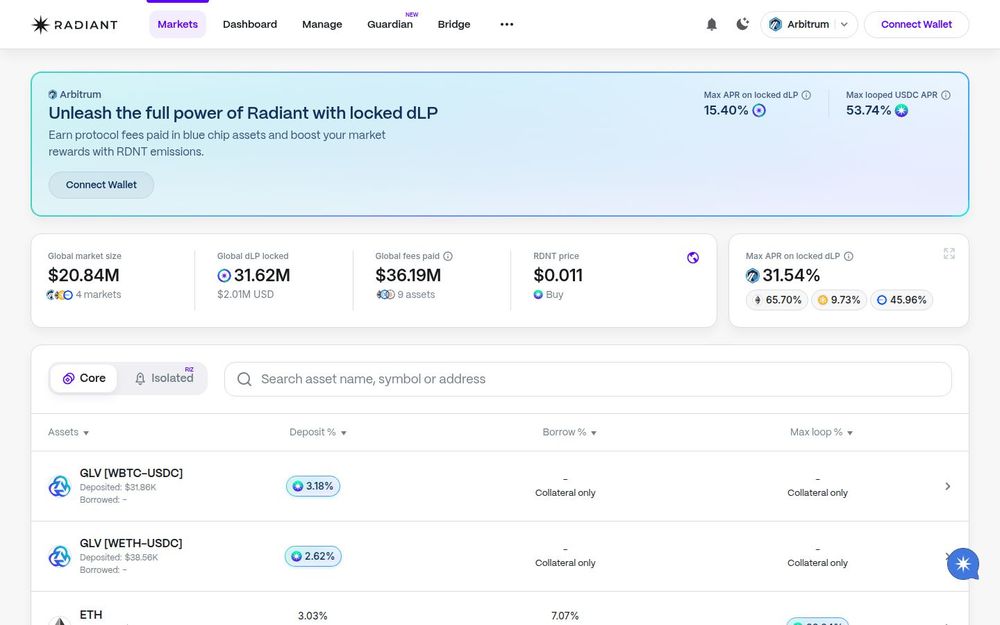
Radiant is a decentralized, non-custodial lending protocol that lets users deposit assets to earn yield, borrow against collateral, and participate in incentive programs. The platform emphasizes on‑chain fee sharing and token incentives: users can lock dLP tokens to receive a share of protocol fees (paid in blue‑chip assets) and to boost market rewards through RDNT emissions. Radiant presents per-asset interest rates, market-level metrics and global statistics such as total dLP locked and fees paid, and is accessed via a wallet connection flow (Connect Wallet).
Core Capabilities
-
Lending & Borrowing: Deposit assets like USDC, ETH, WBTC, USDT to earn interest and open borrow positions using supported collateral. The UI surfaces deposit APRs and borrow APRs for each asset so users can compare rates and utilization.
-
Locked dLP & Fee Sharing: Locked dLP is a special tokenized position that, when locked, entitles holders to a portion of protocol fees paid in high‑quality assets and increases RDNT reward emissions. The dashboard reports Max APR on locked dLP values for different assets and chains.
-
RDNT Incentives & Emissions: Radiant distributes its native token RDNT as market rewards. RDNT boosts effective yields for depositors and stakers and is integrated into deposit/borrow APRs shown across markets.
-
Looping / Leverage Mechanics: The platform supports looping strategies (repeatedly borrowing and re-depositing) to amplify yield — visible as Max looped USDC APR figures. These mechanics can greatly increase potential returns but also carry elevated risk.
-
Multi‑market & Multi‑asset Support: Radiant offers multiple market configurations (e.g., Core, Isolated) and supports numerous assets across different chains (the UI shows chain icons and named markets). Each market displays deposited and borrowed amounts, deposit % and borrow % rates, and additional metrics such as max loop percentages.
How it works
Users connect a wallet and interact with markets to deposit assets or take out loans. Depositors earn base interest plus RDNT rewards; borrowers pay interest and may face collateral/health parameters depending on the market type (Core vs. Isolated). To participate in protocol fee sharing, users lock dLP tokens — this grants rights to a share of fees collected by Radiant and increases RDNT emission weight for the holder.
Markets & Metrics
Radiant’s interface shows per‑asset metrics (deposited, borrowed, deposit %, borrow %, RDNT APR components) and global figures such as Global market size, Global dLP locked, and Global fees paid (examples displayed: global market size ~$20.84M, RDNT price listed at $0.011). Several assets have prominently displayed APRs (for example, looped USDC APRs above 50% in highlighted scenarios), and the dashboard summarizes the number of markets and supported assets.
Why consider Radiant
- Non‑custodial control with direct wallet interactions.
- Fee sharing via locked positions provides an unusual on‑chain revenue stream denominated in blue‑chip assets.
- Reward layering (base interest + RDNT emissions + fee share) can materially increase effective yields for active users.
Getting started & precautions
Connect a compatible wallet, review market rates and collateral requirements, and start with small deposits to understand mechanics such as looping and locked dLP. Be aware that high APY opportunities often come with higher protocol and liquidation risk. Carefully consider token price risk (RDNT price volatility), smart contract risk, and the implications of leverage.
Conclusion
Radiant targets users seeking composable, incentive‑driven lending and borrowing on‑chain with the additional feature of protocol fee sharing through locked dLP. The protocol provides clear per-asset data and global metrics to inform decisions, but users should balance yield potential with the inherent risks of leverage and decentralized finance smart contract exposure.


