


Overview
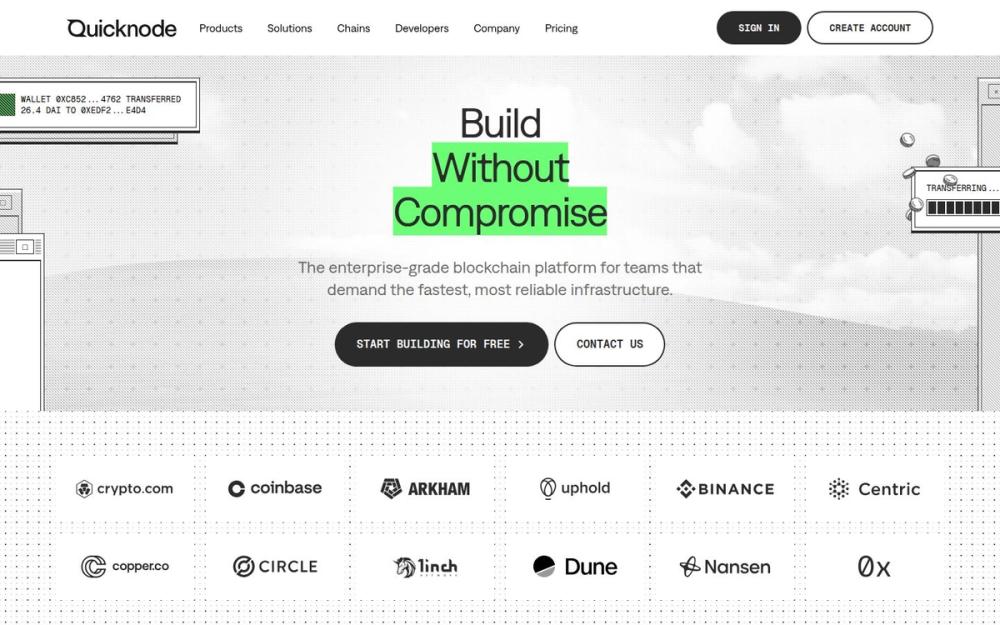
QuickNode is an enterprise-focused blockchain infrastructure provider built to let teams "Build Without Compromise." It offers a globally distributed, auto-scaling network that exposes performant RPC endpoints, real-time streaming and webhook pipelines, historical backfills, and a marketplace of partner integrations. QuickNode is designed to reduce operational overhead for developers and companies building on multiple chains by delivering reliable uptime, predictable performance, and enterprise-grade security and support.
Core Capabilities
-
Low-latency RPC Endpoints: QuickNode’s Core API provides globally distributed access to blockchain nodes, enabling developers to spin up endpoints quickly and serve production traffic with minimal latency. The platform supports full and archive access across dozens of chains, optimizing for both speed and data completeness.
-
Real-time Streams & Webhooks: Stream on-chain events as they occur with built-in reorg handling, data transformations, and guaranteed delivery. These capabilities power wallets, analytics, monitoring, and trading pipelines by delivering filtered or raw event data to destinations of choice with reliability.
-
Historical Backfills: Reconstruct past on-chain activity with guaranteed sequential delivery and flexible batching. Backfills let teams resync or populate analytic systems and ensure historical data is consistent with live streams.
-
Enterprise Dedicated Clusters & Monitoring: For mission-critical applications, QuickNode offers private, isolated infrastructure (dedicated clusters) with performance SLAs, Prometheus exporter support, extended log retention, and advanced visibility into system health.
-
Integrated Marketplace & Ecosystem: A curated marketplace connects builders to add-ons such as DeFi data providers, MEV protection, analytics tools, and exchange integrations—enabling faster feature expansion and reducing integration friction.
Performance & Scale
QuickNode emphasizes speed and reliability: public metrics highlight 17x faster response times compared to some alternatives, 99.99% uptime, and the capacity to handle hundreds of billions of requests monthly. The platform supports over 78 chains across 130+ networks and is used by teams that require sustained high throughput, burst RPS handling, and predictable performance during peak events.
Security, Compliance & Support
QuickNode is positioned for enterprise adoption with multi-layered security controls and compliance auditing (SOC 1, SOC 2, ISO 27001). Security features are combined with priority, around-the-clock support for enterprise customers, offering fast incident response, direct access to engineers, and assistance for tight launch timelines.
Use Cases & Vertical Focus
The platform is tailored for a wide range of blockchain use cases including DeFi, trading, gaming, wallets, AI-blockchain integrations, and financial services. Typical uses include low-latency market data feeds, high-throughput wallet backends, NFT and gaming transaction pipelines, and analytics stacks that rely on consistent historical indexing.
Why Choose QuickNode
- Speed and reliability for production workloads that need low latency and high uptime.
- Operational simplicity: managed endpoints and streaming pipelines reduce the need to run and maintain node fleets.
- Enterprise readiness: dedicated infrastructure, compliance certifications, and 24/7 priority support.
- Extensibility through a marketplace of integrations to quickly add analytics, security, and DeFi primitives.
Getting Started
Developers can start for free by creating an endpoint or exploring Streams and Marketplace offerings. Enterprises can engage sales for dedicated clusters, SLAs, and onboarding support. QuickNode’s documentation, dashboards, and monitoring integrations help teams migrate and scale confidently while minimizing time-to-market.
QuickNode aims to provide the infrastructure primitives needed to power modern blockchain applications at scale—combining speed, reliability, and enterprise features to let teams focus on building rather than maintaining infrastructure.


