


Overview
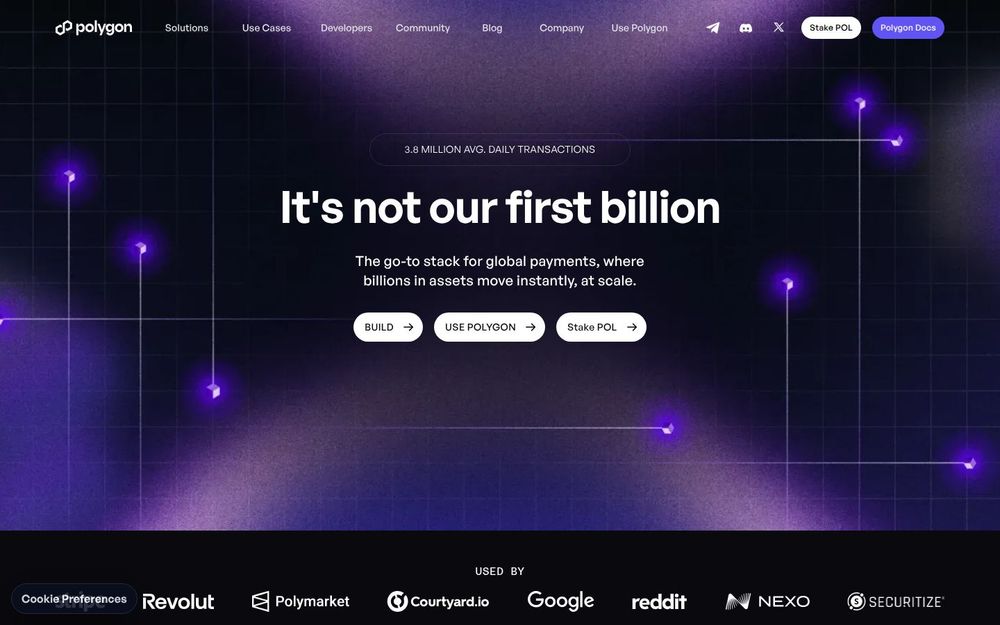
Polygon is a blockchain platform and infrastructure stack designed to enable real-time, low-cost, and highly scalable movement of value on the internet. Built with a focus on payments, stablecoins, tokenization, and DeFi, Polygon markets itself as the rails where billions in assets can move instantly and globally. With an emphasis on enterprise readiness, deep liquidity, and developer tooling, Polygon aims to replace legacy slow and expensive payment rails with blockchain-native primitives.
Core Capabilities
-
High Throughput & Fast Finality: Polygon offers low latency and fast settlement—on the order of seconds for finality and blocktimes optimized for real-time user experiences. This supports payment flows that need immediate confirmation and user-facing products that cannot tolerate long waits.
-
Extremely Low Fees: The network advertises sub-cent transaction costs, making on-chain settlement economically viable compared to legacy wires. Low fees enable micropayments, high frequency flows, and inexpensive cross-border value transfer.
-
Enterprise-Ready Tooling: Polygon bundles infrastructure commonly required by businesses — wallets, onramps, compliance-ready integrations, and staking/gas token mechanisms — so enterprises can adopt blockchain rails with fewer custom components.
-
Stablecoin & Liquidity Depth: Polygon hosts billions in stablecoin supply and a vibrant liquidity ecosystem, enabling seamless access to major assets and on-chain liquidity without prolonged discovery or cold starts.
-
Account Abstraction & UX Enhancements: Polygon invests in abstraction features to improve user experience—social login, sponsored gas, social recovery, and simplified onboarding—so products can offer familiar payment flows while relying on blockchain integrity.
Key Features and How They Help
-
Payments Infrastructure: Designed for continuous uptime and reliability, Polygon caters to products that require never-pausing payments, including weekend settlement and millisecond user flows.
-
Tokenization & RWA Support: Polygon provides rails for tokenized real-world assets with a focus on reputation, distribution, and infrastructure suited for high-value asset flows.
-
DeFi Composition: With broad DeFi integrations, Polygon enables borrowing, swapping, and liquidity tapping across borders, letting products plug into an ecosystem of composable financial primitives.
-
Ecosystem & Distribution: Large existing address base and active user counts lower user acquisition friction for new apps, as the chain already aggregates liquidity and participants.
Why Choose Polygon
Polygon is positioned as a practical, production-grade blockchain stack for businesses that need money to move like data—instantly, with predictable cost and predictable performance. The platform highlights enterprise-specific advantages such as pre-integrated compliance options and UX-focused abstractions to lower integration friction. For firms exploring tokenization, stablecoins, or payment modernization, Polygon promotes a mature liquidity landscape and a roadmap aimed at sustained scaling (from thousands to hundreds of thousands TPS).
Use Cases and Adoption
Polygon is used across payments, stablecoin issuance and circulation, tokenized asset marketplaces, and DeFi services. Prominent partnerships and integrations demonstrate real-world production usage—companies leveraging Polygon can reduce wire costs, accelerate settlement times, and tap into a global audience already active on-chain. The native POL token secures the network and serves as gas for transactions and staking, helping align economic incentives for validators and ecosystem participants.
Getting Started
Developers and businesses can begin by consulting Polygon’s documentation and developer portal, integrating wallets and onramps, and leveraging existing stablecoin liquidity. With a range of tutorials, reference implementations, and enterprise support, teams can prototype and scale payment-enabled products that deliver fast settlement, low fees, and modern user experiences while relying on a robust and production-proven infrastructure.
Conclusion
Overall, Polygon aims to be the foundational rails for the internet of money: combining speed, cost-efficiency, and enterprise tooling to enable real-time value movement, broad liquidity access, and simplified developer integration. Whether your focus is payments, tokenized assets, or composable DeFi, Polygon presents a full-stack, scalable environment for building next-generation financial products.


