


Overview
BRC20 is a community-driven token standard that appeared within the Bitcoin ecosystem as part of the Ordinals revolution. It was popularized in early 2023 and represents a minimalist token convention that uses inscription-based data on Bitcoin to approximate fungible tokens. The Geniidata page at /ordinals/index/orc20 surfaces BRC20 (and related labels like Runes and Collections) and aims to serve as an indexer and analytics dashboard for these on-chain token experiments.
Core Capabilities
-
1. Indexing and Discovery: The platform collects and displays token listings, collections, and related artifacts tied to ordinals-based token standards.
-
2. Market Metrics: It exposes fields for 24H volume, total market cap, price ticks, supply, holders, and transactions, enabling market monitoring when data is available.
-
3. Collection and Token Tabs: The UI groups assets into Collections, BRC20, and other categories (e.g., Runes), making it easier to navigate different token types.
-
4. Alerts and Notifications: The interface provides features like Create Alert and confirmation modals for user actions, which help users track token events.
-
5. Mobile App Integration: The site prompts users to Install our app for an enhanced mobile experience, indicating cross-platform access and better UX on mobile devices.
How It Works
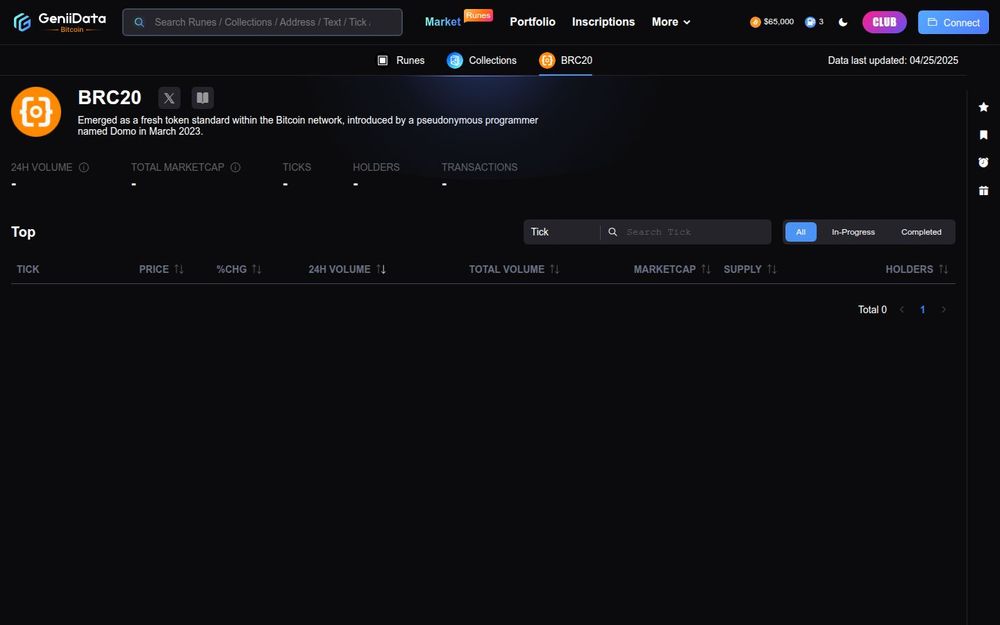
Geniidata’s index page gathers on-chain inscriptions and token-related events from the Bitcoin network and organizes them into web-presentable records. For BRC20 tokens, this means parsing transactions and inscription payloads that follow the community-driven conventions for naming, supply, and issuance. The indexer then attempts to compute derived metrics such as trading volume, total supply, and holder counts. On the specific page snapshot provided, many metric fields are shown but not populated, which suggests gaps in available trading data or a temporary sync state.
Data & Indexing Details
The page shows placeholders for core metrics: 24H VOLUME, TOTAL MARKETCAP, TICKS, HOLDERS, and TRANSACTIONS. When fully populated, these fields help traders and researchers evaluate token activity and liquidity. The page also shows asset images and category icons (e.g., Runes, Collections), and includes a ‘Data last updated’ timestamp, which in the provided snapshot reads 04/25/2025. This timestamp indicates the indexer tracks update time for transparency.
Use Cases
-
Developers and protocol researchers can use the indexer to observe how inscription-based token standards behave on-chain over time.
-
Traders and collectors can monitor token listings, price ticks, and collection activity to find opportunities or track asset provenance.
-
Wallet and dApp integrators can reference the indexer to display token metadata and supply/holder summaries in their UIs.
Why Use This Indexer / Recommended Reasons
-
Centralized view of Ordinals-based tokens: It aggregates different inscription-token types (BRC20, Runes, Collections) in one interface.
-
Metric visibility: When data is available, the indexer surfaces important trading and on-chain metrics that aid decision-making.
-
User-friendly features: Alerts, confirmations, and a mobile app prompt suggest a product designed for both casual users and serious observers.
Getting Started
To begin, users typically browse collections or the BRC20 tab, inspect individual ticks or token entries, and enable alerts for tokens of interest. For developers, integrating with the indexer may require consulting any available API documentation or scraping public pages for the specific index paths (for example /ordinals/index/orc20) to obtain structured data.
Limitations & Considerations
-
Data completeness: The snapshot shows many empty metric fields, indicating that data availability can be limited depending on market activity, indexer coverage, or syncing delays.
-
Standard maturity: BRC20 and similar inscription-based token models are exploratory and differ from established smart-contract token standards, which affects tooling, security assumptions, and interoperability.
-
Attribution: Token conventions are community-driven and may lack centralized verification, so on-chain provenance and issuer claims should be independently validated.
Conclusion
The Geniidata index page for BRC20 (accessible under /ordinals/index/orc20) provides a focused entry point to explore Bitcoin inscription-based tokens and collections. It emphasizes indexing, metric exposure, and user-facing features such as alerts and mobile integration. While promising for discovery and analytics, users should be mindful of data gaps and the experimental nature of inscription token standards when making decisions based on the displayed metrics.


