


Overview
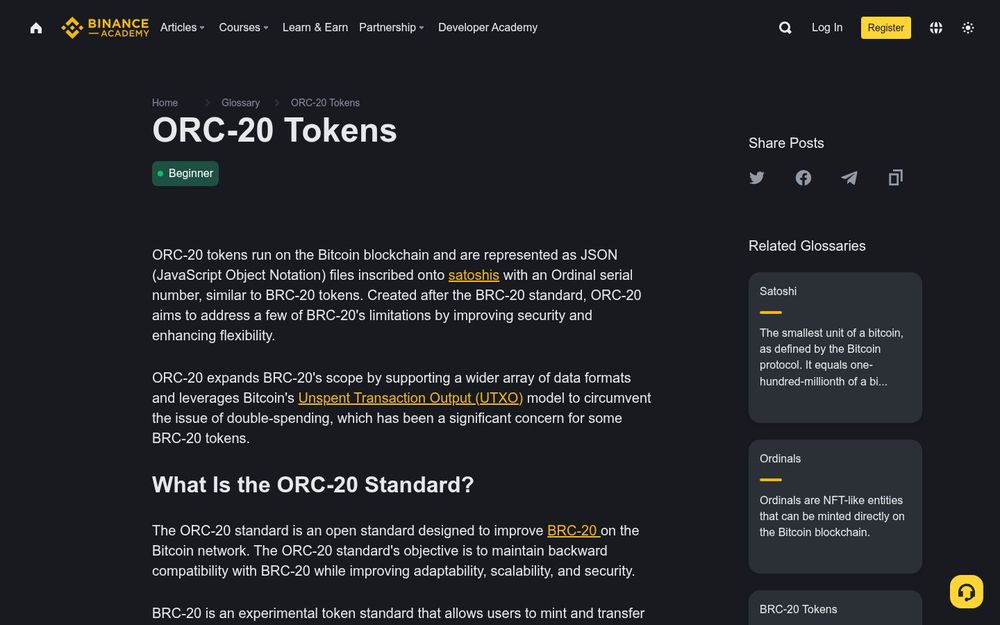
ORC-20 is an open, experimental token standard built on top of the Ordinals protocol to enable fungible tokens on the Bitcoin blockchain. It represents token metadata as JSON files inscribed onto individual satoshis and is intended to improve on the earlier BRC-20 standard. The core goals of ORC-20 include maintaining backward compatibility with BRC-20 while increasing adaptability, enhancing security, and expanding the kinds of data formats that the token standard can support. ORC-20’s design leverages Bitcoin’s UTXO model to address specific limitations of BRC-20, notably double-spending concerns and naming constraints.
Core Capabilities
-
UTXO-based transfer model: ORC-20 uses Bitcoin’s Unspent Transaction Output (UTXO) model for token transfers. By tying token state to UTXOs, each spend invalidates the previous inscribed balance, which helps prevent double-spending vulnerabilities observed in some earlier token designs.
-
Flexible data format support: Unlike more restrictive standards, ORC-20 expands the scope of supported data formats. By allowing a broader array of data types in the JSON inscriptions, developers can encode richer metadata and adapt token behaviors to different use cases.
-
Backward compatibility with BRC-20: ORC-20 aims to remain compatible with the existing BRC-20 ecosystem. This allows for migration paths where existing BRC-20 tokens can be ported to ORC-20 implementations while preserving ecosystem value and liquidity.
-
Nonce-enabled transactions: ORC-20 supports nonces within transfer events. A nonce serves as a unique identifier for a specific send, enabling the sender to cancel or reverse a partial transaction that has not been fully processed. This adds a layer of transactional control not natively present in some earlier ordinal token schemes.
-
Flexible naming space: To address naming limitations in BRC-20, ORC-20 introduces a more flexible naming scheme that reduces collisions and constrains fewer reserved names, giving creators greater freedom when minting and registering tokens.
How ORC-20 Works
ORC-20 inscriptions are stored as JSON attached to satoshis via the Ordinals protocol. When an ORC-20 token is minted, the token’s metadata—including supply, symbol, and relevant instructions—is inscribed. Transfers create new UTXOs that reference the inscription state; when a UTXO is spent, the prior state is rendered invalid, aligning token accounting with Bitcoin’s native transaction model. Nonces can be included in send events to uniquely mark those events and allow for controlled rollback or cancellation in specified scenarios.
Use Cases and Advantages
ORC-20 is suitable for projects that want fungible token functionality anchored to Bitcoin’s security model and immutable ledger. Potential use cases include community tokens, utility tokens tied to Bitcoin-native services, and experimental financial tokens where the provenance and immutability of inscriptions are desirable. Advantages include improved double-spend resistance, greater expressive power in metadata, and migration compatibility for BRC-20 projects.
Risks and Considerations
ORC-20 is experimental and carries technical and market risks. The standard introduces complexity in inscription management and token lifecycle, and it may not provide meaningful advantages for every project compared to existing standards. Community adoption will determine ORC-20’s long-term viability. Users and developers should perform due diligence, thoroughly test implementations, and weigh trade-offs such as inscription cost, indexability, and wallet support before committing significant value.
Recommendation
ORC-20 offers promising technical refinements for ordinal-based fungible tokens on Bitcoin, particularly for projects that need UTXO-aligned accounting and richer metadata. However, because the standard and tooling are still evolving, cautious experimentation and phased migration strategies are advisable until broader ecosystem support and best practices solidify.


