


Overview
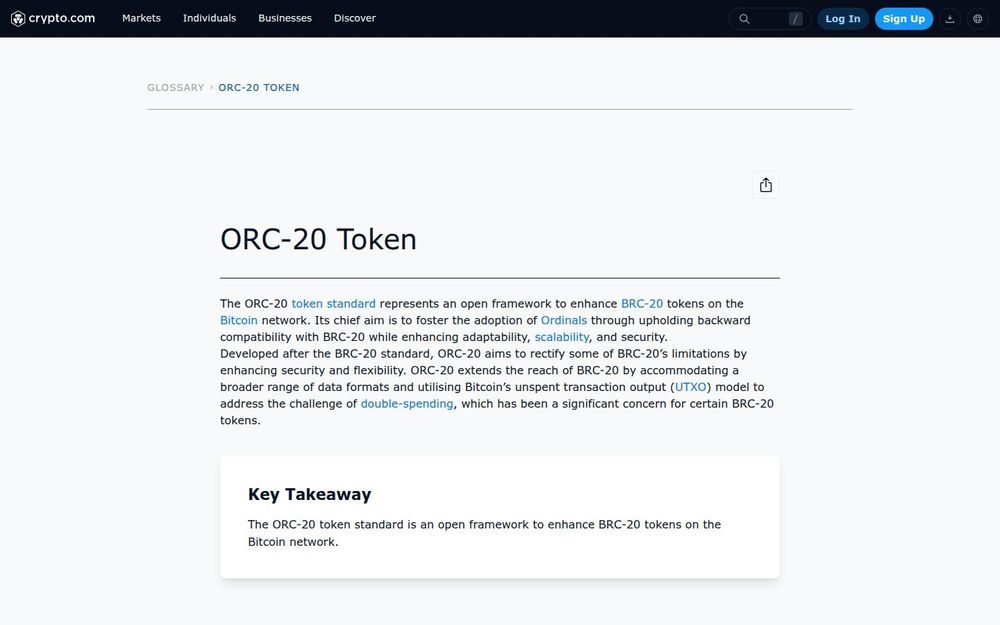
The ORC-20 token standard is an open framework created to enhance BRC-20 tokens on the Bitcoin network while remaining backward compatible. Its core objective is to accelerate adoption of Ordinals-based tokens by improving security, flexibility, and scalability relative to earlier token efforts built on top of Bitcoin. ORC-20 is positioned as an incremental evolution rather than a replacement, extending the BRC-20 model to support a wider range of data formats and leveraging Bitcoin’s native UTXO (unspent transaction output) design to address integrity and double-spend concerns. This makes ORC-20 particularly relevant for developers and projects seeking to issue programmable assets or NFTs that interact cleanly with Ordinals conventions.
Core Capabilities
-
Backward compatibility with BRC-20: ORC-20 maintains compatibility with the established BRC-20 convention so existing tokens and tooling can adapt with minimal disruption.
-
Enhanced security via UTXO-aware design: By explicitly accounting for the UTXO model in token operations, ORC-20 reduces the likelihood of problematic behaviors such as accidental double-spending and mis-attributed state transitions.
-
Support for broader data formats: ORC-20 enables a more flexible set of payload types compared with BRC-20, allowing token metadata and instruction formats to accommodate richer content and diverse use cases.
-
Improved scalability and operational clarity: The standard is designed to optimize how token operations are represented on-chain, making it easier to batch, index, or validate token events at scale.
-
Ordinals-first interoperability: ORC-20 is intended to work well with the Ordinals protocol, ensuring token inscriptions and ownership markers remain compatible with common Ordinals tooling and marketplaces.
Technical Details and Features
ORC-20 focuses on pragmatic improvements rather than radical protocol changes. Key technical considerations include defining clear conventions for how token actions (mint, transfer, burn, etc.) are encoded within inscriptions or transactions, and specifying validation rules that take UTXO behavior into account. The standard encourages deterministic indexing and straightforward parsing so wallets, explorers, and marketplaces can reliably interpret token state. It also places emphasis on minimizing ambiguous edge cases that could arise from complex transaction flows or non-standard inscription payloads.
Use Cases
-
Tokenized collectibles and Ordinals-native NFTs that require precise ownership and transfer semantics.
-
Fungible or semi-fungible tokens issued on Bitcoin for specialized communities or utility purposes where compatibility with Ordinals is desirable.
-
Layered tooling such as wallets, marketplaces, and indexing services that need a dependable standard to interpret token events and preserve historical accuracy.
Advantages and Trade-offs
Why choose ORC-20? It offers a path to greater robustness without abandoning the BRC-20 ecosystem, enabling developers to leverage improved security assumptions and richer data handling while preserving existing market and tooling investments. The trade-offs are typical of standards evolution: adoption requires coordination among tooling providers and token issuers, and ecosystem fragmentation could occur if multiple variant conventions proliferate. However, by focusing on compatibility and clear UTXO-aware semantics, ORC-20 seeks to limit fragmentation and provide upgrade paths.
Recommendation and Adoption Considerations
Adopters should evaluate whether their token behaviors benefit from UTXO-aware validation and broader data format support. Projects already relying heavily on BRC-20 should weigh migration complexity against the security and flexibility gains. Tooling providers—wallets, explorers, marketplaces, and indexers—should prioritize support for ORC-20 parsing rules to ensure tokens using the standard are discoverable and usable in the broader Ordinals ecosystem.
Conclusion
ORC-20 is a practical evolution of BRC-20 that targets the real-world needs of Ordinals-based tokens on Bitcoin. By combining backward compatibility, UTXO-conscious security, and expanded data flexibility, it aims to make token issuance and lifecycle management more reliable and extensible. For teams building on Bitcoin with Ordinals, ORC-20 represents a meaningful step toward more mature, interoperable token standards.


