


Overview
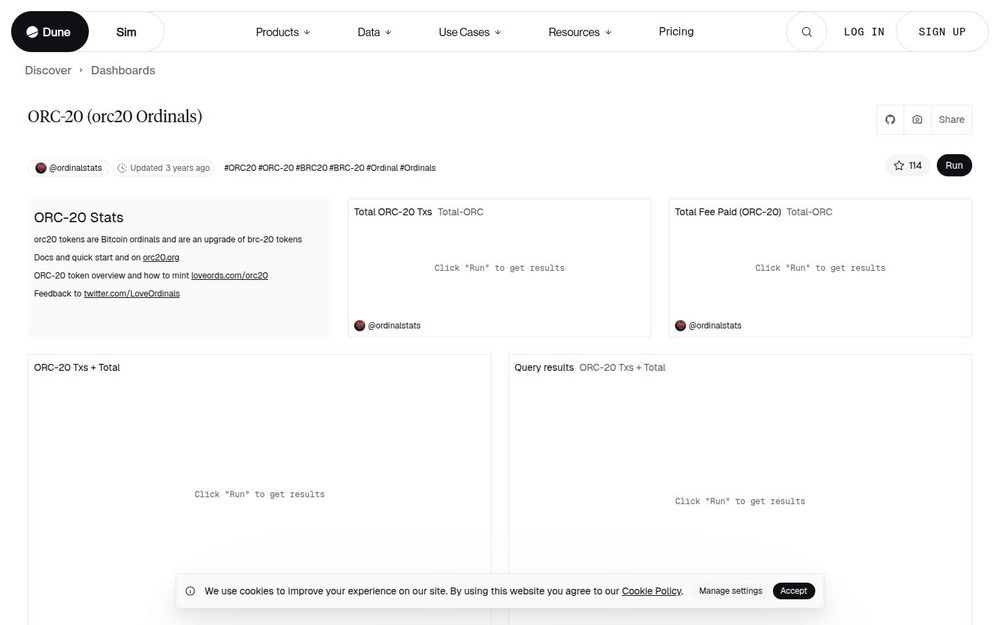
The ORC-20 page on Dune is a specialized analytics dashboard focused on the ORC-20 token standard and Ordinals activity on Bitcoin. It leverages Dune’s data infrastructure to collect, normalize, and visualize on-chain events related to ORC-20 tokens—such as minting, transfers, holder counts, and supply metrics—so users can quickly assess ecosystem health and token dynamics. The presentation typically combines charts, tables, and interactive filters, allowing both high-level trend observation and granular transaction inspection.
Core Capabilities
-
On-chain Metrics and Visualizations: The dashboard provides time-series charts and summary tables for key metrics like total supply, daily transfer volume, number of active wallets, and newly minted tokens. These visualizations help spot trends and anomalies in ORC-20 activity.
-
Holder and Distribution Analysis: Users can examine concentration metrics, top-holder lists, and distribution curves to understand how ORC-20 supply is allocated across wallets. This capability is essential for assessing centralization risk and identifying influential accounts.
-
Transaction-level Drill-downs: The platform supports detailed inspection of individual transactions and events, enabling users to trace token flows, wallet interactions, and significant transfers that affect token dynamics.
-
Custom Querying and Reproducibility: Leveraging Dune’s SQL-based environment, the dashboards are either backed by or accompanied with queries that can be copied, modified, and executed by users. This enables custom analyses, replication, and the development of derivative dashboards.
-
Shareability and Collaboration: Dashboards on Dune are shareable and often community-maintained. Users can fork dashboards, embed charts, and share links to specific visualizations or query results for collaboration or reporting.
Key Features and Practical Use Cases
-
Trend detection: Analysts use the ORC-20 dashboard to detect rising or waning interest in particular tokens by monitoring trading and transfer volumes.
-
Risk assessment: By examining holder concentration and top holder movements, risk managers can estimate the probability of price impact from large transfers.
-
Research and discovery: Researchers can identify novel token behavior, such as sudden minting surges or coordinated transfers, and follow up with on-chain forensic queries.
-
Investor monitoring: Traders and portfolio managers can watch wallet activity and distribution changes that may signal accumulation or distribution phases.
Why Use the Dune ORC-20 Dashboard
Dune’s ORC-20 visualization provides a unified, queryable snapshot of Ordinals token activity that is difficult to assemble elsewhere without engineering effort. The dashboard condenses raw on-chain events into meaningful metrics and offers transparent queries that underpin the visualizations, enabling reproducibility and customization. For participants in the ORC-20 ecosystem—developers building token tooling, researchers mapping on-chain behavior, or traders monitoring liquidity—the dashboard reduces friction by making complex data accessible through interactive charts and open queries.
Recommendations
-
If you need a quick overview of ORC-20 activity, start with the summary metrics and time-series charts to understand momentum.
-
For deeper insight, copy the underlying SQL queries and adapt them to filter by token, time range, or wallet set; this turns a static dashboard into a tailored analytics tool.
-
Use holder distribution and top-transfer views to assess concentration risk before making large trades or deploying protocol changes tied to ORC-20 assets.
Conclusion
The ORC-20 Dune page is a practical entry point for anyone looking to quantify and explore token-level activity within the Ordinals space. It combines visual analytics with reproducible queries and sharing capabilities, making it useful for both one-off research and ongoing monitoring of the evolving ORC-20 ecosystem.


