


Overview
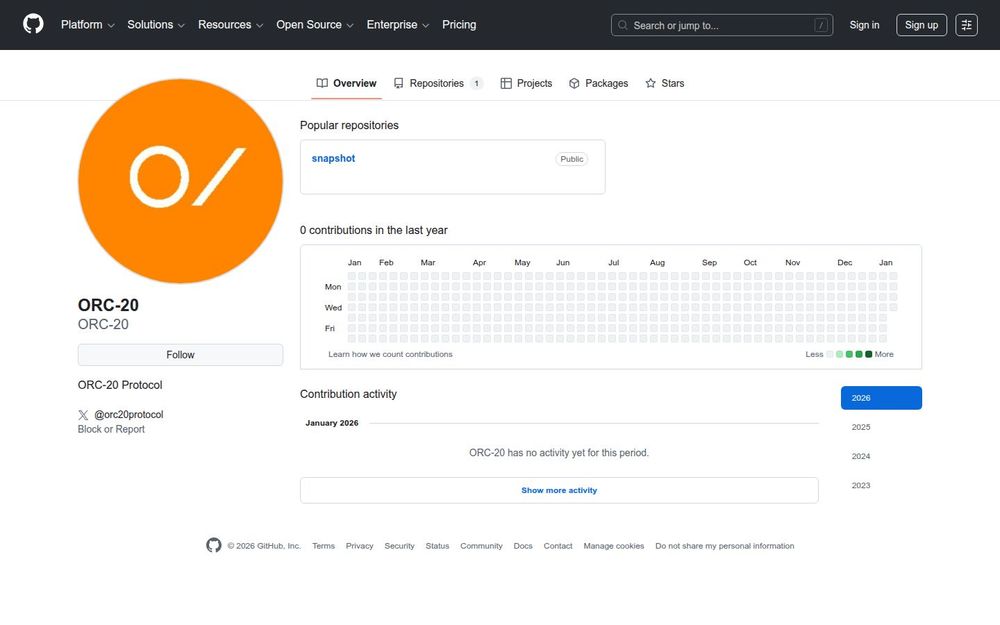
ORC-20 is represented on GitHub as the ORC-20 Protocol. The visible profile information is concise: it highlights the protocol name, provides a link to an X (Twitter) account (@orc20protocol), and exposes at least one public repository called snapshot. The GitHub page follows the standard layout for a public account with sections for Overview, Repositories, Projects, Packages, and Stars. Activity indicators on the profile show very low or no recent contributions, which may mean the account is primarily a repository host, a documentation hub, or that development happens off-GitHub or through other channels.
Core Capabilities
-
Protocol Identity: The profile serves as the canonical GitHub identity for the ORC-20 Protocol, providing a single place to surface repositories, documentation, and community links.
-
Repository Hosting: The account lists public repositories (for example, snapshot). These repositories can contain reference implementations, tooling, specifications, or other assets related to the protocol.
-
Community Linkage: The presence of an X (Twitter) handle suggests a channel for public communication, announcements, and community coordination beyond GitHub’s issue and discussion systems.
Key Features
-
Protocol Specification and Documentation: The GitHub account is positioned to host formal specifications, README documentation, and usage guides that describe how the ORC-20 Protocol is intended to work.
-
Reference Repositories and Tooling: Public repositories such as snapshot can contain reference implementations, developer tools, or scripts that help implementers interact with or test the ORC-20 standard.
-
Community & Communication Links: With an external social link to @orc20protocol, the profile provides avenues for broader outreach, updates, and community feedback.
-
Package and Project Management: The account structure supports projects, packages, and repository management, which could be used for release artifacts, CI configurations, and coordinated development when active.
-
Governance & Reporting Controls: Standard GitHub features shown on the page—such as block/report options and contribution graphs—support transparent community moderation and visibility into account activity.
Getting Started
To explore ORC-20 on GitHub, visitors should review the listed repositories (starting with snapshot), read any available README files or documentation, and follow the linked X account for announcements. If code or a spec is present in the repositories, cloning or forking the project is the usual next step for developers who want to experiment, build integrations, or contribute.
Community & Activity
The visible contribution calendar indicates near-zero activity in the last year. That may reflect a dormant project, a newly created account, or that primary development occurs elsewhere (for example, in private repos, other platforms, or through separate developer communities). When community activity is limited on GitHub, it’s useful to check the project’s social channels, issue trackers, or linked websites for additional context and coordination.
Why Consider ORC-20
If you are researching token standards or protocol projects, a GitHub profile named ORC-20 can serve as a starting point to locate formal documentation, reference code, and community links. Even with limited visible activity, the account centralizes project assets and provides the usual GitHub infrastructure for collaborative development, releases, and issue-based communication.
Notes and Limitations
The public profile contains sparse detail beyond the protocol name, a social link, and the presence of at least one public repository. For authoritative technical details, specifications, or active development status, consult repository READMEs, linked social channels, or other official project resources that the account references.

