


Overview
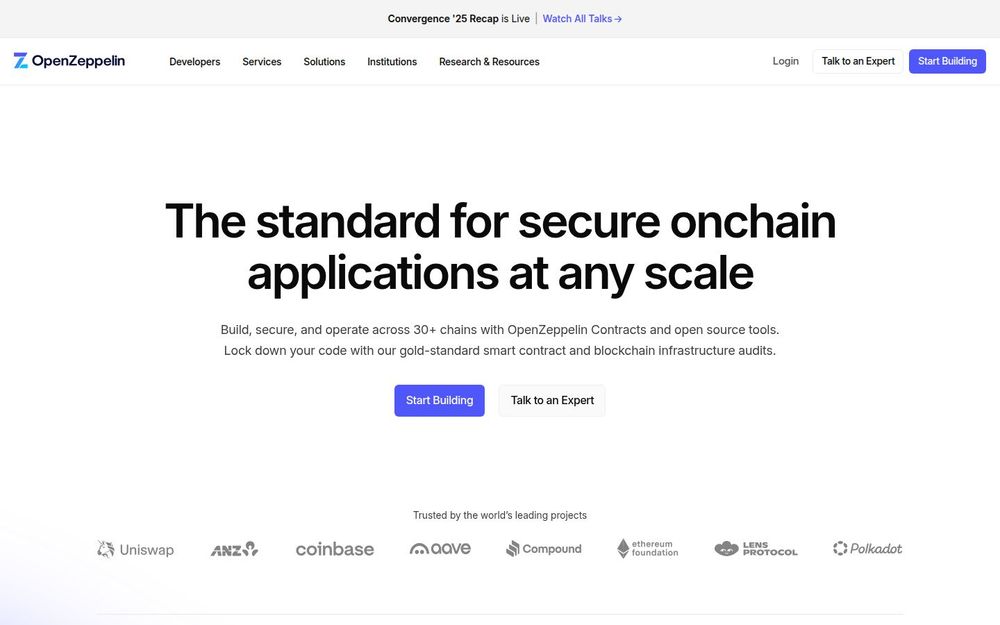
OpenZeppelin is a recognized industry standard for building, securing, and operating onchain applications at scale. The organization combines a battle-tested, open source contracts library with professional security services and operational tooling so teams can accelerate development while minimizing risk. OpenZeppelin’s offerings span the full lifecycle of smart contract projects: from templates and libraries used in production to audits, monitoring, and transaction orchestration services for live systems. Their community contributions, educational initiatives, and participation in standards work make them both a practical toolkit and a governance-minded steward of best practices in the Ethereum and broader blockchain ecosystems.
Core capabilities
-
Contracts Library: The OpenZeppelin Contracts collection provides modular, audited, and reusable components for common smart contract patterns like ERC20, ERC721, ERC1155, access control, upgradeability, and safe math utilities. These components are designed for composability and ease of integration into new or existing projects.
-
Security Audits & Advisory: OpenZeppelin’s security researchers perform comprehensive code reviews, vulnerability assessments, and advisory services. Their audits cover smart contracts, zero-knowledge proofs (ZKP), and infrastructure, and often include remediation guidance and follow-up verification.
-
Defender — Operate Tools: Defender is a suite for operating onchain systems with features such as Relayer (transaction API and secure key management), Monitor (pre-built templates for risk detection and automated response), and governance tools to manage upgrades and multisig workflows.
-
Developer Tooling & Templates: The platform offers deployment wizards, templates, and plugins for popular toolchains (Foundry, Hardhat) and language support for Solidity, Cairo, and other smart contract stacks. Quick-start templates for token contracts, governance contracts, and upgradeable patterns reduce time-to-market.
-
Community & Public Goods: OpenZeppelin maintains educational resources like Ethernaut (a smart contract security CTF), publishes documentation and reference implementations, and contributes to ERC/EIP standards including account abstraction and upgradeability specifications.
Features and use cases
-
Battle-tested primitives: Use audited contract modules for tokens, governance, and access control to reduce implementation errors.
-
Cross-chain coverage: Support for 30+ mainnet and testnet networks simplifies multi-chain deployments and integrations.
-
Operational safety: Relayer and Monitor services enable teams to orchestrate transactions, implement policies, and automate incident detection and responses.
-
Audit-backed assurance: Professional audits and security advisories help projects identify and remediate critical and high-severity issues before they become exploits.
-
Ecosystem integration: Plugins and upgrade tools integrate with common developer stacks, CI/CD pipelines, and governance processes.
Why choose OpenZeppelin
OpenZeppelin is recommended for teams that prioritize security and reliability in onchain software. Their open source libraries are widely adopted and vetted in production, meaning lessons learned from large-scale deployments inform the design of their components. For projects that require both rapid development and robust security posture, OpenZeppelin reduces friction by combining reusable code, tooling for secure operations, and access to expert auditing services. The organization’s contributions to standards and community education further position it as a strategic partner for long-term protocol maintenance and resilience.
Getting started
Developers can begin by exploring the Contracts library and documentation, using the contract wizard to scaffold tokens or governance systems, and integrating Defender for live operation needs. For teams seeking assurance, procuring an audit and combining it with continuous monitoring and relayer policies will provide layered defenses against common risks. OpenZeppelin’s public resources, examples, and community support make onboarding relatively straightforward while keeping security central to the development lifecycle.


