


Overview
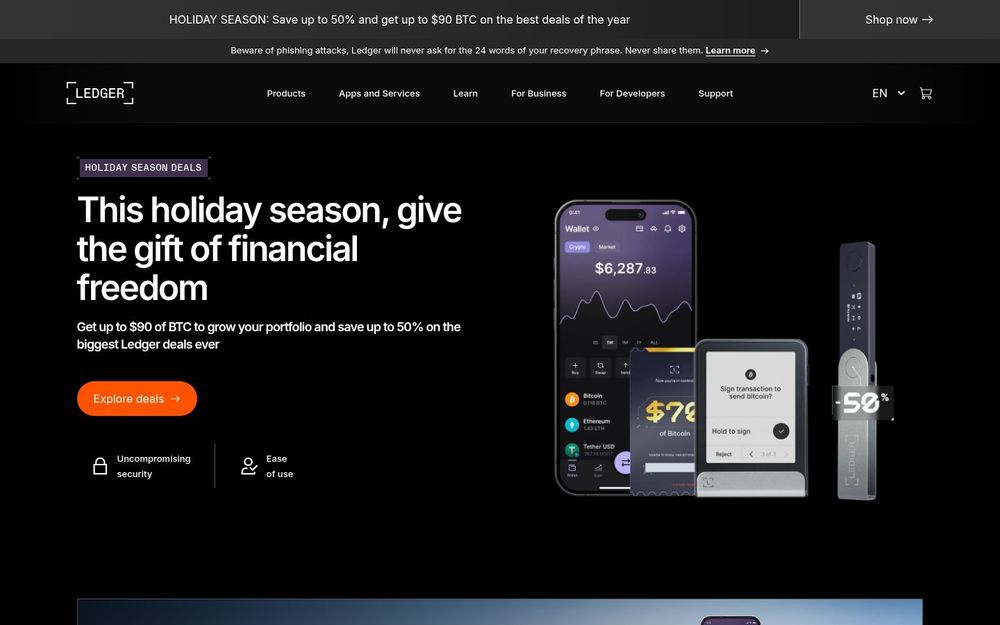
Ledger is a company focused on giving individuals full, non‑custodial control over their digital assets by combining physical hardware wallets with a comprehensive software ecosystem. The website presents Ledger as a security-first brand offering multiple hardware signers and the Ledger Wallet app (Ledger Wallet™) to manage, transact, and interact with decentralized applications. The page highlights product families such as Ledger Stax™, Ledger Flex™, Ledger Nano™ Gen5, and Ledger Nano™ Classics, and communicates practical guidance on backups, recovery, and the risks of phishing. Ledger also promotes seasonal deals while making clear that crypto transaction services are provided by third‑party partners.
Core Capabilities
-
Secure Hardware and OS: Ledger devices use an industry‑leading Secure Element chip combined with Ledger’s proprietary operating system to keep private keys offline and protected from remote attacks. This hardware‑rooted security model reduces exposure compared to hot wallets and exchange custody.
-
Comprehensive App Experience: The Ledger Wallet app (available on mobile and desktop) centralizes portfolio tracking, transfers, swaps, staking, and top-ups. It acts as a single interface to manage assets across chains while keeping signing operations anchored to the hardware device.
-
Wide Asset Support: Ledger supports more than 15,000 crypto assets, including Bitcoin, Ethereum, Solana, XRP, and many tokens and layer‑2 networks. Users can view supported coins on the site and install the necessary apps within the Ledger ecosystem.
-
Touchscreen Signers & Product Choices: The product range includes touchscreen signers and varying form factors to fit user preferences — from the premium, high‑resolution Ledger Stax™ to the lightweight Nano Gen5 and the durable Ledger Flex™. Each device caters to different tradeoffs between portability, screen size, and ergonomics.
-
Ecosystem Integrations and Backup Solutions: Ledger hardware integrates with over 50 software wallets and many third‑party providers for buying, swapping, and staking. Ledger also offers recovery and backup solutions and repeatedly instructs users to never share their 24‑word recovery phrase.
Why choose Ledger
Ledger’s value proposition centers on self‑custody and layered security. By keeping private keys in an offline Secure Element and requiring physical confirmation for transactions, Ledger reduces many of the attack vectors associated with hot wallets and centralized exchanges. The combined hardware + app model lets users perform common actions (buy, sell, send, receive, swap, stake) while keeping sensitive signing operations off‑device. Ledger is also focused on accessibility: clear product tiers, app support on mobile and desktop, and a large roster of supported assets mean both beginners and experienced users can adopt the solution.
Use cases and practical notes
- Long‑term cold storage: Use one device purely for long‑term holdings and another for daily activity to isolate risk.
- Active management: Use Ledger Wallet to connect to dApps and manage DeFi positions while signing with the hardware device for security.
- Recovery planning: Ledger emphasizes backups and sells dedicated recovery solutions; users must securely store their Secret Recovery Phrase and never disclose it.
Ledger also publishes FAQs and educational content explaining wallet types, key management, and the differences between custodial and non‑custodial solutions. Note that some transaction features are delivered by third‑party providers, and Ledger disclaims providing financial advice. The site includes community testimonials, links to social channels, and a clear anti‑phishing warning: Ledger will never ask for your 24‑word recovery phrase.
Conclusion
For individuals seeking a robust, hardware‑anchored approach to crypto and NFT security with broad asset support and integrated app features, Ledger provides a mature ecosystem. It balances strong technical protections with practical usability, multiple device options, and a range of integrations—while reinforcing best practices around backups and phishing awareness.


