


Overview
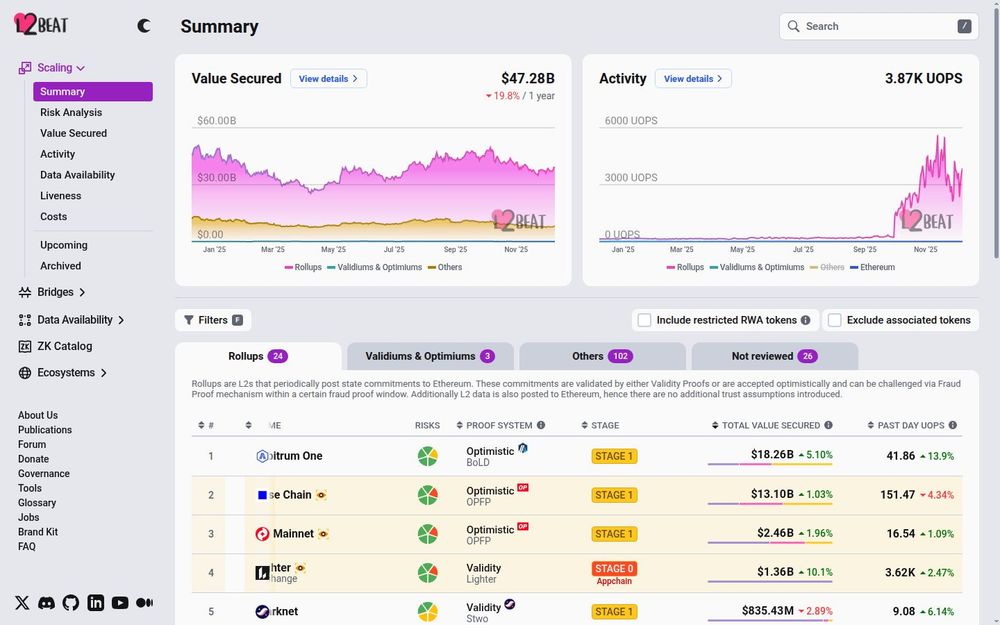
L2BEAT is a specialized analytics and research platform that monitors and documents the state of Layer 2 solutions built on Ethereum. Its aim is to provide clear, comparable, and up-to-date information about a wide range of scaling projects — from optimistic rollups and zk-rollups to various experimental or archived systems. The site aggregates quantitative metrics and qualitative descriptions to help stakeholders understand each project’s security model, design trade-offs, and relative adoption.
Core Capabilities
-
Total Value Secured (TVS): L2BEAT tracks and displays the amount of assets secured by each Layer 2 solution, offering a quick way to compare economic significance across projects.
-
Activity Metrics: The platform reports activity measures such as UOPS (user operations) and daily transaction-like metrics, helping users gauge real usage, throughput, and momentum over time.
-
Risk and Security Analysis: Each project page includes a risk overview that describes trust assumptions (e.g., fraud proofs vs validity proofs), recovery semantics, and any centralization vectors, enabling a security-minded comparison.
-
Data Availability & Liveness: L2BEAT documents how and where rollups post their data (on-chain, off-chain, or via external sequencers) and discusses liveness guarantees — important when evaluating censorship resistance and withdrawal guarantees.
-
Catalogs and Classification: The site organizes projects into categories (Rollups, Validiums & Optimiums, Others), labels stages (e.g., Stage 0, Stage 1, Appchain), and maintains related catalogs such as a ZK Catalog that maps provers and proof types.
Main Features (numbered)
- Project Directory: A browsable list of scaling projects with logos, links, and short metadata.
- Detailed Project Pages: Per-project breakdowns covering state-validation, stage, TVS, activity, and direct links to relevant on-chain or technical sources.
- Comparative Dashboards: Aggregated views for TVS, activity, risk, costs, and data availability that support trend analysis and filter-based exploration.
- ZK Catalog & Technical References: A curated catalog of zero-knowledge provers and proof systems used by different projects, useful for technical due diligence.
- Publication & Community Resources: Articles, methodology notes, a forum, and donation/governance links for community engagement and transparency.
Why L2BEAT is Useful
L2BEAT fills a practical need in the Ethereum ecosystem by combining quantitative metrics with concise qualitative context. For researchers and builders, the platform reduces the overhead of independently gathering TVS and activity numbers, normalizes metrics for comparison, and surfaces security-related distinctions between optimistic and validity-based approaches. For investors and users, it provides a quick sense of which networks hold substantial value or show meaningful user activity. The project pages also help developers and auditors find technical references — such as the prover used or the fraud-proof window — which are essential when evaluating safety and composability.
How to Use L2BEAT Effectively
- Use the main summary pages to filter projects by category (e.g., rollups) and highlight specific projects for side-by-side comparison.
- Consult individual project pages for state-validation details and links to on-chain contracts or prover documentation before making trust assumptions.
- Monitor TVS and activity trends to identify rapid growth, decoupling of value from usage, or possible risk exposures.
Data Sources and Limitations
L2BEAT aggregates on-chain data, public documentation, and direct project disclosures. While the platform emphasizes transparency about methodology, users should be aware that TVS and activity snapshots can vary by data provider and that off-chain systems or custodial designs may introduce measurement blind spots. Security assessments are summarised at a high level and should be complemented with deeper audits and primary-source verification for high-stakes decisions.
Recommendation
L2BEAT is recommended for anyone needing an organized, empirical view of Ethereum Layer 2s: researchers, protocol teams, ecosystem analysts, and advanced users. It provides a practical balance of metrics, qualitative context, and curated technical references that collectively improve understanding and decision-making in the rapidly evolving L2 landscape.


