


Overview
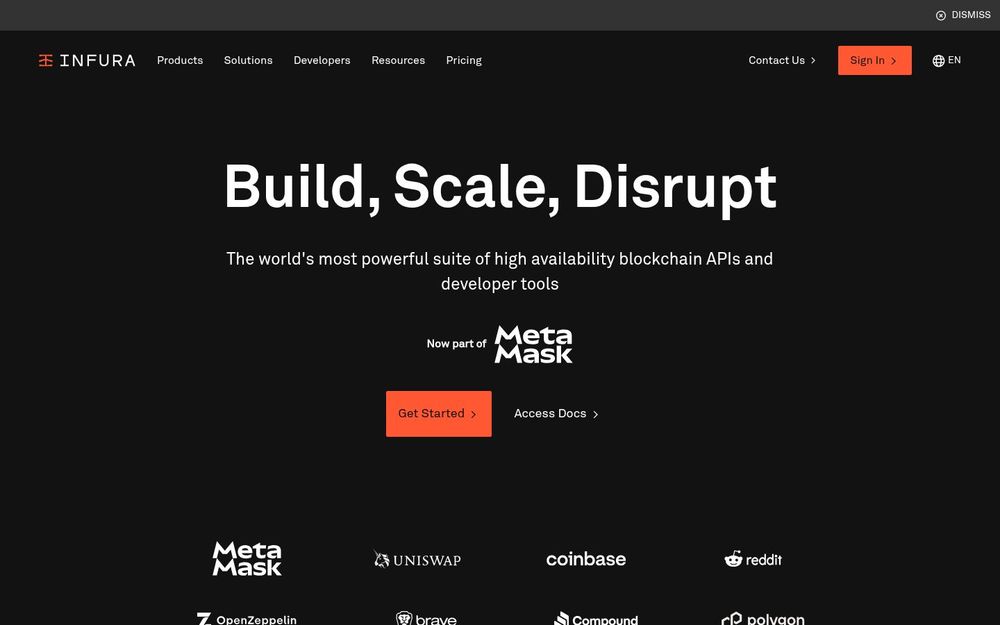
Infura is a widely used Web3 infrastructure provider that offers developers reliable, scalable access to blockchain networks and decentralized storage. Backed by ConsenSys and integrated closely with MetaMask, Infura provides a suite of APIs and services designed to remove the operational complexity of running blockchain nodes and IPFS gateways. The platform emphasizes high availability, performance, and developer-friendly tooling so teams can focus on building applications rather than maintaining infrastructure.
Core Capabilities
-
High-availability RPC and node access: Infura runs managed nodes and RPC endpoints across many popular networks, enabling fast and consistent interactions with blockchains without the need to host your own full nodes.
-
Multi-network support: Developers can access a broad range of networks — Ethereum mainnet and testnets, Layer 2s like Polygon, Arbitrum, Optimism, opBNB, and Layer 1 chains such as Avalanche and Monad — from a single API surface.
-
IPFS and decentralized storage connectivity: Infura provides gateways and APIs for IPFS, enabling developers to store, retrieve, and serve content in a decentralized manner. Note that IPFS access may be limited to pre-qualified customers depending on service policy.
-
SDK and ecosystem integrations: Infura integrates with the MetaMask SDK and ConsenSys ecosystem, offering seamless connections for wallets, SDKs, and tooling, which simplifies authentication, request routing, and developer workflows.
-
Scalability and performance tooling: The platform includes features and service tiers designed for production-scale throughput, monitoring, and reliability so teams can scale their dApps while maintaining predictable performance.
Features and Tools
-
API-first design: REST and JSON-RPC endpoints let you interact programmatically with supported networks.
-
Developer documentation and quickstarts: Infura provides comprehensive documentation and examples to help onboard developers quickly.
-
Access controls and service tiers: Multiple plans and access controls allow teams to choose levels of throughput, SLAs, and feature access (including gated IPFS usage in some cases).
-
Decentralized Infrastructure Network (DIN): An initiative to progressively decentralize the RPC layer by collaborating with other providers to reduce single points of failure and improve network resilience.
Security, Reliability, and Ecosystem
Infura emphasizes reliability and transparency, which is why it’s a common choice for big-name projects and wallets. The platform offers monitoring and operational practices to maintain uptime and consistent response times. Its partnership with ConsenSys and close integration with MetaMask make it an attractive option for teams that want a proven route to production and ecosystem distribution.
Getting Started
Developers can register for a free account to obtain API keys and begin integrating Infura endpoints into their dApps. The documentation includes code snippets, SDK references, and network lists to help you choose the right RPC endpoints and configuration. For projects requiring IPFS at scale, Infura may require qualification or a specific plan to enable full gateway access.
Why Choose Infura
Infura removes the heavy lifting of node maintenance and lets teams focus on product development. Its combination of broad network support, production-grade reliability, and ecosystem integrations (MetaMask, ConsenSys) makes it a pragmatic choice for startups, established projects, and enterprises building on Web3. Whether you need fast RPC endpoints, IPFS connectivity, or an approach toward decentralized RPC via DIN, Infura offers a mature, well-documented platform to accelerate development and scale with confidence.
Recommended Next Steps
- Sign up for a free account and generate API keys.
- Review documentation and SDKs to integrate RPC endpoints.
- Evaluate service tiers and IPFS access requirements for production usage.
- Explore DIN and architecture guidance if you need higher decentralization or resilience.


