


Overview
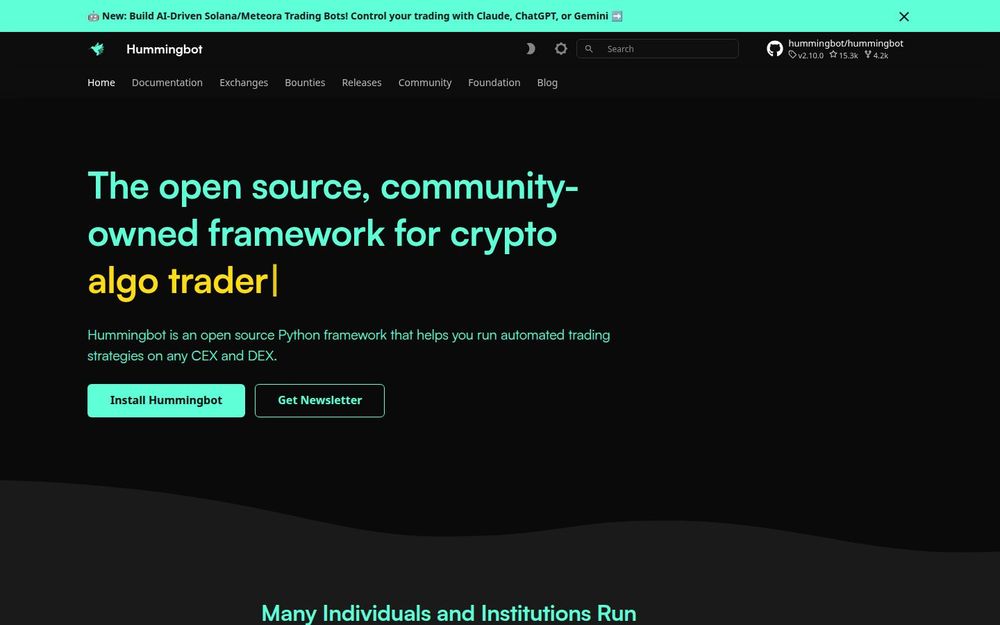
Hummingbot is an open-source Python framework that enables developers, traders, and institutions to build, deploy, and operate automated cryptocurrency trading strategies across both centralized and decentralized markets. It is maintained by a community and stewarded by the Hummingbot Foundation, with the project published under the Apache 2.0 license. Hummingbot emphasizes modularity, transparency, and extensibility: its architecture separates strategy logic, exchange connectors, and deployment tooling to make it straightforward to customize and scale trading systems.
Core Capabilities
-
Modular strategy framework: Hummingbot ships with a library of strategy templates—market making, arbitrage, directional strategies, and advanced V2 controllers—that can be run out of the box or extended to meet bespoke requirements.
-
Multi-exchange connectivity: The client supports numerous exchange connectors for both CEXs and DEXs. A bounty-driven connector program encourages the community and exchanges to add and maintain integrations, expanding the ecosystem of supported markets.
-
Deployment and management tools: The Hummingbot API and Dashboard provide centralized orchestration, allowing users to configure, deploy, and manage multiple bot instances from a web interface or programmatic API.
Key Features
-
Strategy Library and Extensibility: A suite of production-ready strategies (market making, funding-rate arbitrage, liquidation snipers, grid strategies, etc.) plus APIs for building custom controllers and strategy modules.
-
Connectors and Gateway: Connector architecture provides WebSocket and REST integrations to exchanges; the Gateway middleware aids in routing transactions and interacting with blockchain networks for DEX activity.
-
Backtesting and Research (Quants Lab): Quants Lab enables data collection, backtesting, research workflows, and automated task scheduling to validate strategies against historical data before live deployment.
-
Monitoring and Reporting: A built-in reporting dashboard aggregates real-time volume and performance metrics from Hummingbot instances, filterable by exchange and client version, which is useful for performance auditing and community transparency.
-
Deployment and API Automation: The Hummingbot API serves as a command center for programmatic deployment and orchestration of bot fleets, enabling institutional workflows and scale operations.
Community, Governance, and Research
Hummingbot is both community-driven and foundation-supported. The Foundation coordinates partnerships with exchanges and academic institutions, facilitating research collaborations (for example, with universities) and encouraging open contributions. Governance documentation explains how stakeholders can influence the project’s roadmap and development priorities. The open-source model and community activity attract market makers, prop traders, and researchers who share connectors, strategies, and operational practices.
Why Choose Hummingbot
Hummingbot is well-suited for users who need a flexible, transparent platform for algorithmic crypto trading. Its open-source license, modular architecture, and active community make it easy to audit, extend, and integrate into institutional workflows. The combination of a strategy ecosystem, deployment tools, research utilities, and real-time reporting provides a full-stack solution for developing, validating, and running automated trading strategies across many markets.
Getting Started and Next Steps
Users can begin by reviewing the installation guide and documentation for the client, API, dashboard, and Quants Lab. For exchanges, the connector bounty program offers a path to integrate and reach Hummingbot’s community. For researchers and developers, the Apache 2.0 licensing and repository structure make it straightforward to fork, experiment, and contribute back to the project.


