


Overview
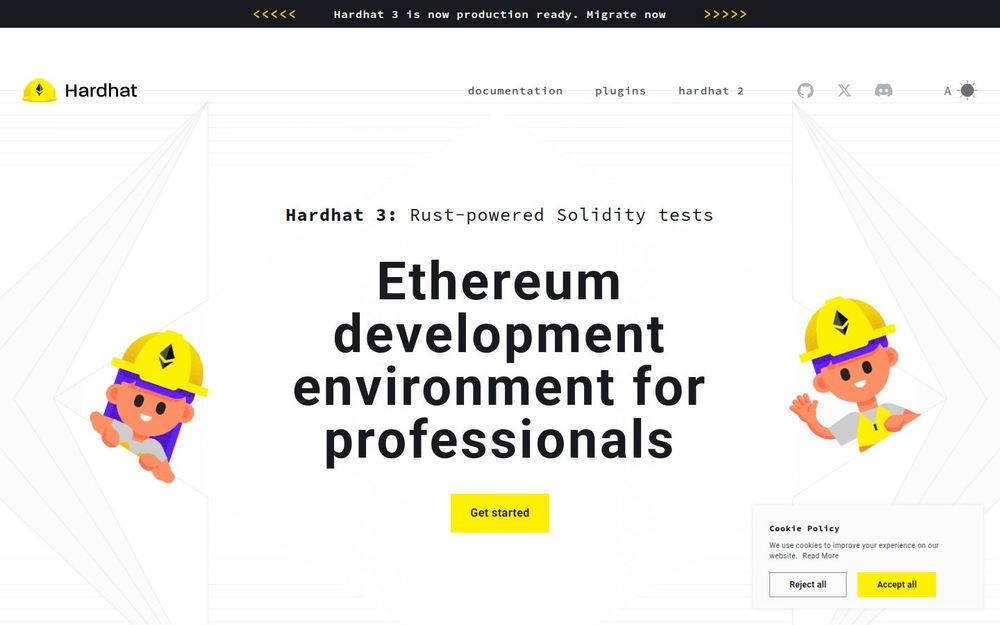
Hardhat is a purpose-built Ethereum development environment aimed at professional teams and individual developers who need speed, flexibility, and reliable tooling for smart contract development. With the release of Hardhat 3, the project ships a Rust-powered Ethereum Development Runtime (EDR) that significantly improves execution performance for testing and simulation. Hardhat bundles a comprehensive toolset out of the box — testing, debugging, deployment orchestration, multi-chain simulation, and verification — while remaining highly extensible through a mature plugin ecosystem.
Core Capabilities
-
Rust-powered runtime (EDR): Hardhat 3 runs its Ethereum simulation layer on a runtime implemented in Rust, offering improved performance and lower latency for running Solidity tests and simulations.
-
Multi-language testing support: Hardhat treats both Solidity tests and TypeScript tests as first-class citizens. You can write fast, concise unit tests in Solidity and expressive integration tests in TypeScript, and combine both approaches within the same project.
-
Actionable debugging and stack traces: When transactions revert, Hardhat surfaces clear, actionable error messages and detailed Solidity stack traces that point directly to the failing source lines. This makes iterating on contracts and locating root causes far faster.
-
Declarative deployments with Hardhat Ignition: Hardhat Ignition lets you define contract instances and deployment operations declaratively. The system automates complex orchestration and parallelization, simplifying reliable deployments across networks.
-
Multi-chain and network simulation: Built with multi-chain workflows in mind, Hardhat supports simulation and testing tailored to specific targets like Optimism’s OP Stack and Base, enabling confident deployment on L2 and alternative networks.
-
Plugin ecosystem and TypeScript extensibility: A composable plugin system enables integrating existing tools and extending functionality. Hardhat is designed for TypeScript-first extensibility so projects can customize tasks, hooks, and behaviors to match their processes.
Features in Practice
-
Comprehensive testing matrix: Use Solidity unit tests for speed and precision, TypeScript for complex integration scenarios, and fuzzing tests to probe edge cases and invariants.
-
Clear developer feedback: Human-readable error messages and stack traces reduce guesswork during development and debugging sessions.
-
Parallelized, reliable deployments: Ignition coordinates complex deployment flows, reducing manual orchestration and minimizing human error during deployment across many contracts.
-
Extensible tooling: Whether you need custom tasks, specialized verification, or deeper CI integrations, the plugin ecosystem and TypeScript APIs let you adapt Hardhat to your toolchain.
Recommended reasons to use Hardhat
Hardhat is recommended for teams and projects that require a high-performance development loop, deep debugging capabilities, and flexible testing strategies across multiple chains. Its Rust-powered runtime reduces the iteration time for tests, while the dual testing model (Solidity + TypeScript) lets teams choose the right trade-offs between speed and expressiveness. The declarative Hardhat Ignition deployment system and plugin architecture decrease operational complexity and enable consistent workflows from local development to production deployments.
In short, Hardhat is a full-featured Ethereum developer platform focused on speed, clarity, and extensibility — suitable for single developers experimenting rapidly and for larger engineering organizations building robust, multi-chain applications.


