


Overview
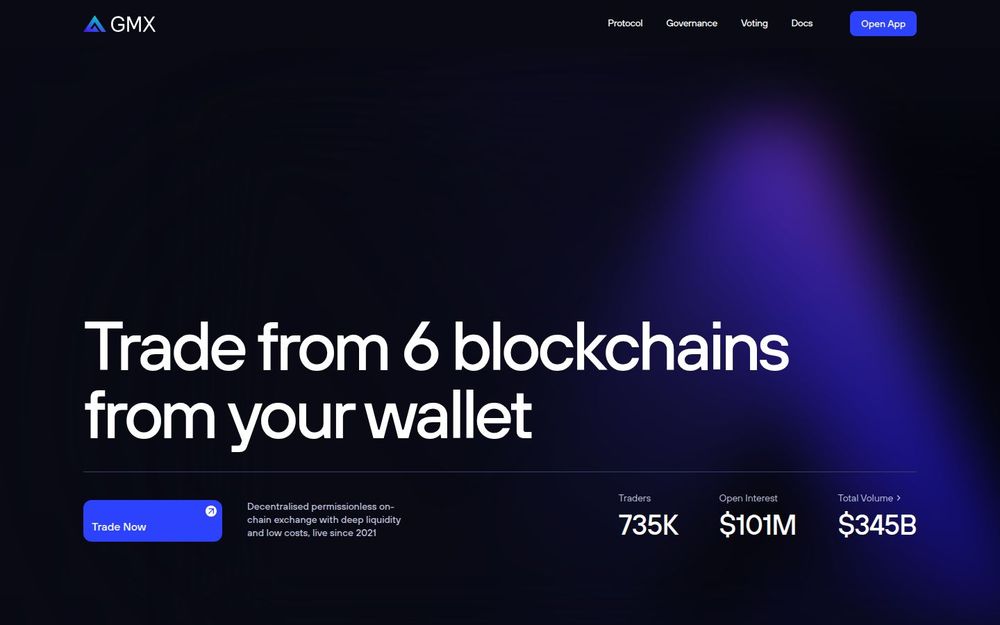
GMX is a permissionless, decentralized perpetual exchange designed to let users trade multiple asset classes directly from their wallets without custodial deposits. Rather than relying on order books, GMX routes execution through dynamically balanced liquidity pools that provide deep liquidity and reduce slippage, enabling large notional trades with minimal price impact. Launched in 2021, the protocol emphasizes low-cost trading, composability, and on-chain transparency while operating across several blockchains including Arbitrum, Avalanche, Base, BNB, Solana, and Botanix.
Core Capabilities
-
Deep On-Chain Liquidity: GMX executes trades against a liquidity pool model that supports large position sizes with limited slippage. This approach allows opening positions worth tens of millions with price impact often much lower than comparable order-book venues.
-
Leverage & Perpetuals: Traders can access up to 100x leverage on supported markets, enabling both directional and hedging strategies in a decentralized environment.
-
Non-Custodial, Wallet-First Trading: No KYC, no centralized deposits — users trade directly from self-custody wallets (MetaMask, Coinbase Wallet, Ledger, etc.), retaining full ownership of their funds and private keys.
-
Robust Price Oracles & Liquidation Protection: GMX integrates Chainlink and additional feeds to deliver sub-second, aggregated pricing, reducing the risk of unfair liquidations and manipulation caused by thin or noisy on-chain data.
-
Staking & Yield Mechanics: The protocol issues native tokens (GMX, GLP/GLV) and distributes a significant portion of trading and liquidation fees to liquidity providers and stakers. Liquidity providers reportedly receive a large share of fees (e.g., ~63%), while staking options offer competitive APRs.
How It Works
GMX’s execution model centers on dynamically rebalanced pools that supply liquidity for perp and spot trades. Instead of matching buyers and sellers, the pool accepts trades and adjusts internal parameters to maintain balance. This enables continuous liquidity, lowers slippage, and can occasionally produce positive price impact (where a trader receives better pricing rather than paying a premium). Developers and integrators can interact directly with smart contracts or use provided APIs and SDKs to build on top of GMX.
Security, Governance & Composability
GMX operates with community-driven governance, on-chain proposals, and snapshot voting for protocol decisions. The architecture is fully composable: protocols may integrate GMX liquidity or trading primitives into larger DeFi stacks. Security is enhanced by decentralized oracle feeds and audited smart contracts; the protocol also emphasizes permissionless access and open-source tooling (GitHub, developer docs). Recent multichain and messaging expansions (e.g., LayerZero selection for cross-chain messaging) aim to broaden reach while preserving contract ownership and security.
Recommended Reasons
-
Low Cost & Deep Liquidity: If you need to execute large or scaled trades without suffering heavy slippage, GMX’s pool-based approach is a compelling choice.
-
Non-Custodial Simplicity: Users who prioritize self-custody and quick onboarding will appreciate the wallet-first design and lack of KYC or deposit friction.
-
Yield & Participation: Active liquidity providers and stakers can earn a meaningful share of protocol fees and incentives, making GMX attractive for yield-seeking DeFi users.
Getting Started
To begin, connect a supported wallet, select the desired chain, and start trading or provide liquidity to earn fees. Builders should consult the GMX developer docs for APIs and integration patterns. For governance participation, use the protocol’s snapshot and governance interfaces to vote on proposals.
Final Notes
GMX blends on-chain perpetual trading, scalable liquidity, and community-driven governance into a single protocol that prioritizes decentralization and composability. Its multi-chain expansion, oracle integrations, and reward structures make it a practical option for traders, liquidity providers, and developers in the DeFi ecosystem.


