


Overview
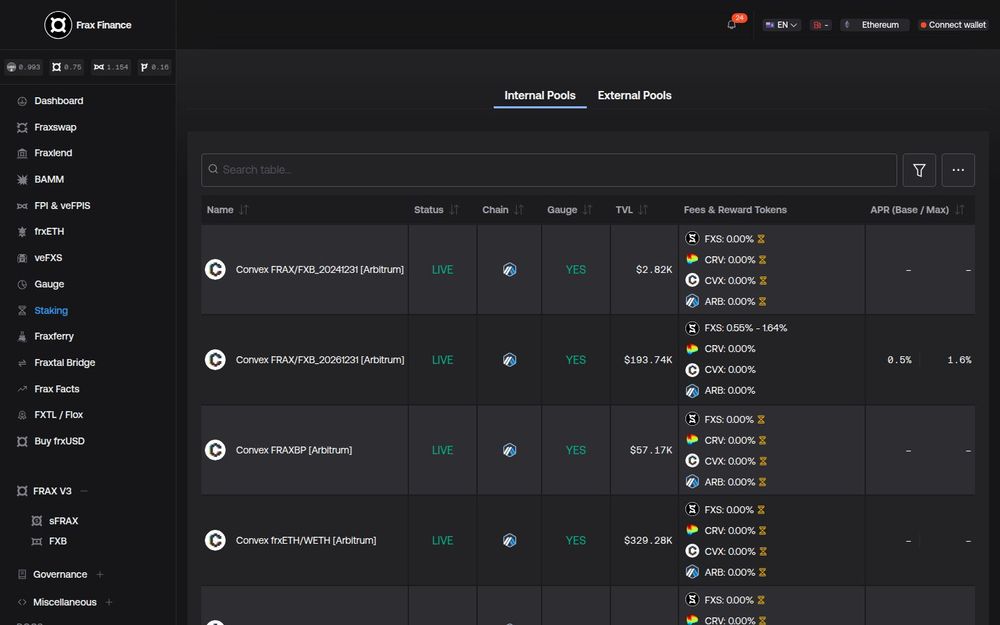
Frax Staking is the central dashboard for discovering and interacting with staking and liquidity pools in the Frax ecosystem. It aggregates both internal Frax-managed pools and external partner pools, presenting a unified list of opportunities where FRAX and related tokens can earn rewards. The interface displays pertinent data for each pool, including its status (LIVE or OFF/Deprecated), chain (Ethereum, Arbitrum, Polygon, Optimism, Fraxtal, etc.), TVL (Total Value Locked), gauge participation, fees, and the set of reward tokens available. Pools range from simple FRAX pairs to complex Convex and Curve-enabled gauges, and include both on-chain AMM pools and more specialized vaults like Fraxlend or Fraxswap liquidity positions.
Core Capabilities
-
Comprehensive pool catalog: The platform lists a wide selection of pools — over a hundred records — covering single-chain and cross-chain liquidity offerings. Each entry includes metadata such as pool name, chain icon, live/deprecated status, TVL, and reward breakdowns so users can compare options easily.
-
Detailed reward and APR visibility: For each pool, Frax Staking displays reward tokens (for example FXS, CRV, CVX, ARB, and partner tokens like KNC, VSP, FPIS, etc.), along with reported APR ranges (base and max) and fee types (swap fees, supply fees). This helps users evaluate potential yields and the composition of rewards for deciding where to allocate liquidity.
-
Integration with major liquidity protocols: The dashboard highlights pools that integrate with Convex, Curve, Uniswap (V2 and V3), KyberSwap, Fraxswap, Saddle, and other DeFi building blocks. These integrations enable reward stacking (e.g., native FXS plus protocol tokens) and allow users to tap into aggregated yield streams such as CRV and CVX after platform fees.
-
Multi-chain support: Pools on Arbitrum, Ethereum, Polygon, Optimism, Fraxtal and other networks are represented, making it possible to find staking opportunities across the ecosystem and understand which chains host the most attractive or largest TVL pools.
-
Status and lifecycle tracking: Each pool indicates whether it is LIVE or DEPRECATED, helping users avoid deprecated contracts and choose actively maintained opportunities. Live pools often show up-to-date TVL and APR metrics, while deprecated entries remain documented for historical reference.
How it works
Users can browse the list, inspect pools of interest and connect their wallet to deposit FRAX or LP tokens into the corresponding gauge or staking contract. Many pools require providing liquidity on partnered exchanges (Uniswap, Fraxswap, KyberSwap) before staking LP tokens in Frax gauges or external vaults. Reward distribution may occur in multiple tokens and can include both protocol-native incentives (like FXS) and third-party rewards (like CRV, CVX, or network tokens). The interface surfaces swap or supply fees and shows both base APY and maximum potential yield to aid in risk/reward assessment.
Recommended reasons to use Frax Staking
-
It centralizes yield opportunities within the Frax ecosystem so users don’t need to visit multiple partner sites to compare pools.
-
Transparent reward breakdowns and APR ranges give a clearer picture of expected returns and composability of incentives across protocols.
-
Multi-protocol and multi-chain integrations enable advanced strategies, such as funneling Curve/Convex rewards alongside Frax-native incentives for yield optimization.
Risks and considerations
While Frax Staking aggregates many opportunities, users should still consider smart contract risk, impermanent loss for LP positions, cross-chain bridging hazards, and rapidly changing APRs. Deprecated pools are retained for reference, but active participation should focus on LIVE pools with audited contracts and healthy TVL. Always perform due diligence and consider diversifying across pools and strategies rather than concentrating funds in a single gauge.
Conclusion
Frax Staking is a purpose-built, data-rich hub for exploring staking and liquidity rewards tied to the FRAX ecosystem. By combining multi-chain pool listings, reward transparency, and integrations with major DeFi protocols, it serves both casual liquidity providers and advanced yield farmers seeking to compose multi-token incentive strategies. Users should pair the insights provided by the dashboard with their own risk assessment before committing capital.


