


Overview
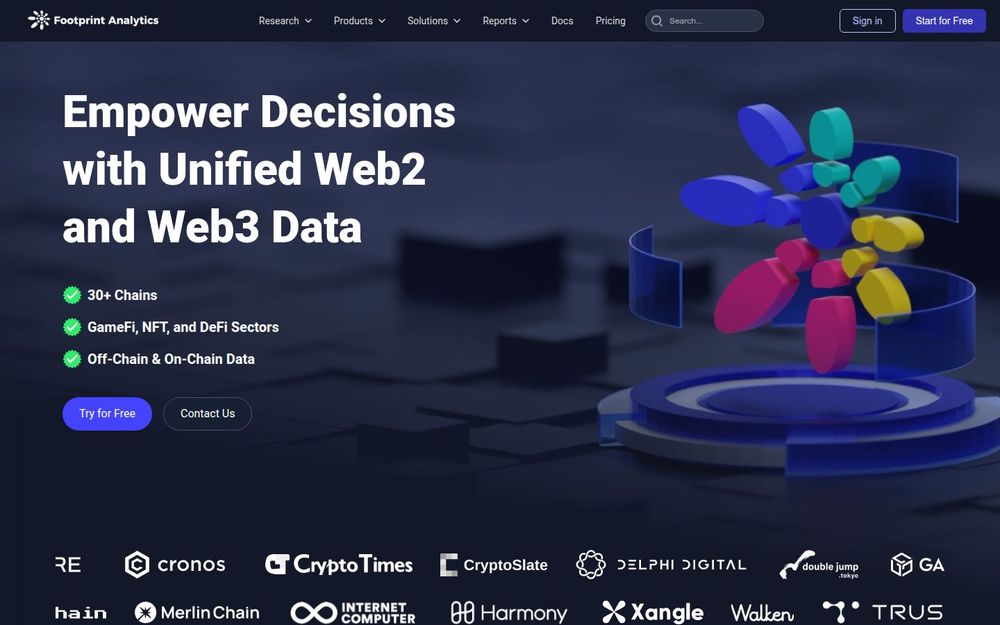
Footprint is a comprehensive Web3 data solution that brings together on-chain and off-chain information into a unified, structured environment. Its purpose is to eliminate the technical overhead of building and maintaining data pipelines, while delivering actionable insights for product teams, analysts, marketing groups, and blockchain ecosystems. By standardizing diverse datasets and exposing them through intuitive analytics and APIs, Footprint enables stakeholders to explore historical trends, run SQL queries, build dashboards, and sync bulk datasets with minimal engineering effort.
Core Capabilities
Footprint offers a suite of capabilities tailored to different business needs. Key strengths include structured cross-chain data coverage, developer-friendly APIs, no-code analytics, and growth-oriented tooling that blends Web2 and Web3 signals.
-
Data Room & Abstractions: Footprint provides a consolidated Data Room that abstracts raw blockchain events into semantic, business-friendly datasets. This layer simplifies exploration and reduces the need to decode contract logs or normalize disparate chain schemas.
-
Batch Download & Historical Sync: The platform supports batch download of historical blockchain data for teams that require offline analysis or want to ingest standardized datasets into their own warehouses. This eases migration and long-term archival of full historical records.
-
SQL API & Programmatic Access: For analysts and engineering teams, Footprint exposes a powerful SQL API that allows programmatic querying of indexed, well-documented tables. This capability enables reproducible analytics, automated reporting, and integration into internal tooling.
-
Zero-Coding Analytics & Dashboards: With drag-and-drop dashboards and templated visualizations, Footprint delivers zero-coding analytics comparable to mainstream BI tools but tuned for crypto-native metrics. Users can combine on-chain events with uploaded Web2 data in a single visualization layer.
-
Growth Analytics & Web2 Integration: Footprint’s growth analytics offerings let teams merge Web2 customer signals (like campaign data or user CRM fields) with wallet-level blockchain activity. This fusion supports retention analysis, cohort tracking, and data-driven customer acquisition strategies.
Features and Functionality
- Cross-chain coverage across 30+ chains, including EVM and non-EVM networks, with full historical and real-time sync.
- Pre-abstracted datasets and semantic models to accelerate analysis without low-level contract decoding.
- Drag-and-drop dashboards plus full SQL support for both no-code and code-first workflows.
- Batch export tools and programmatic APIs to integrate Footprint data into external pipelines or analytical stacks.
- Growth-focused integrations that correlate off-chain marketing and community signals with on-chain behavior.
Use Cases and Audience
Footprint is designed for a wide range of users: blockchain teams who need ecosystem analytics, game developers tracking in-game asset flows, marketing teams performing wallet-level acquisition analysis, researchers surveying protocol activity, and data teams that require a reliable, structured feed of token, NFT, and protocol metrics. The platform’s mix of no-code dashboards and SQL endpoints makes it accessible for non-technical stakeholders while remaining powerful for engineers and data scientists.
Why Choose Footprint
Footprint reduces the friction of working with blockchain data by offering high-quality, standardized datasets and flexible access patterns. Organizations that want to avoid building and maintaining crawling, parsing, and indexing infrastructure benefit from Footprint’s managed coverage and responsive technical support. The combination of real-time feeds, full historical archives, and Web2 + Web3 integration positions the platform as a practical choice for teams focused on growth velocity, research rigor, and easier collaboration across product, analytics, and marketing functions.
Recommendations
For teams evaluating analytics vendors, Footprint is a strong candidate when you need broad chain coverage, a balance of no-code and SQL-based analysis, and the ability to merge off-chain user data with on-chain events. Consider Footprint if you prioritize speed-to-insight, standardized data models, and an API-first architecture to power both dashboards and downstream integrations.


