


Overview
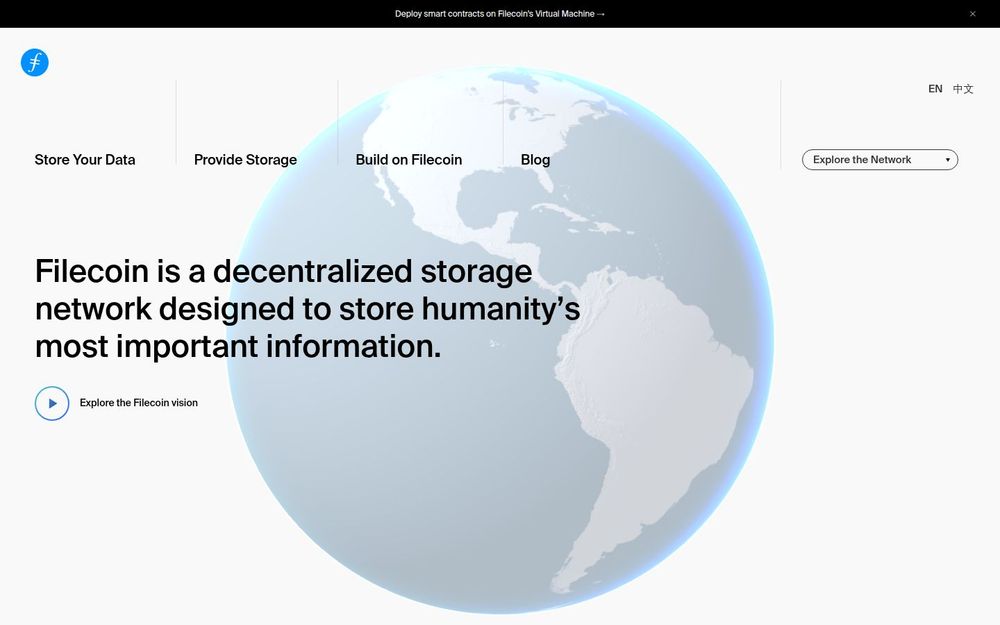
Filecoin is a decentralized storage network and protocol built to enable verifiable, market-driven storage of digital information. By combining an open marketplace for storage providers with cryptographic proofs and token-based economics, Filecoin aims to create a global, permissionless storage layer that can serve as an alternative to centralized cloud providers. The network is designed to preserve data integrity, provide incentives for long-term storage, and integrate with broader Web3 infrastructure and developer tooling such as the Filecoin Virtual Machine (FVM).
Core Capabilities
-
Decentralized Storage Marketplace: Filecoin connects clients who need storage with storage providers who offer capacity. Payments and storage agreements are managed through the protocol, allowing supply and demand to set market terms.
-
Verifiable Storage Proofs: The network uses cryptographic proofs like Proof-of-Replication (PoRep) and Proof-of-Spacetime (PoSt) to ensure that providers actually store the promised data over time. These proofs are verifiable on-chain, enabling trustless verification.
-
Incentive Layer and Native Token: The FIL token incentivizes storage providers and participants. Economic incentives align long-term availability and honest behavior across the network.
-
Developer Tooling and Interoperability: With components like the Filecoin Virtual Machine (FVM) and rich APIs, developers can build applications, smart contracts, and integrations that leverage persistent, decentralized storage in combination with computation.
-
Data Retrieval and Distribution: Filecoin supports retrieval markets and protocols that optimize data delivery, enabling both archival storage and more performant content distribution scenarios.
Key Features
-
Market-driven Storage: Enables competitive pricing and flexible storage agreements between clients and providers.
-
Provable Storage Integrity: Ensures providers are storing data through periodic, cryptographic proofs that are publicly verifiable.
-
Incentivized Availability: Uses FIL-based incentives and penalties to promote long-term data retention and reliability.
-
Developer Ecosystem: Offers tooling such as the FVM, APIs, and integrations with IPFS and other protocols for building decentralized applications with persistent storage.
-
Censorship Resistance and Redundancy: Data can be distributed across multiple independent providers, reducing single points of failure and censorship risk.
How It Works
Clients submit data to the network, negotiate storage deals with providers, and pay using FIL. Providers commit to storing the data and periodically submit cryptographic proofs to demonstrate continued custody. The protocol logs commitments and proofs on-chain, creating an auditable history of storage that can be inspected by clients and third parties. Retrieval can occur via the retrieval market, where providers optimized for delivering data can be chosen for faster access, or via integrated gateways that combine IPFS-like addressing with Filecoin storage guarantees.
Use Cases and Recommendations
Filecoin is well-suited for archival storage, decentralized backups, preservation of cultural or scientific datasets, and any application that needs durable, verifiable persistence in a permissionless environment. It is particularly valuable for projects that prioritize data integrity, redundancy, and economic incentives for long-term availability. Developers building decentralized applications should consider using Filecoin alongside IPFS for content addressing and the FVM for programmable storage-related logic.
Conclusion
Filecoin represents a comprehensive approach to decentralized storage by combining market mechanics, cryptographic guarantees, and developer-centric tooling. Its layered design supports diverse use cases from archival to active retrieval, offering a resilient and auditable alternative to traditional centralized storage services.


