


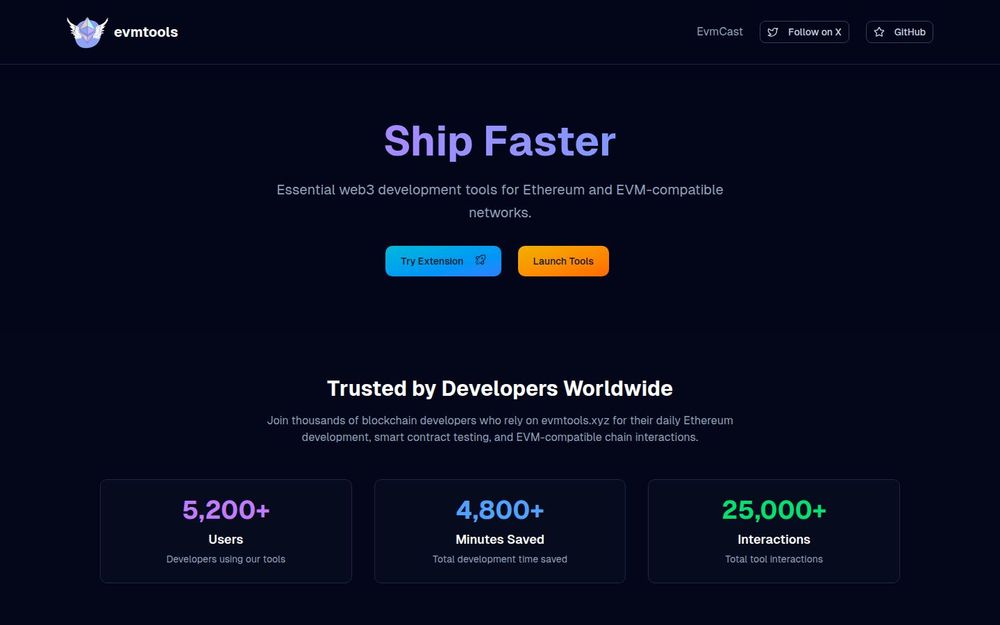
Overview
evmtools is a focused collection of development utilities designed to accelerate Ethereum and EVM-compatible blockchain development. It combines web-based tools, interactive playgrounds, and a command-line toolkit to address common developer needs such as decoding transactions, converting between EVM data formats, generating cryptographic artifacts, and interacting with contracts. The platform emphasizes multi-chain compatibility and practical workflows so developers can debug, test, and experiment quickly across mainnet and Layer 2 networks.
Core Capabilities
-
Transaction Decoding & Analysis: Decode Ethereum transaction data and function calls to inspect contract interactions, view parameters, and understand on-chain behavior for debugging and auditing.
-
Data Conversion Tools: Convert between bytes, strings, hex, bytes32, and human-readable formats; compute cryptographic hashes (keccak256, sha256, etc.); and generate Merkle trees for airdrops and verification schemes.
-
Smart Contract Utilities: Use ABI encoding/decoding, a Contract UI for invoking and testing functions, and developer helpers that simplify preparing low-level calls and payloads for transactions.
-
Wallet & Signature Utilities: Generate burner wallets for ephemeral testing, produce and verify EIP-712 structured data signatures, and work with ERC-191 message signing patterns for off-chain authentication.
-
Cross-Chain & Gas Tools: Convert gas units (wei, gwei, ether), estimate transaction costs across networks, and support development across Ethereum, Arbitrum, Polygon, BNB Chain, Optimism, Base, and many other EVM chains.
Supported Chains & Multi-Chain Workflow
evmtools intentionally supports a broad set of EVM-compatible networks so that your debugging and tooling workflows are portable between mainnet, Layer 2s, and sidechains. By providing chain-specific icons and quick selectors, the platform helps you ensure encoded transactions, gas calculations, and contract interactions match the semantics of the target network.
Developer Experience & Tool Categories
-
Interactive Playgrounds: Play with features such as the EIP-7702 Playground to experiment with account delegation and advanced transaction constructs without leaving the browser.
-
One-Click Utilities: Quick access to decoders, hashing utilities, serializers, and converters speeds repetitive tasks and reduces context switching between multiple tools.
-
CLI Integration (EVMCast): For power users and automation, EVMCast provides a command-line interface to run many of the same conversions, decodes, and contract interactions from scripts or CI pipelines, enabling reproducible terminal workflows.
Why Use evmtools
-
Speed: Rapid, focused utilities remove friction from everyday developer tasks — from decoding obscure calldata to constructing Merkle proofs.
-
Coverage: The suite covers a broad set of needs — cryptographic utilities, transaction decoding, ABI encoding, wallet generation, and a contract UI — reducing the need for multiple disparate tools.
-
Accessibility: Browser-based tools and an optional CLI let both beginners and experienced engineers access functionality in the environment that fits their workflow.
-
Multi-Chain Support: Native consideration for many EVM-compatible chains ensures that what you test locally maps correctly to the target network.
Getting Started & Recommendations
-
Start with the web-based transaction decoder and ABI encoder to inspect on-chain calls and prepare test payloads.
-
Use the EIP-7702 Playground to prototype account abstraction scenarios and the Burner Wallet for ephemeral testing.
-
Introduce EVMCast into your local toolchain or CI to automate decoding and conversion tasks as part of deployments or debugging pipelines.
Conclusion
evmtools is a practical, developer-focused toolkit that bundles many day-to-day Ethereum development tasks into a single accessible place. Whether you need to decode calls, generate cryptographic primitives, test contract functions via a Contract UI, or run automated conversions from the terminal, evmtools aims to simplify the work of building, debugging, and maintaining Web3 applications across multiple EVM networks.


