


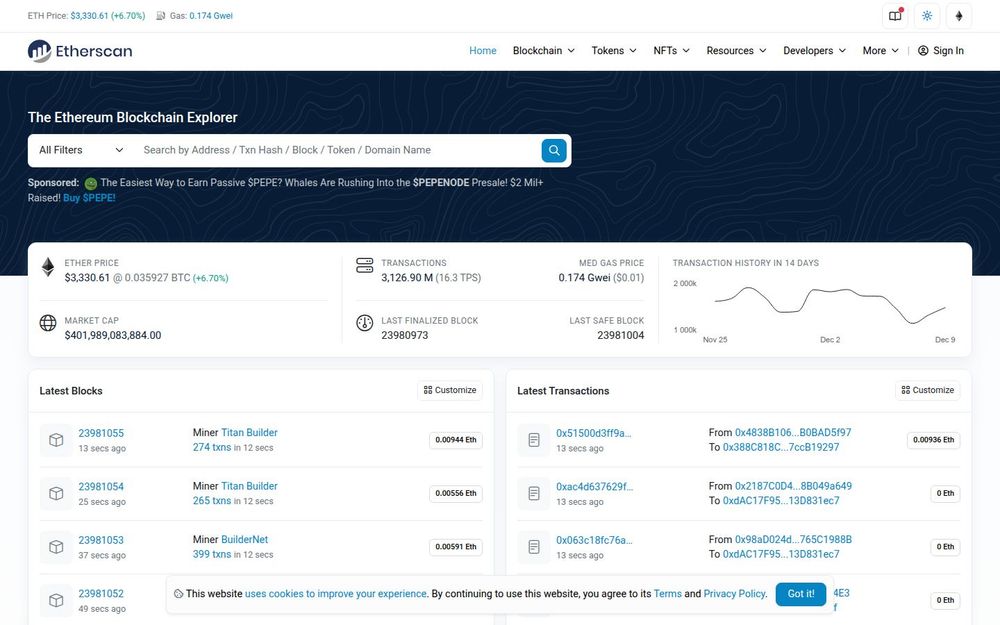
Overview
Etherscan is a leading Ethereum blockchain explorer that provides a comprehensive window into the state and history of the Ethereum network. It aggregates and presents detailed data about blocks, transactions, addresses, tokens, and smart contracts in a user-friendly interface. Etherscan is used by developers, security researchers, analysts, and everyday crypto participants to verify transactions, monitor gas prices, inspect smart contract source code, and analyze token activity. The platform supports Ethereum Mainnet and links to related services such as beacon chain explorers and various testnets, offering both casual users and professionals the tools needed to interrogate on-chain events.
Core Features
-
Transaction & Block Explorer: Search and inspect individual transactions, view confirmations, gas usage, internal transactions, and full block contents including miner data.
-
Address & Token Pages: Lookup wallet addresses and token contracts to see balances, historical transfers, holder distributions, and token metadata.
-
Gas Tracker & Charts: Real-time and historical gas price data, median gas costs, and charts that help users choose appropriate gas settings for timely confirmations.
-
Contract Verification & Analytics: View verified smart contract source code, ABI, and interact with contracts via a read/write interface directly from the browser.
-
Developer APIs and Tools: Programmatic access to blockchain data through APIs, plus developer utilities for event logs, token transfers, and block statistics.
How It Works
Etherscan indexes blocks and transactions as they are produced on the Ethereum network. The platform decodes on-chain data — including transaction input, event logs, and token transfers — and maps that information to intuitive pages and charts. When a contract is verified on Etherscan, its source code is matched against the compiled bytecode on-chain, enabling users to read or interact with the contract using the verified ABI. The site also labels known addresses (exchanges, bridges, prominent projects) to make interpreting activity easier, and provides links to related resources like token explorers and third-party analytics.
Use Cases
-
Transaction Verification: Confirm whether a payment or contract interaction succeeded, how much gas was used, and how many confirmations were received.
-
Security and Audits: Investigate suspicious addresses, trace suspicious flows, and review verified smart contract source code to understand contract behavior.
-
Token Research: Analyze token transfers, distribution among holders, and contract creation details to evaluate token mechanics and activity.
-
Development and Integration: Use APIs to fetch historical or real-time on-chain data for dApps, dashboards, and automated monitoring systems.
Why Choose Etherscan
Etherscan stands out for its combination of accessibility and depth. It presents granular blockchain data in a format usable by non-technical users while exposing advanced features for developers and auditors. The verified contract system builds trust by allowing users to read the actual source behind deployed contracts. The platform’s indexing, labeling, and historical charts make it a primary reference for anyone needing transparent, reliable Ethereum data.
Getting Started & Tips
- Use the search bar to paste a transaction hash, address, or token name to jump directly to a detailed page.
- Check the Gas Tracker before sending transactions to optimize fees and avoid failed transactions.
- For developers, explore the API documentation to integrate Etherscan data into dashboards or monitoring scripts.
Etherscan remains a cornerstone tool for the Ethereum ecosystem, combining real-time monitoring, historical analytics, and developer services to help users interact with and understand on-chain activity.


