


Overview
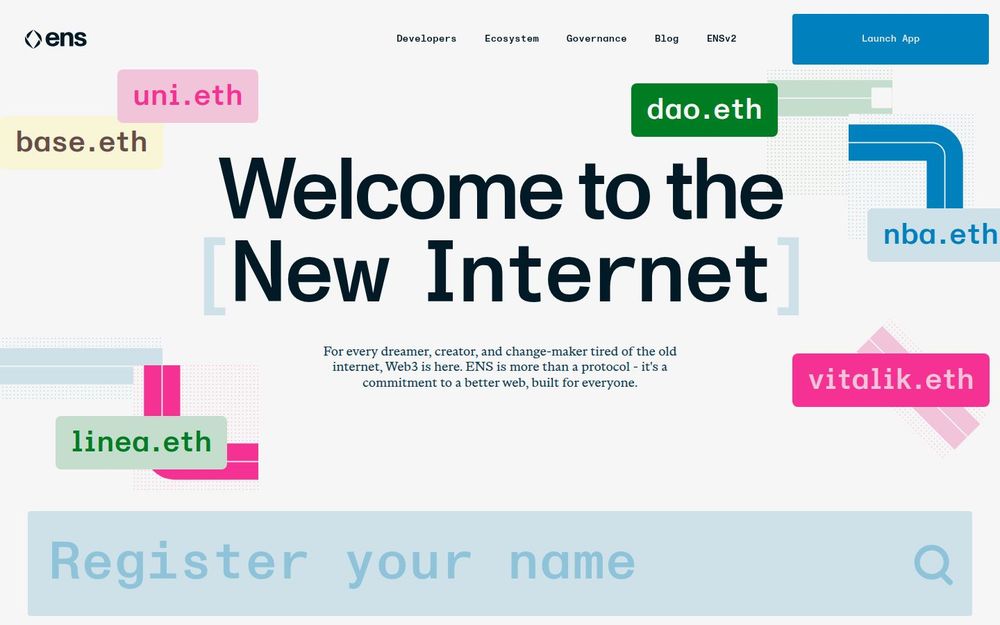
ENS (Ethereum Name Service) is a decentralized naming protocol that brings human-readable identifiers to the Web3 ecosystem. Instead of relying on long hexadecimal addresses, ENS lets users register names like yourname.eth that can resolve to Ethereum addresses, content hashes (for decentralized websites), metadata, and other identifiers. ENS aims to simplify blockchain interactions, enable consistent online identity, and provide uncensorable, user-owned naming infrastructure for the new internet.
Core Capabilities
-
Resolution of human-readable names: ENS converts simple domains such as alice.eth into complex machine-readable assets like wallet addresses and IPFS content hashes.
-
On-chain ownership and management: Names are owned and controlled on-chain, giving holders full ownership and the ability to transfer, set records, and configure subdomains without intermediaries.
-
Interoperability and integrations: ENS works with a broad ecosystem of wallets, browsers, and dApps—examples include Coinbase Wallet, Rainbow, Brave, Uniswap, GoDaddy, and Etherscan—enabling seamless use across services.
-
Usernames and profile records: ENS supports profiles and ENS usernames that can be used across platforms (for instance, ENS usernames on Farcaster), helping users maintain a consistent identity across the web.
-
Developer tooling and documentation: Comprehensive developer docs and APIs let builders integrate ENS resolution, name registration, and metadata support into decentralized applications.
Main Features
-
Simple Address Resolution: Replace long hex addresses with memorable ENS names for sending and receiving crypto and interacting with dApps.
-
Content and Metadata Linking: Point ENS names to decentralized content (IPFS/Arweave) and attach metadata, enabling names to serve as anchors for decentralized websites and profiles.
-
Subdomain Management: Create and delegate subdomains to organize identity, teams, or services (for example, user.domain.eth or mail.domain.eth).
-
Governance via ENS DAO: Participate in protocol governance and contribute to the roadmap through the ENS DAO, ensuring the project is community-led.
-
Extensive Integrations: Use ENS across wallets, browsers, marketplaces, and explorer tools thanks to hundreds of integrations—making names practical across the entire Web3 stack.
Why ENS Matters
ENS addresses a fundamental usability barrier in blockchain systems: unfriendly addresses. By providing human-readable names, ENS lowers the entry cost for non-technical users, reduces errors when sending funds, and creates a portable identity layer across services. Because names are controlled on-chain, users retain true ownership—no central intermediary can seize or censor a name once it’s registered under standard ENS rules.
Governance, Community, and Ecosystem
ENS is run as a public good with a strong community ethos. The ENS DAO stewards protocol parameters, development decisions, and funding allocations, giving stakeholders a voice. The project promotes participation through community forums, governance documentation, and open developer resources. Key ecosystem metrics showcase adoption: hundreds of thousands of owners, over a million names, and roughly 600 integrations, illustrating both network effects and real-world utility.
Getting Started and Resources
To register or manage an ENS name, users typically visit the ENS App (app.ens.domains), which provides an accessible interface for name search, registration, and record management. Developers should consult the Developer Docs for integration guides, API references, and examples. Those interested in protocol direction can explore the ENS DAO to learn how to participate in governance.
Recommendation
ENS is recommended for users and builders who want a portable, on-chain identity layer that is interoperable across wallets and dApps. Its combination of usability, on-chain ownership, and wide integrations makes it a practical foundational component for personal identity, decentralized websites, and application-level name resolution in Web3.


