


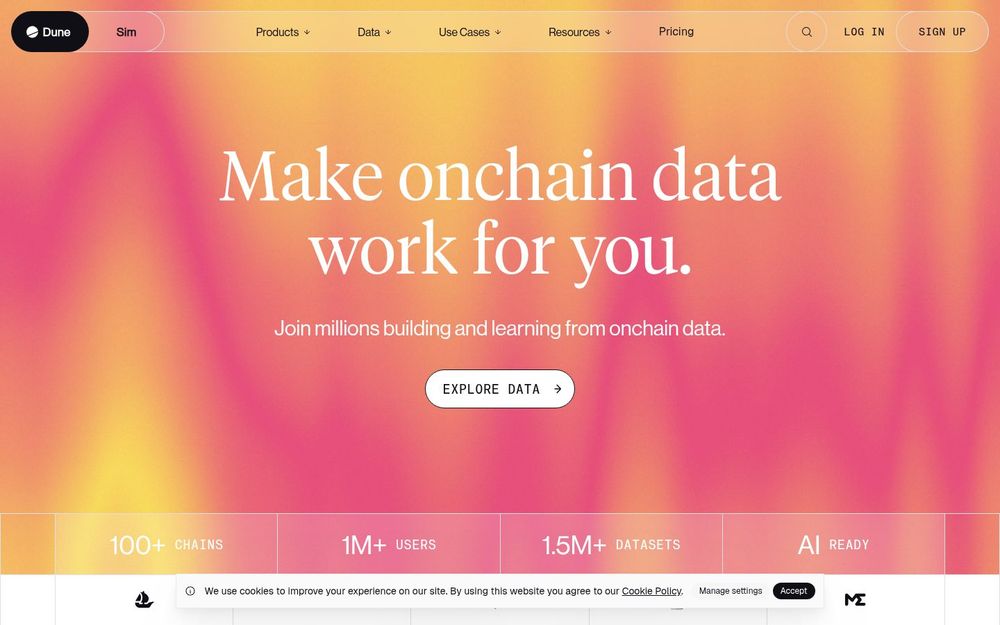
Overview
Dune is a purpose-built platform for exploring, analyzing, and operationalizing on-chain blockchain data. It combines a large public catalog of datasets and user-created queries with tools for visualization, API access, and data delivery. Whether you are an on-chain analyst, a developer building products across chains, or an AI system needing structured on-chain inputs, Dune is designed to lower the friction of working with blockchain telemetry and to accelerate insight-driven decisions.
Core Capabilities
- Public query library: A searchable, community-driven collection of SQL queries and dashboards that make it easy to discover and reuse analyses.
- Multi-chain coverage: Support across 100+ chains, enabling cross-chain comparisons and aggregated views.
- APIs & Connectors: Programmatic access to results and raw data so teams can integrate Dune outputs into external apps and warehouses.
- Datashare: Managed data delivery that brings curated on-chain datasets into your own data warehouse for downstream analytics and ML.
- Sim & Sim API: Developer-focused tools for multichain simulation, testing, and building incentive flows.
Key Features (numbered list)
-
Interactive SQL queries and visualizations: Write or reuse SQL-based queries against normalized on-chain datasets, then convert the results into shareable charts and dashboards for exploration and publication.
-
APIs and Connectors: Pull query results and structured datasets directly into other environments via RESTful APIs, webhooks, or connector integrations so insights can feed products, reports, or automation pipelines.
-
Datashare and warehouse delivery: Subscribe to curated, production-ready datasets that are delivered to your data warehouse, reducing the need for custom ETL and ensuring data consistency.
-
Community-driven content and discovery: Leverage the largest community of on-chain analysts—discover trending content, fork and iterate on public work, and learn from curated case studies and dashboards.
-
AI and developer readiness: Dune is positioned as AI-ready, providing structured, high-quality datasets and APIs that facilitate training models, building analytics agents, or powering on-chain-aware applications.
How it works
Dune ingests and normalizes blockchain event and transaction data across many chains and exposes that data through a SQL interface. Users can create queries, transform results into visualizations, and assemble dashboards. Public content is discoverable, which encourages collaboration and reproducibility. For teams that require programmatic access or enterprise workflows, Dune provides connectors and Datashare to deliver datasets directly to customer environments and a Sim API for development and simulation work.
Recommended reasons to use Dune
-
Faster time to insight: Reuse community queries and dashboards rather than building pipelines and ETL from scratch, accelerating analysis and reporting.
-
Broad multi-chain visibility: Access 100+ chains and cross-chain datasets, making it easier to correlate activity and derive comparative metrics.
-
Production-ready data delivery: Datashare and connectors provide stable, curated datasets for analytics and ML without extensive engineering overhead.
-
Community and transparency: A large ecosystem of analysts and public examples helps teams validate methods, replicate results, and learn best practices.
-
Developer and AI support: APIs, Sim, and AI-ready datasets empower integrations, automated analysis, and the building of intelligent blockchain products.
Use cases and audience
Dune is useful for on-chain analysts doing exploratory analysis, product and data teams integrating on-chain metrics into dashboards, researchers performing longitudinal studies across chains, and AI practitioners who need clean, structured blockchain datasets to train or inform models. Enterprise customers can leverage case studies and dedicated features to operationalize insights at scale.
Conclusion
Dune offers an end-to-end approach to on-chain analytics: a public, collaborative ecosystem for discovery; robust tools for querying and visualization; and enterprise-grade delivery mechanisms for production use. Its combination of community knowledge, multi-chain coverage, and programmatic access makes it a compelling choice for anyone seeking to make on-chain data actionable and reliable.


