


Overview
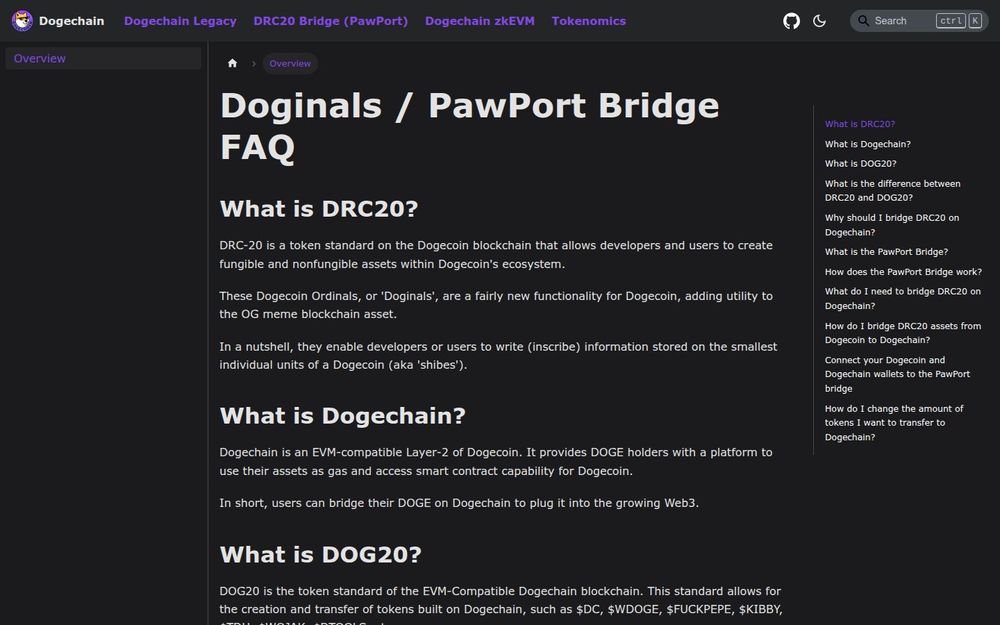
DRC-20 is a token inscription standard for the Dogecoin blockchain that allows developers and users to create fungible and non-fungible assets by inscribing data onto individual units of DOGE. Dogechain is an EVM-compatible Layer-2 designed to bring smart contract functionality to Dogecoin assets. Through the PawPort Bridge, DRC-20 inscriptions can be ported to Dogechain and represented as DOG20 tokens, unlocking compatibility with decentralized exchanges, smart contracts, and Web3 applications.
Dogechain’s approach links the simplicity and cultural reach of Dogecoin with the composability of EVM ecosystems. The bridge workflow deposits inscribed DOGE into secure storage and mints DOG20 tokens on Dogechain, enabling holders to use their assets as gas and interact with the broader DeFi and NFT tooling available in the EVM world.
Core capabilities
-
Cross-chain bridging of inscriptions: The PawPort Bridge accepts DRC-20 inscriptions from Dogecoin wallets, secures the underlying DOGE, and mints equivalent DOG20 tokens on Dogechain so users can use them in EVM smart contracts.
-
EVM compatibility and smart contract access: Once bridged, assets gain the ability to interact with smart contracts on Dogechain, enabling lending, automated market-making, gaming integrations, and programmable token logic that are not natively possible on Dogecoin.
-
Indexer integration and inscription detection: The bridge uses the drc-20.org indexer to detect transferable inscriptions, monitor inscription status, and surface mintable assets in the PawPort app, reducing manual tracking for users.
-
Wallet interoperability: The flow supports a DRC20-compatible Dogecoin wallet (e.g., Doge Labs Wallet) for inscription creation and an EVM wallet (e.g., MetaMask) for receiving minted DOG20 tokens and interacting with Dogechain dApps.
-
Cold storage custody model: PawPort stores the inscribed DOGE backing bridged assets in cold storage while minting DOG20 tokens on Dogechain, providing a custodialized-backed token model for cross-chain utility.
How it works
The bridging process is a two-step operational flow. First, the user connects both their Dogecoin and Dogechain wallets to the PawPort bridge and selects the DRC-20 inscription to transfer. The bridge detects existing transferable inscriptions via the indexer; if none exist or the user needs a different amount, the user can create a new inscription on Dogecoin and wait for confirmation. Once the inscription is confirmed and transferred to the bridge’s custody, the system mints a corresponding DOG20 token on Dogechain and sends it to the user’s EVM wallet.
Reverse bridging follows a similar pattern: the user selects the DOG20 token to release, initiates a transfer back through PawPort, and the bridge releases or re-inscribes the DRC-20 asset to the specified Dogecoin address after processing.
Recommended reasons
-
Liquidity and composability: Bridging DRC-20 assets to DOG20 unlocks decentralized exchange listings, AMMs, and DeFi primitives that dramatically increase liquidity and utility compared to trading raw inscriptions on specialized marketplaces.
-
Smart contract utility: By converting inscriptions into EVM-compatible tokens, users can embed DOG20 into games, lending protocols, yield strategies, and other programmable uses that were previously unavailable on Dogecoin.
-
Simplified workflow: Integration with the drc-20.org indexer and clear wallet requirements streamline the bridging experience—users can detect inscriptions, mint tokens, and manage transfers without manually tracking inscriptions across the Dogecoin chain.
Use cases and considerations
Use cases include bringing art, collectibles, and community tokens into DeFi, using DOG20 tokens for staking and liquidity provision, and enabling Web3 developers to build Dogecoin-native dApps on Dogechain. Considerations include custodial risk from the custody model, network fees on both Dogecoin and Dogechain, and the time required for inscription creation and confirmation.
By combining the inscription capabilities of DRC-20 with the EVM tooling of Dogechain via PawPort, users gain an efficient pathway to make Dogecoin-based tokens programmable, liquid, and interoperable within modern Web3 ecosystems.


