


Overview
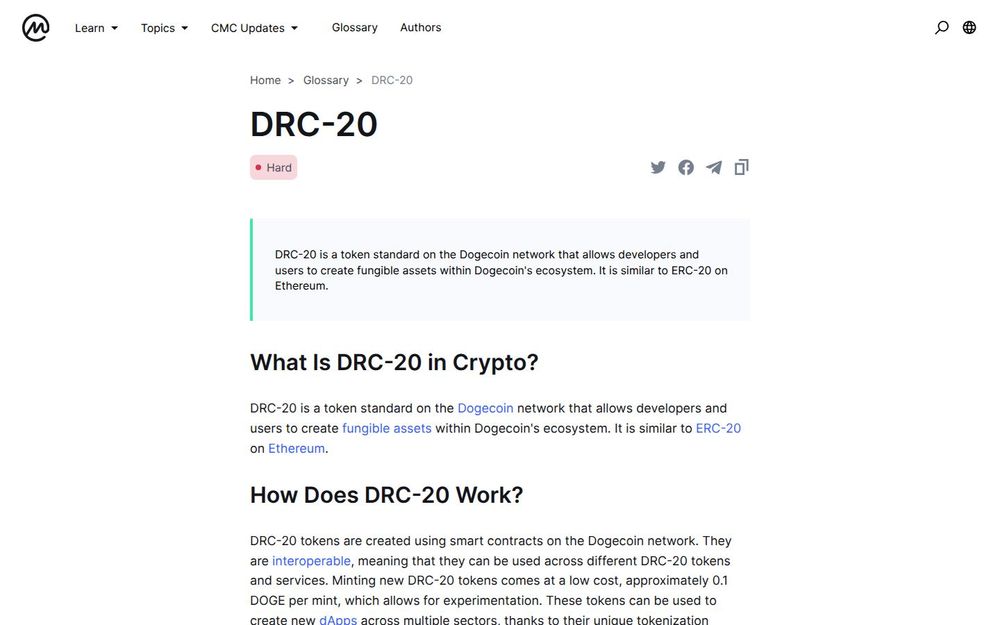
DRC-20 is a token specification implemented on the Dogecoin network that enables developers and users to create fungible assets and tokenized constructs using a standardized format. Introduced as a Dogecoin analogue to Ethereum’s ERC-20, DRC-20 simplifies the process of minting and distributing tokens on Dogecoin while leveraging the network’s existing infrastructure. The standard has attracted attention for its low per-mint cost and accessibility, which lowers the barrier to experimentation and the rapid deployment of token-based experiments and simple dApps.
Core Capabilities
-
Standardized Token Creation: DRC-20 defines a consistent method for minting and naming fungible tokens on Dogecoin, enabling predictable behavior across supported wallets and services.
-
Low-Cost Minting: One of the most notable features is its affordability; minting operations often require a modest fee (around 0.1 DOGE per mint), which makes iteration and experimentation economically feasible.
-
Interoperability: DRC-20 tokens are designed to be interoperable across services that adopt the standard, meaning wallets and exchanges that support the format can interact with tokens in a common way.
-
Token Utility on Dogecoin: Tokens can be configured so that certain network fees or token functions are tied to DOGE, potentially increasing use and demand for the native currency.
-
Explorer Verification: Transactions and token mints can be tracked and validated using Dogecoin blockchain explorers, offering transparency and auditability.
Key Features (Numbered)
-
Fungible Token Standardization: DRC-20 provides a uniform structure for creating fungible assets, enabling consistent token behavior across the Dogecoin ecosystem.
-
Low Barrier to Entry: Minimal minting costs and straightforward tools (for example, wallets like DPalWallet) allow users with limited resources to participate in token creation.
-
Wallet and Service Integration: Tokens created under DRC-20 can be recognized by compatible wallets and services, facilitating transfer and display of balances.
-
Simple Minting Workflow: The minting process typically involves creating a wallet, depositing DOGE, specifying token parameters, and confirming the transaction — a process intended to be accessible to non‑technical users.
-
Support for dApp Experimentation: By allowing token issuance and transfer tied to Dogecoin transactions, DRC-20 enables new decentralized application prototypes and use cases.
How It Works
DRC-20 tokens are generated by performing specific inscription-like transactions on the Dogecoin blockchain using a supporting wallet. The process usually entails creating or using a compatible wallet, funding it with DOGE, selecting a minting interface, inputting token attributes (name, symbol, amount), and confirming the transaction. Once the network confirms the transaction, the token issuance appears in the wallet and can be verified on a blockchain explorer. Because the mechanism relies on Dogecoin transactions rather than a fully featured smart contract virtual machine, DRC-20 is simpler but also more constrained compared to platforms like Ethereum.
Use Cases and Benefits
DRC-20 makes it straightforward to prototype tokenized assets, loyalty points, community tokens, or limited experimentations in DeFi-like flows on Dogecoin. Its low cost encourages developers and communities to experiment without significant financial risk. Interoperability with wallets and explorers also improves transparency and utility for token holders.
Limitations and Considerations
While DRC-20 expands Dogecoin’s utility, it is not a full smart contract platform; complex programmable logic and composability found on platforms like Ethereum are limited. Security and ecosystem support depend on wallet and tooling adoption, and token standards implemented outside robust smart contract frameworks carry different risk profiles. Users should verify tokens via explorers and exercise caution when interacting with newly minted tokens.
Recommendation
DRC-20 is well suited for experimentation, community tokens, and simple tokenized applications on Dogecoin due to its low-cost minting and straightforward workflow. Developers and users should evaluate tool support, wallet compatibility, and the trade-offs between simplicity and the limitations of a transaction-based token standard before integrating DRC-20 tokens into production systems.


