


Overview
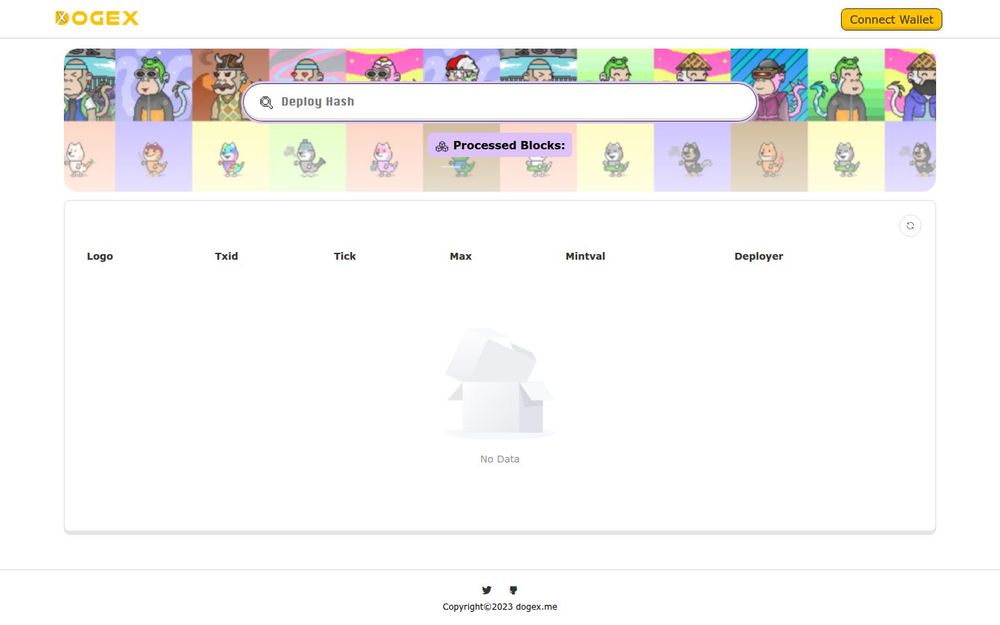
Dogex is presented as a lightweight token metadata dashboard designed to surface basic attributes of blockchain tokens and transactions. The available interface shows a tabular "Processed Blocks" view with columns such as Logo, Txid, Tick, Max, Mintval, and Deployer, indicating a focus on token identity, issuance parameters, and deployment provenance. Although the current page contains no data, the structure implies that Dogex aims to offer quick token inspection and on-chain monitoring rather than extensive analytics or portfolio features.
Core Capabilities
-
1. Token Metadata Display: Dogex is structured to present essential token metadata including a token logo, ticker (Tick), maximum supply (Max), and minted value (Mintval). This provides a concise snapshot of a token’s issuance details.
-
2. Transaction Identification: The Txid column suggests the platform links tokens back to their originating transactions, allowing users to trace creation events and verify the on-chain provenance of an asset.
-
3. Deployer Attribution: The Deployer field indicates the ability to surface the deploying address or account that created the token, which is useful for trust and ownership checks.
-
4. Processed Block Tracking: The table header “Processed Blocks” implies Dogex processes blockchain blocks in real time or near real time to extract token creation events and related metadata.
-
5. Lightweight, Focused UI: The minimal design and tabular layout point to a low-friction interface for quickly scanning recent token creations or inspecting specific tokens without heavy dashboards or charts.
Why Dogex Might Be Useful
Dogex is useful for people who want quick visibility into newly minted tokens or need to validate token creation details without navigating complex explorers. For blockchain researchers, token hunters, and security-conscious traders, a clean view that ties transaction IDs to token parameters and deployer addresses can speed up due diligence. The emphasis on concise metadata helps users form an initial trust assessment — for example, comparing Max supply and Mintval to detect inflationary patterns or suspicious minting behaviors.
Limitations and Current State
At present, the page contains an empty table and the entry “No Data,” which means either the data feed is not yet configured, the site is awaiting indexing of blocks, or there is a temporary outage. Because of that limitation, many features are inferred from the schema rather than observed in operation. Users should treat the site as exploratory until live data appears, and cross-check any findings with a full blockchain explorer or other trusted analytics tools.
Recommended Use Cases
- Quick verification of token creation events by cross-referencing Txid values with an on-chain explorer.
- Preliminary scouting of newly minted tokens by scanning Tick, Max, and Mintval for suspicious patterns.
- Attribution and accountability checks using the Deployer field to identify token origin addresses.
Recommendations for Users and Operators
For users: combine Dogex’s snapshots with more complete on-chain data sources to confirm token behavior and ownership. For operators: populate the dataset, add clear refresh and indexing indicators, and provide links from each row to a full blockchain explorer and a token contract page. Additional features that would increase utility include search, filtering by block range, sorting by mint value, and explicit timestamping of processed blocks.
Conclusion
Dogex is conceptually a focused token metadata and block-processing dashboard that emphasizes quick lookup of token attributes, transaction provenance, and deployer information. While the current site indicates no live data, the presented schema reveals a straightforward value proposition: fast, readable visibility into token creation events for users who need a lightweight tool to begin on-chain investigations.


