


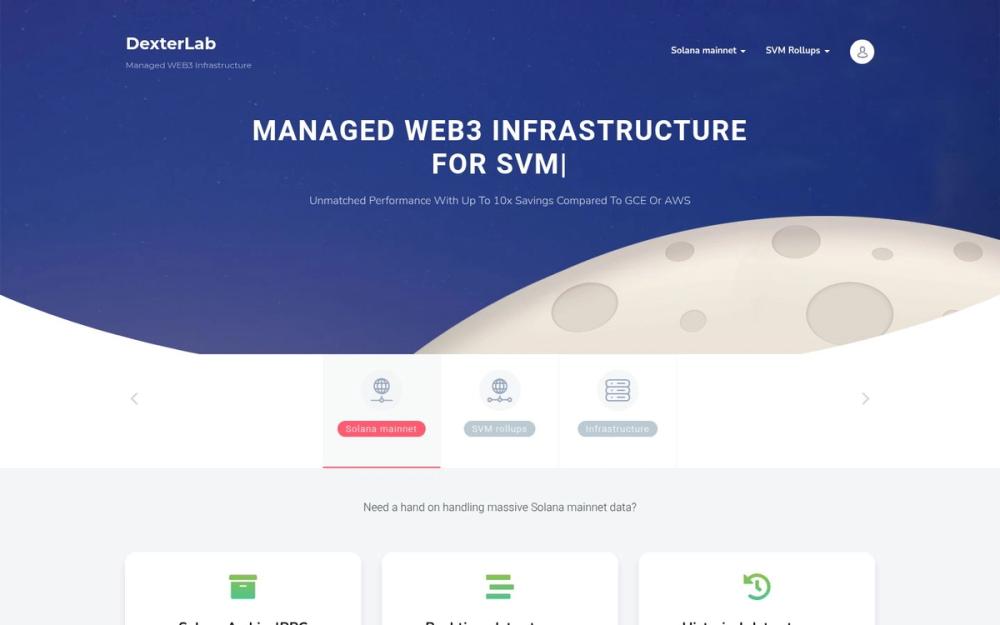
Overview
DEXterlab is a specialized Web3 data warehouse and infrastructure provider focused on handling large-scale Solana mainnet traffic and SVM rollup data. The company offers a mix of archival RPC endpoints, guaranteed real-time streams, historical backfilling, and raw block access designed for RPC providers, exchanges, analytics vendors, and rollup operators. Emphasizing open-source principles, bare-metal deployments, and global data center partnerships, DEXterlab positions itself as a performance-oriented vendor for organizations that need predictable throughput, low-latency queries, and efficient storage strategies.
Core Capabilities
-
Solana ArchivalRPC: Shared or dedicated archival nodes tailored for high-demand environments. These endpoints are built to support heavy read loads and long-term ledger retention for analysis and backfilling.
-
Real-time data streams: Reliable, low-latency streams delivering on-chain activity with a guaranteed 100% delivery rate, useful for monitoring, alerting, and live analytics.
-
Historical data streams & Backfilling: Tools to reconstruct datasets from genesis quickly; backfilling solutions extract complete histories from the chain, enabling historical analysis without the cost or time of naive RPC crawling.
-
Raw blocks access: Pre-packaged raw block archives (e.g., 250-block gzip files) that make it easy to ingest and reprocess ledger data efficiently.
-
SVM rollup support & backups: End-to-end archival and backup solutions for SVM rollups, including ledger restoration and backfilling capabilities designed to serve thousands of requests per second.
Architecture and Deployment
DEXterlab favors bare-metal deployments over cloud-hosted solutions to avoid the per-IO costs and throttling issues typical with cloud providers, especially for Solana which produces extremely high write rates. Their architecture combines archival RPC nodes, streaming ingestion pipelines, and managed analytics clusters. For streaming and event distribution they provide dedicated Kafka clusters with integrated transaction, block, and account streams. For analytics and large-scale querying they offer managed ClickHouse clusters with out-of-the-box sharding and replication handled by the provider.
Deployments can be shared or dedicated, and DexterLab works with multiple data centers around the world to minimize latency and provide regional isolation when needed. This setup helps achieve sub-20ms historical RPC query times for geographically proximate clients when properly hosted.
Use Cases
-
Exchange or wallet providers that need durable archival RPC endpoints and historical access for compliance and reconciliation.
-
Analytics firms that require deterministic backfills from genesis to build datasets and dashboards without the complexity of raw RPC crawling.
-
Rollup teams running SVM chains that need reliable backups, cold storage of ledger history, and high-performance archival RPCs to bootstrap nodes or rehydrate state.
-
High-frequency trading and monitoring systems that demand guaranteed real-time delivery of on-chain events.
Why Choose DEXterlab?
-
Performance-first: Bare-metal hosting and specialized infrastructure tuned for Solana’s heavy IO characteristics.
-
Comprehensive stack: From raw archives to managed Kafka and ClickHouse, the platform covers ingestion, storage, and query layers.
-
Openness and transparency: An open-source-first philosophy that allows customers to audit code and run independent deployments if desired.
-
Operational simplicity: Managed clusters, backfilling tools, and archival endpoints reduce the operational burden on engineering teams.
Getting Started
To begin, evaluate which components you need: archival RPC for live and historical reads, real-time streams for monitoring, raw block archives for batch reprocessing, or managed analytics clusters for large-scale queries. DexterLab provides both shared and dedicated options depending on throughput and isolation requirements. Contact their sales or review technical docs on the site to plan a migration or trial deployment. Their stack is particularly suitable for teams that prioritize speed, deterministic data delivery, and cost-effective large-scale storage.


