


Overview
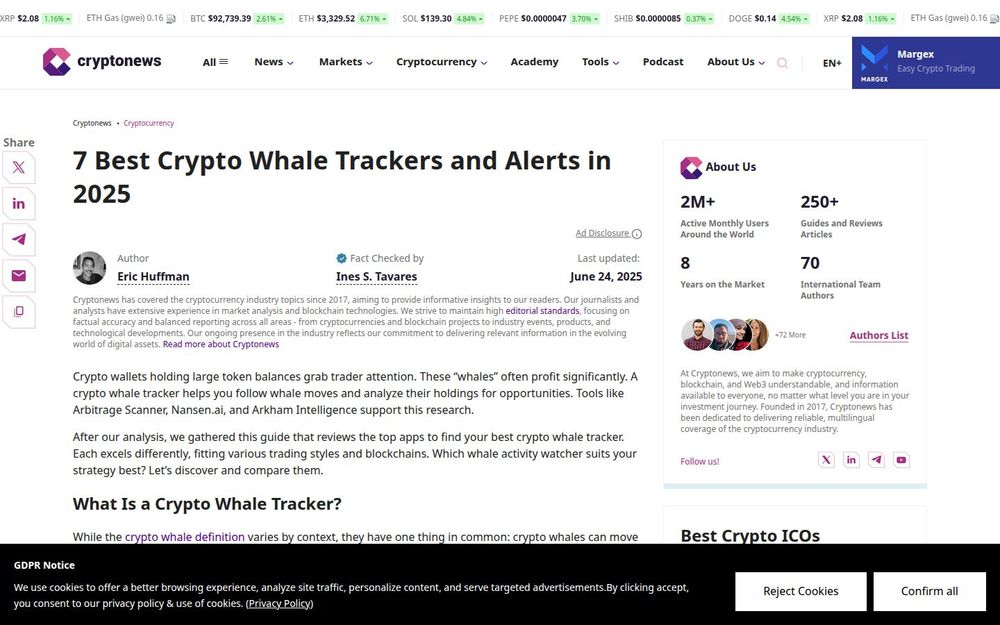
CryptoNews’ guide “7 Best Crypto Whale Trackers and Alerts in 2025” offers a practical, comparative review of tools designed to monitor large crypto wallet movements and notify users of significant transactions. The article distills a busy market into seven recommended platforms, each chosen for a specific strength—arbitrage detection, token inflows/outflows, customizable dashboards, DEX trade monitoring, social feeds, simple alerts, and broad multi-market notifications. The guide explains how whale trackers convert raw on-chain data into actionable alerts and research signals while cautioning readers about common pitfalls.
Core Capabilities
-
Real-time Alerts & Notifications: Many platforms provide instant alerts via Telegram, Slack, email, SMS, or APIs so users can act quickly when large transfers, exchange deposits, or new token listings occur.
-
Wallet and Token Analytics: Tools analyze holdings, P&L, transaction histories, and token inflows/outflows to help users evaluate whether a whale’s moves indicate momentum or potential risk.
-
Cross-chain and DEX Coverage: Trackers vary in chain support—from Ethereum and EVM-compatible chains to Bitcoin and Solana—and some specialize in decentralized exchange activity, showing large buys and sells in real time.
-
Custom Dashboards and Labels: Advanced platforms allow users to create personalized dashboards, labels, and watchlists to group wallets, tokens, or strategies for faster research and monitoring.
-
Social and Community Signals: A few services integrate social feeds or wallet-verified posts, helping users surface high-conviction moves and social context behind large trades.
How the Tools Differ
-
Arbitrage Scanner focuses on arbitrage opportunities and wallet-level P&L analysis, catering to advanced and active traders.
-
Nansen.ai emphasizes inflows/outflows and NFT metrics with detailed labeling and token-focused research features.
-
Arkham Intelligence offers free customizable alerts and in-depth wallet dashboards, useful for investigative tracking and pattern discovery.
-
DexCheck specializes in live DEX trades and wallet win-rate metrics, making it ideal for decentralized exchange traders.
-
Debank provides broad EVM support and a social feed, integrating portfolio tracking and community signals.
-
Whale Alert delivers simple, high-volume alerts and API access for developers and trading desks.
-
Cryptocurrency Alerting brings multi-market alerting, new listing detection, and a range of notification channels.
Advantages and Practical Use Cases
Whale trackers save time by transforming raw blockchain data into searchable, filterable insights. Use cases include finding early token accumulation by large holders, spotting exchange inflows that may precede sell-offs, and backtesting whale behavior to validate a follow strategy. These tools also support risk management by highlighting unusual wallet activity and enabling configurable alert thresholds.
Caveats and Risks
While whale trackers offer valuable signals, they can generate information overload and misleading cues. Large wallets can be part of scams, honeypots, or multi-wallet clusters controlled by the same entity. Blindly copying whale trades is risky—users should analyze historical P&L, check for multiple wallet ownership, and practice paper trading before committing capital.
Why This Guide Helps
This Cryptonews roundup combines practical walkthroughs, platform-specific strengths, pricing snapshots, and a transparent methodology. It helps readers choose a tracker aligned with their strategy—whether arbitrage, NFT research, DEX trading, social-following, or automated alerting—while emphasizing cautious, data-driven decision-making.
Conclusion
Whale trackers are powerful research and alerting tools when used judiciously. Choose platforms that match your chains and workflow, set thoughtful alert thresholds, and treat whale data as one input among many in a disciplined trading or research process.


