


Overview
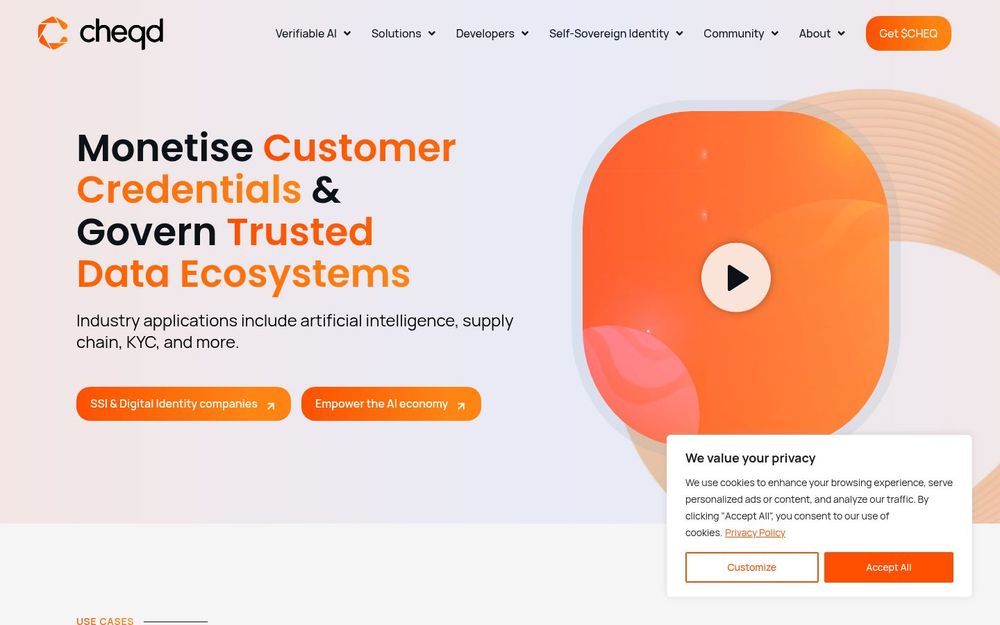
cheqd is a purpose-built trust and payment infrastructure designed to support verifiable digital identity, privacy-preserving data exchange, and the commercialisation of trusted data. The platform focuses on enabling organisations and ecosystems to issue, verify and transact with digital credentials while ensuring individuals retain control over their personal information. cheqd combines decentralised identifiers (DIDs), standards-based credential formats, and a payments layer to unlock new business models in AI, KYC, supply chain, e-commerce, and government eID initiatives.
Core Capabilities
-
Standards-based credential support: cheqd supports a broad set of standards including W3C VCDM, SD-JWT, OpenID4VC, AnonCreds, and DIDComm, enabling interoperable credential issuance, presentation, and verification across ecosystems.
-
Trust Registries and governance: cheqd provides industry-leading Trust Registries (and evolving towards a Trust Graph) that let ecosystems define, gate and automate trust relationships among issuers, verifiers and agents, supporting permissioned, permeable or permissionless configurations.
-
Payments for trusted data: a unique commercial layer that enables privacy-preserving payments for credentials and data, including support for stablecoins (e.g., USDC, EUROe), creating incentives to responsibly release data from silos and enabling new monetisation models.
-
Decentralised Identifiers (DIDs): full conformance with the W3C DID specification, DID-linked resources, and integration with tools such as the Universal Registrar and Universal Resolver to simplify DID lifecycle management.
-
SaaS and developer tooling: cheqd Studio offers a managed SaaS experience for DIDs, Trust Registries and payments, while the ecosystem supports multiple SDKs and partners (Credo, ACA-Py, Veramo, Creds, and others) for flexible integration and deployment.
How it works
cheqd blends blockchain-based naming and verification primitives with off-chain credential handling and selective disclosure techniques. Organisations issue verifiable credentials that reference DIDs; verifiers can consult Trust Registries or Trust Graphs to evaluate issuer status and policy. The payments layer allows transactions tied to credential disclosure or data access, enabling monetised and privacy-preserving data flows. Support for zero-knowledge and anonymous credential schemes (AnonCreds, ZK) helps maintain minimal disclosure while proving claims.
Use cases and ecosystem
cheqd is aimed at enterprise and industry scenarios such as verifiable AI (trusted agent identities and content provenance), reusable KYC and onboarding, supply chain provenance, healthcare identity, e-commerce loyalty, NFT provenance, decentralised reputation, and eID/eIDAS-aligned deployments. The cheqd ecosystem includes AI partners, SSI companies, validators, investors and complementary products like Creds for credential issuance and reputation, and many SDK partners for bespoke integrations.
Why choose cheqd
- Interoperability through broad standards support makes integration with existing SSI stacks straightforward.
- Commercial viability via payments for data enables sustainable business models for credential exchange.
- Governance and trust features let consortia and ecosystems automate policy and issuer vetting.
Getting started
Organisations can start with cheqd Studio for a managed on-ramp or work with partner SDKs to run private or public networks. The site provides documentation, partner listings, and community channels for developers and enterprises to join, stake $CHEQ, participate in governance, or integrate verifiable credentials into real-world workflows.
By combining standards, governance primitives, and a payments layer, cheqd positions itself as a practical infrastructure for organisations building privacy-preserving identity and trusted data services in an increasingly decentralised digital economy.


