


Overview
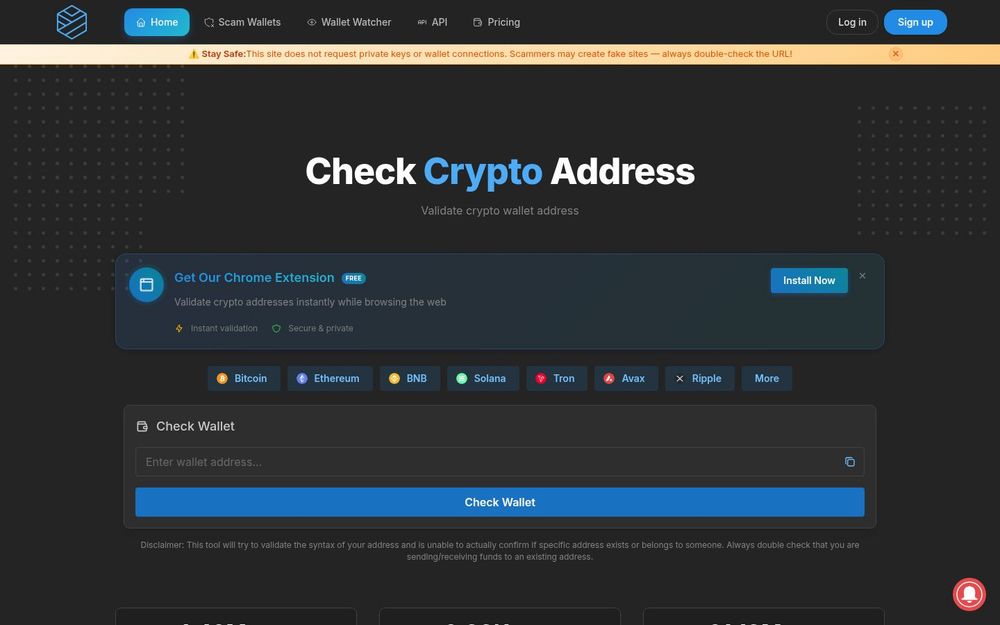
CheckCryptoAddress is a lightweight web tool and a companion Chrome extension for validating cryptocurrency wallet addresses and monitoring wallet activity. The service focuses on quick, client-side or server-assisted checks that verify address format and network compatibility across a broad set of chains. It is intended as a safety check to reduce manual errors and phishing risks when sending or receiving crypto, while maintaining a privacy-first stance: the site explicitly does not request private keys or direct wallet connections.
Core Capabilities
-
1. Instant Address Validation: Validate address syntax for 100+ cryptocurrencies. The system checks whether an input address matches the expected format for a given blockchain, helping catch typographical mistakes and mismatched-network errors.
-
2. Wallet Monitoring & Notifications: Monitor wallets in real time. Users can add addresses to tracking to receive notifications about incoming or outgoing transactions, ensuring quick awareness of significant movements.
-
3. Transaction History Access: View a wallet’s transaction history with filtering and search options to inspect past activity. This helps users review balances, transfers, and token movements linked to an address.
-
4. Contract Information: Analyze smart contract addresses by surfacing code-related details, known functions, and basic metadata to help users distinguish contracts from externally owned accounts.
-
5. Browser Extension Integration: Use the Chrome extension to validate crypto addresses while browsing, providing immediate feedback on addresses encountered on websites without needing to copy-paste into the main site.
How It Works
The validation process primarily examines address format and encoding rules specific to each blockchain (for example, base58check for many Bitcoin-like addresses, Ethereum hex checksums, and network-specific prefixes). The tool also surfaces transaction history and balance information by querying public blockchain data sources and indexing services. Because the site relies on public on-chain data, it can list recent activity and aggregated metrics such as total wallet queries and notifications sent.
Privacy and Limitations
-
No Private Keys or Wallet Connections: The site deliberately avoids requesting private keys or asking users to connect their wallets. This design reduces the risk of malicious data capture and reinforces the tool’s role as a non-custodial verifier.
-
Syntax-Only Validation: CheckCryptoAddress cannot prove that a particular address belongs to a specific person or that it can receive funds in a custodial sense. It validates format and can show on-chain history, but it cannot guarantee ownership or the recipient’s identity.
-
Reliance on Public Data: Transaction history and monitoring depend on blockchain explorers and indexing services; differences in latency or indexing coverage can affect timeliness.
Why Use CheckCryptoAddress
CheckCryptoAddress is useful for individuals and teams that frequently copy or receive addresses and want an extra verification layer before sending funds. It reduces common human errors, supports many major and niche chains, and offers convenient browser-based validation via an extension for on-the-fly checks. The monitoring and notification features make it suitable for anyone tracking high-value wallets or looking for automated alerts on specific addresses.
Additional Notes and Trust Signals
The site publishes aggregate usage metrics (e.g., total wallet queries, monitored wallets, notifications delivered) and highlights recent transaction activity to demonstrate utility and service scale. It also lists partners and collaborators in analytics and security, which can provide additional reassurance about data practices and tooling. Still, users should always independently verify addresses and remain cautious of phishing sites; the tool itself advises double-checking the URL and never sharing private keys.
Conclusion
In summary, CheckCryptoAddress is a practical, privacy-conscious tool focused on syntactic validation and monitoring of cryptocurrency addresses across many networks. It offers fast checks, notification-driven monitoring, transaction history inspection, and contract insights while emphasizing that it cannot confirm address ownership. For routine safety checks and lightweight monitoring, it provides a helpful, non-custodial layer of protection in a user-friendly format.


