


Overview
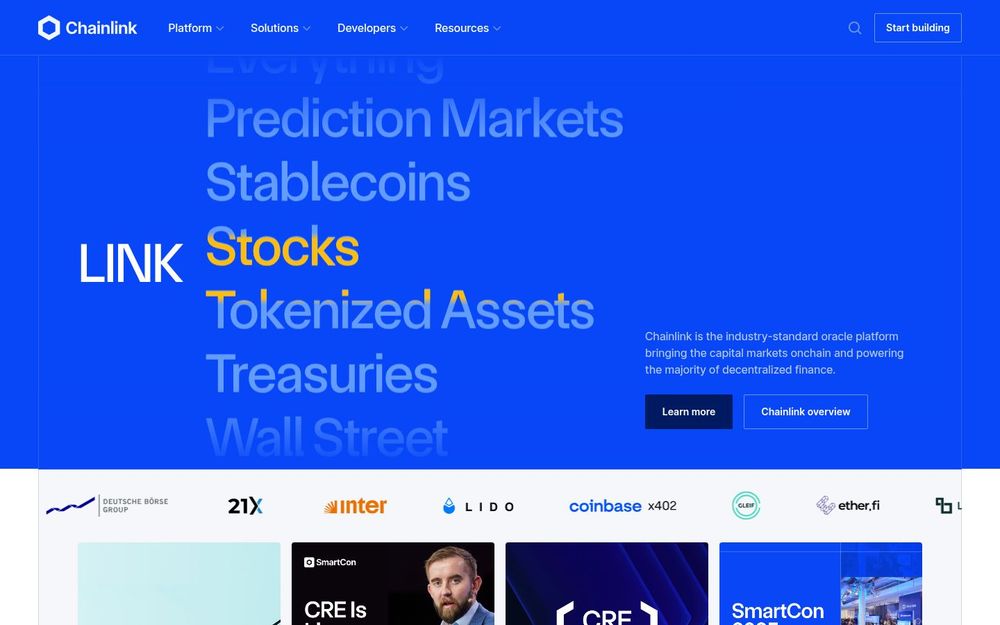
Chainlink is the industry-standard oracle platform designed to bridge blockchains with the real-world systems that power modern finance. It enables organizations to securely ingest, verify, and deliver external data, regulatory signals, and legacy financial messages into smart contracts and decentralized applications. Chainlink’s mission is to unlock onchain finance at scale by providing a unified, institutional-grade stack for data, compliance, identity, and cross-chain orchestration that can be integrated as a single line of code and executed inside a verifiable decentralized runtime.
Core Capabilities
-
Secure Data Feeds: Chainlink provides tamper-resistant, high-availability price and market data feeds which are designed for low-latency and high-throughput use cases like lending, derivatives, and real-time risk management.
-
Cross-Chain Interoperability: Chainlink’s Cross-Chain Interoperability Protocol (CCIP) enables secure message and token transfer across multiple blockchains, facilitating cross-chain settlement, atomic DvP workflows, and hybrid onchain/offchain integrations.
-
Institutional Data Delivery: The platform supports encryption, permissioned distribution, and compliance controls so institutions can publish and commercialize datasets onchain while maintaining auditability and regulatory adherence.
-
Verifiable Decentralized Runtime: Chainlink runs workflows in a verifiable runtime environment that ensures data and computations are auditable and resistant to single-point failures.
-
Privacy and Compliance Tools: Chainlink offers configurable access controls, privacy-preserving techniques, and integrations with legacy messaging standards to support regulated stablecoins, CBDC pilots, and tokenized securities.
Key Features and How They Matter
-
Reliable Price Oracles: Accurate market data is fundamental for collateralization, liquidations, and derivatives. Chainlink’s feeds combine multiple sources and on-chain aggregation to reduce manipulation risk and provide resilient inputs for protocols.
-
Cross-Chain Settlement: Enabling atomic or hybrid settlement between tokenized assets and fiat rails reduces settlement risk and operational friction for institutions transitioning assets onchain.
-
Data Monetization & Distribution: Institutions can publish trusted datasets onchain with configurable permissioning, enabling new revenue models and simplified integration for downstream consumers.
-
Compliance-Ready Workflows: Chainlink integrates identity, attestations, and compliance checks so regulated entities can adopt tokenization and stablecoins while meeting audit and regulatory requirements.
-
Scalable, Institutional Integrations: Prebuilt connectors and standards lower the integration burden for banks, asset managers, and market infrastructures to adopt onchain finance.
Use Cases
Chainlink is used across tokenized funds, stablecoins, payments and settlements, lending and borrowing, derivatives, and prediction markets. Real-world examples include cross-border CBDC settlement pilots, secure delivery of index and reference data for tokenized securities, and low-latency feeds for onchain derivatives markets.
Security, Reliability, and Adoption
Chainlink’s infrastructure emphasizes decentralization, redundancy, and rigorous operational practices to deliver high uptime and verifiable accuracy. The platform is adopted by major financial institutions and leading DeFi projects, reflecting both enterprise trust and blockchain-native innovation. Metrics such as transaction value enabled (TVE) and broad institutional partnerships highlight its role as foundational infrastructure for onchain finance.
Recommendation and Next Steps
For teams exploring institutional tokenization, regulated stablecoins, or reliable onchain data pipelines, Chainlink offers a mature, security-focused foundation with established enterprise integrations. To get started, review the platform documentation, explore Chainlink’s data and interoperability services, and engage with their enterprise support to design compliant, auditable workflows that meet both onchain and legacy system requirements.


