


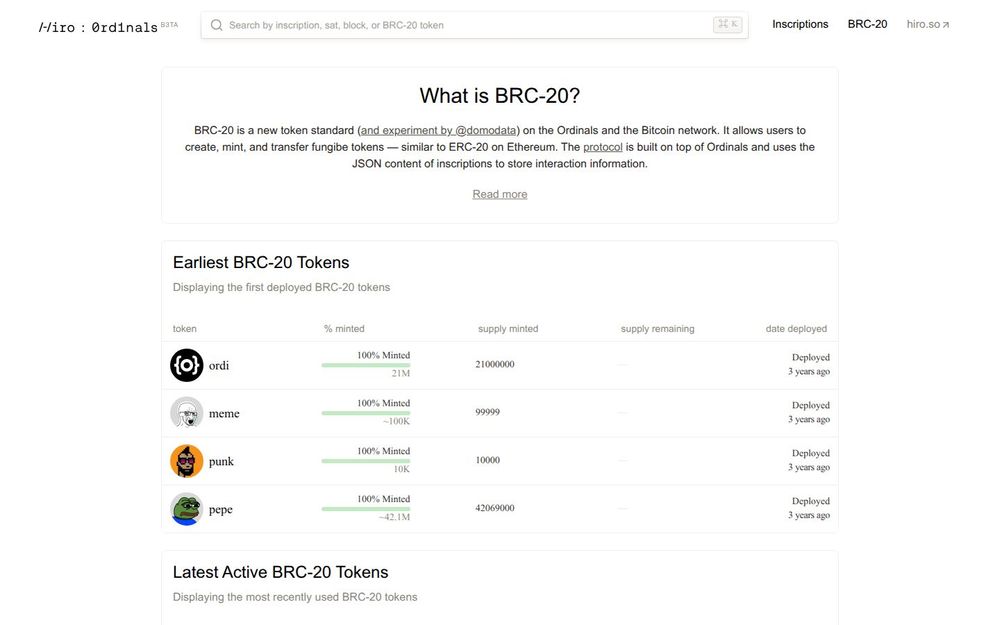
Overview
BRC-20 is an experimental token standard that emerged as a way to create and manage fungible tokens on Bitcoin using the Ordinals inscription system. Rather than relying on native smart contracts, BRC-20 encodes token-related operations — such as deploy, mint, and transfer — into JSON inscriptions that are written into Bitcoin transactions. The result is a protocol that offers a simple, auditable history for token issuance and movements while remaining compatible with Bitcoin’s UTXO model and the Ordinals infrastructure.
BRC-20 is notable for being lightweight and accessible: anyone familiar with crafting inscriptions can participate in token creation and minting. However, the standard is intentionally constrained compared to smart-contract platforms, which affects how complex token logic can be implemented.
Core Capabilities
-
Token Deployment: BRC-20 allows a creator to deploy a token specification by inscribing a JSON payload that defines the token ticker, maximum supply, and schema. This deploy inscription establishes the token’s identity and rules on-chain.
-
Minting: Through subsequent inscriptions, token issuers or minters can mint units of the token according to the rules set at deployment. Each mint action is recorded as an inscription so the total supply and distribution are verifiable on Bitcoin’s ledger.
-
Transfers (via Inscription Tracking): While BRC-20 lacks native contract-based transfer functions, transfers are tracked through inscriptions and convention-based methods that assign minted tokens to outputs. Explorers and indexers interpret inscription sequences to surface balances and movements.
-
On-chain Provenance: All operations for BRC-20 tokens are stored on-chain as JSON inscriptions. This yields strong provenance guarantees because every deploy, mint, or state-related entry is discoverable in the Bitcoin transaction history.
-
Explorer and Indexer Support: Tools such as the Hiro Ordinals Explorer index BRC-20 inscriptions, display token statistics (supply, percent minted, deployment time), and provide interfaces for browsing early and active tokens on the protocol.
How It Works
BRC-20 uses the Ordinals system to inscribe JSON data into individual satoshis. A standard sequence typically begins with a deploy inscription that defines metadata and parameters. Minters then create inscriptions that reference the token definition and indicate minted amounts. Indexers parse these inscriptions, reconstruct token state, and expose token supply, minting progress, and related activity through user-friendly explorers. Because all information is embedded in Bitcoin transactions, there is a permanent, auditable trail for each BRC-20 token.
BRC-20 intentionally relies on conventions rather than on-chain execution logic. That means wallets, marketplaces, and tooling must agree on how to interpret inscriptions to present balances and enable transfers. As a result, the quality of the user experience depends heavily on indexers and explorers.
Limitations and Considerations
-
No native smart contracts: Complex behaviors like on-chain governance, automated token logic, or composable DeFi primitives are limited. BRC-20 is best suited for simple fungible token issuance and distribution.
-
Fee and scalability constraints: Writing inscriptions to Bitcoin can be more expensive and slower than operations on layer-2 or smart-contract chains, which impacts frequent minting or microtransactions.
-
Standard maturity: BRC-20 is experimental and evolving. Implementations and best practices can change, so developers should consider risks and compatibility when building tooling around it.
Why Use BRC-20
BRC-20 offers a straightforward way to mint and track fungible tokens while leveraging Bitcoin’s security and permanence. For creators who prioritize on-chain provenance and the simplicity of inscription-driven workflows, BRC-20 provides an accessible entry point. Combined with explorers like Hiro’s, it enables discovery, transparency, and basic token economics on Bitcoin, making it an interesting option for experimental projects, collectibles, and tokenized communities.
Recommendations
For developers and users interested in BRC-20, start by exploring indexed data using a trusted explorer, study the deploy and mint inscription formats, and test workflows on small scales before large-scale issuance. Expect to rely on off-chain indexers and tooling to reconstruct token state and ensure clear conventions for transfers and custody.


