


Overview
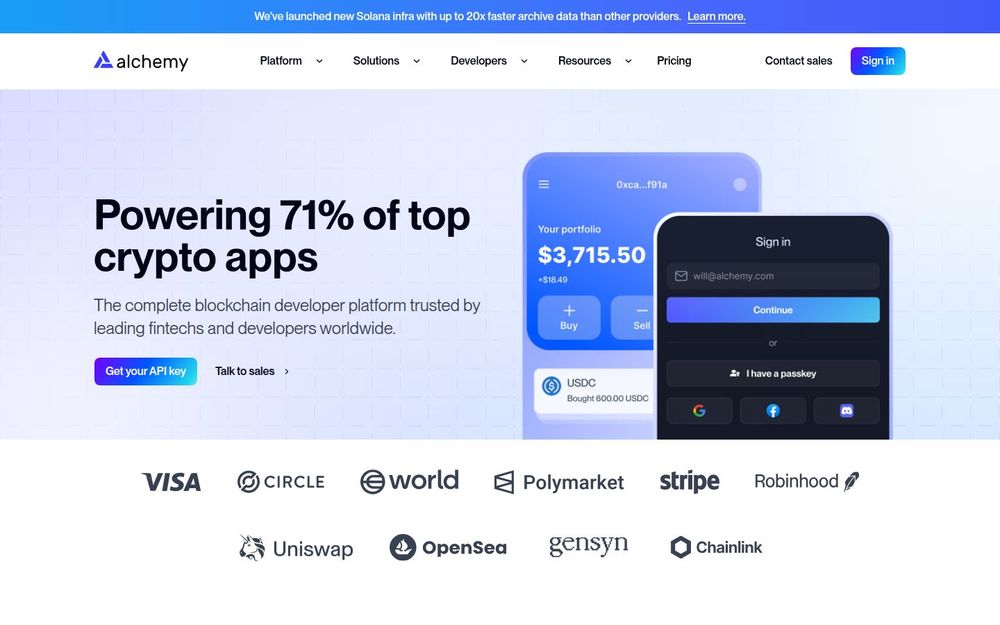
Alchemy is a unified blockchain development platform designed to simplify and accelerate the creation of web3 and crypto applications. Built around the intelligent Cortex engine, Alchemy positions itself as an enterprise-grade infrastructure provider offering high throughput, improved reliability, and near-zero downtime. The platform serves a wide range of customers — from startups to established fintechs and institutional players — by providing managed node access, data services, wallet orchestration, and developer tools that remove common operational burdens and allow teams to focus on product innovation.
Core Capabilities
-
Infrastructure & Node APIs: Real-time, block-perfect access via a scalable Node RPC API that abstracts node management and provides high availability and predictable performance.
-
Custom Chains & Rollups: Support for rollups and launching custom chains, enabling teams to deploy tailored layer-2 or application-specific networks with integrated orchestration.
-
Wallets & Orchestration: Multiple wallet models including embedded wallets (user-controlled) and server wallets (developer-controlled), plus native support for gasless transactions and sponsored gas flows to improve end-user onboarding.
-
Data & Webhooks: Real-time and historical blockchain data services, including webhooks, portfolio APIs for transaction history, and token APIs for price and token metadata to drive user engagement and monetization.
-
Developer Tooling & Support: SDKs, debugging suites, production-ready examples, and enterprise-grade support (24/7/365) to reduce time-to-market and troubleshoot complex production issues.
Key Features and Functionality
-
Cortex Engine: At the core of Alchemy is Cortex, an intelligent blockchain engine that claims to deliver orders-of-magnitude improvements in throughput and reliability compared to traditional providers. This underpins uptime guarantees and performance optimizations.
-
High Availability: Infrastructure built for scale with advertised 99.99% uptime, designed to handle large traffic bursts and critical financial use cases with minimal interruption.
-
Gasless & Orchestrated Transactions: Native orchestration capabilities let developers sponsor gas fees and handle multi-step flows like swaps, minting, and staking without exposing users to complex crypto UX.
-
Enterprise Integration: Compliance, custody options, and the ability to support institutional products are emphasized, with case studies such as integrations with major financial firms and high-volume rollups.
-
Observability & Debugging: Built-in debugging tools and monitoring to help teams identify issues quickly and maintain production reliability as usage grows.
Recommended Reasons to Use Alchemy
-
If you need a single provider that combines robust node infrastructure, advanced data APIs, wallet orchestration, and developer tooling, Alchemy offers an integrated stack that reduces the number of vendors and operational complexity.
-
For teams building products that require high throughput and reliability — such as exchanges, payment systems, or large consumer apps — Alchemy’s emphasis on uptime, performance, and enterprise-grade support is a major advantage.
-
Developers looking to ship quickly will benefit from simple REST and RPC endpoints, SDKs, quick onboarding flows (get API keys and make first calls), and comprehensive documentation and sample code.
Getting Started & Use Cases
Getting started typically involves signing up for an API key, exploring the docs to make the first RPC call, and integrating SDKs to leverage data and wallet features. Common use cases include NFT marketplaces, custodial or non-custodial wallets, DeFi orchestration (swaps, staking), stablecoin payment rails, and launching rollups or private chains.
Conclusion
Alchemy is positioned as a full-stack blockchain platform built to support production-grade, scalable crypto applications. Its combination of Cortex-powered infrastructure, comprehensive data services, wallet orchestration, and developer-centric tooling makes it a compelling choice for teams that need reliability, speed, and reduced blockchain complexity while building innovative onchain products.


